Kingdom
Pseudomonadati
Phylum
Pseudomonadota
Class
Gammaproteobacteria
Order
Enterobacterales
Family
Enterobacteriaceae
Genus
Shigella
Description
Taxonomy
| Kingdom | Pseudomonadati |
|---|---|
| Phylum | Pseudomonadota |
| Class | Gammaproteobacteria |
| Order | Enterobacterales |
| Family | Enterobacteriaceae |
| Genus | Shigella |
| Species | Shigella boydii |
| Strain | strain DMB SH134 |
Profile
| Physiology | |
|---|---|
| Gram staining properties | Negative |
| Shape | Rod |
| Mobility | No |
| Flagellar presence | Yes |
| Number of membranes | 2 |

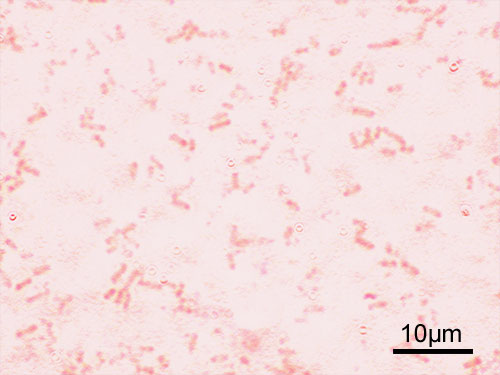
Image source: Wikipedia/Wikimedia
| Ecology, Host, and Life Cycle | |
|---|---|
| Oxygen requirements | Facultative anaerobe |
| Optimal temperature | 37 |
| Temperature range | Mesophilic |
| Habitat | HostAssociated |
| Biotic relationship | Free living |
| Host(s) | Homo sapiens, Metazoa |
| Cell arrangement | Pairs - Singles |
| Sporulation | Not Available |
| Energy source | Chemoorganotroph |
| Pathogenicity | Not Available |
Gene Summary
Adenine Count
1179951 bp
Thymine Count
1180164 bp
Guanine Count
1201480 bp
Cytosine Count
1210614 bp
Genome Length
4772209 bp
Protein-coding Genes
4434 genes
Non-Coding Genes
251 genes
# of Chromosomes/Plasmids
1
Genes
| Name | Locus Tag | UniProt ID | Strand Orientation | Gene Start/End | Protein Molecular Weight |
|---|---|---|---|---|---|
| l-amino acid n-acyltransferase mnat | UL57_10815 | Not Available | Positive | 2093907 - 2094425 | 19235.7 |
| dmt family transporter | UL57_10820 | Not Available | Positive | 2094422 - 2094871 | 15856.1 |
| duf2526 domain-containing protein | UL57_10825 | Not Available | Negative | 2094872 - 2095105 | 8800.41 |
| ghot/ortt family toxin | UL57_10830 | Not Available | Negative | 2095191 - 2095412 | 8530.86 |
| hypothetical protein | UL57_10835 | Not Available | Positive | 2095347 - 2095562 | 8618.49 |
| stress response membrane protein yncl | UL57_10840 | Not Available | Positive | 2095559 - 2095654 | 3490.44 |
| antibiotic acetyltransferase | UL57_10845 | Not Available | Negative | 2096056 - 2096865 | 31046.2 |
| abc transporter permease | UL57_10855 | Not Available | Negative | 2098362 - 2099180 | 29601.6 |
| abc transporter atp-binding protein | UL57_10865 | Not Available | Negative | 2100110 - 2101123 | 37049.9 |
| extracellular solute-binding protein | UL57_10870 | Not Available | Negative | 2101141 - 2102286 | 42386.4 |
Pathways
0 pathways
No pathways found
No metabolic pathways have been associated with this bacterium yet.