Kingdom
Pseudomonadati
Phylum
Pseudomonadota
Class
Gammaproteobacteria
Order
Enterobacterales
Family
Enterobacteriaceae
Genus
Shigella
Description
Taxonomy
| Kingdom | Pseudomonadati |
|---|---|
| Phylum | Pseudomonadota |
| Class | Gammaproteobacteria |
| Order | Enterobacterales |
| Family | Enterobacteriaceae |
| Genus | Shigella |
| Species | Shigella boydii |
| Strain | strain DMB SH134 |
Profile
| Physiology | |
|---|---|
| Gram staining properties | Negative |
| Shape | Rod |
| Mobility | No |
| Flagellar presence | Yes |
| Number of membranes | 2 |

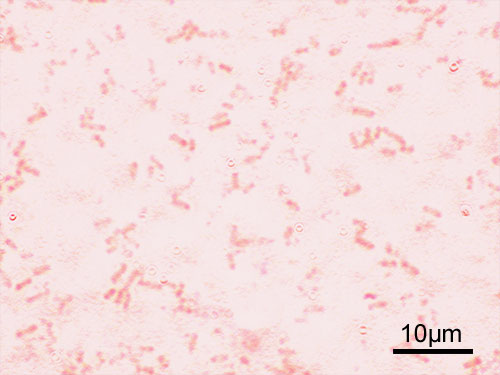
Image source: Wikipedia/Wikimedia
| Ecology, Host, and Life Cycle | |
|---|---|
| Oxygen requirements | Facultative anaerobe |
| Optimal temperature | 37 |
| Temperature range | Mesophilic |
| Habitat | HostAssociated |
| Biotic relationship | Free living |
| Host(s) | Homo sapiens, Metazoa |
| Cell arrangement | Pairs - Singles |
| Sporulation | Not Available |
| Energy source | Chemoorganotroph |
| Pathogenicity | Not Available |
Gene Summary
Adenine Count
1179951 bp
Thymine Count
1180164 bp
Guanine Count
1201480 bp
Cytosine Count
1210614 bp
Genome Length
4772209 bp
Protein-coding Genes
4434 genes
Non-Coding Genes
251 genes
# of Chromosomes/Plasmids
1
Genes
| Name | Locus Tag | UniProt ID | Strand Orientation | Gene Start/End | Protein Molecular Weight |
|---|---|---|---|---|---|
| triphosphoribosyl-dephospho-coa synthase | UL57_10270 | Not Available | Negative | 1984480 - 1985358 | 31706.4 |
| apo-citrate lyase phosphoribosyl-dephospho-coa transferase | UL57_10275 | Not Available | Negative | 1985333 - 1985884 | 20271.5 |
| citrate lyase subunit beta | UL57_10285 | Not Available | Negative | 1987431 - 1988339 | 33111.6 |
| citrate lyase acyl carrier protein | UL57_10290 | Not Available | Negative | 1988339 - 1988632 | 10561.8 |
| [citrate (pro-3s)-lyase] ligase | UL57_10295 | Not Available | Negative | 1988647 - 1989654 | 38015.0 |
| sensor histidine kinase dpib | UL57_10300 | Not Available | Positive | 1990085 - 1991743 | 61665.7 |
| two-component response regulator | UL57_10305 | Not Available | Positive | 1991712 - 1992392 | 25453.9 |
| monooxygenase | UL57_10320 | Not Available | Negative | 1994048 - 1994353 | 11288.5 |
| Trna-val | Not Available | Not Available | Positive | 1994412 - 1994488 | Not Available |
| Trna-val | Not Available | Not Available | Positive | 1994493 - 1994569 | Not Available |
Pathways
0 pathways
No pathways found
No metabolic pathways have been associated with this bacterium yet.