Kingdom
Pseudomonadati
Phylum
Pseudomonadota
Class
Gammaproteobacteria
Order
Enterobacterales
Family
Enterobacteriaceae
Genus
Shigella
Description
Taxonomy
| Kingdom | Pseudomonadati |
|---|---|
| Phylum | Pseudomonadota |
| Class | Gammaproteobacteria |
| Order | Enterobacterales |
| Family | Enterobacteriaceae |
| Genus | Shigella |
| Species | Shigella boydii |
| Strain | strain DMB SH134 |
Profile
| Physiology | |
|---|---|
| Gram staining properties | Negative |
| Shape | Rod |
| Mobility | No |
| Flagellar presence | Yes |
| Number of membranes | 2 |

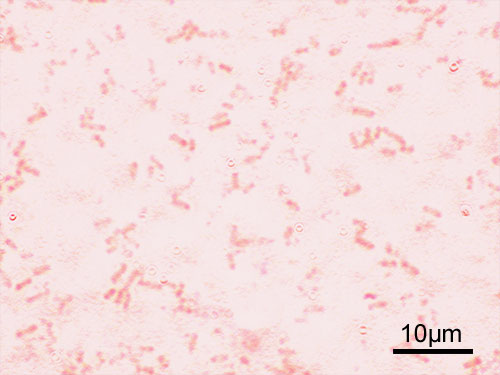
Image source: Wikipedia/Wikimedia
| Ecology, Host, and Life Cycle | |
|---|---|
| Oxygen requirements | Facultative anaerobe |
| Optimal temperature | 37 |
| Temperature range | Mesophilic |
| Habitat | HostAssociated |
| Biotic relationship | Free living |
| Host(s) | Homo sapiens, Metazoa |
| Cell arrangement | Pairs - Singles |
| Sporulation | Not Available |
| Energy source | Chemoorganotroph |
| Pathogenicity | Not Available |
Gene Summary
Adenine Count
1179951 bp
Thymine Count
1180164 bp
Guanine Count
1201480 bp
Cytosine Count
1210614 bp
Genome Length
4772209 bp
Protein-coding Genes
4434 genes
Non-Coding Genes
251 genes
# of Chromosomes/Plasmids
1
Genes
| Name | Locus Tag | UniProt ID | Strand Orientation | Gene Start/End | Protein Molecular Weight |
|---|---|---|---|---|---|
| duf454 family protein | UL57_07750 | Not Available | Positive | 1510632 - 1511009 | 14771.0 |
| adenine phosphoribosyltransferase | UL57_07755 | Not Available | Positive | 1510987 - 1511094 | 4011.83 |
| adenine phosphoribosyltransferase | UL57_07760 | Not Available | Positive | 1511162 - 1511713 | 19876.1 |
| dna polymerase iii subunit gamma/tau | UL57_07765 | Not Available | Positive | 1511842 - 1513773 | 71151.8 |
| ybab/ebfc family nucleoid-associated protein | UL57_07770 | Not Available | Positive | 1513826 - 1514155 | 12015.6 |
| recombination protein recr | UL57_07775 | Not Available | Positive | 1514155 - 1514760 | 21964.3 |
| molecular chaperone htpg | UL57_07780 | Not Available | Positive | 1514870 - 1516744 | 71452.4 |
| adenylate kinase | UL57_07790 | Not Available | Positive | 1516924 - 1517568 | 23587.4 |
| ferrochelatase | UL57_07795 | Not Available | Positive | 1517700 - 1518662 | 35868.4 |
| acetylesterase | UL57_07800 | Not Available | Negative | 1518659 - 1519618 | 35986.0 |
Pathways
0 pathways
No pathways found
No metabolic pathways have been associated with this bacterium yet.