
Kingdom
Pseudomonadati
Phylum
Pseudomonadota
Class
Gammaproteobacteria
Order
Vibrionales
Family
Vibrionaceae
Genus
Vibrio
Description
Taxonomy
| Kingdom | Pseudomonadati |
|---|---|
| Phylum | Pseudomonadota |
| Class | Gammaproteobacteria |
| Order | Vibrionales |
| Family | Vibrionaceae |
| Genus | Vibrio |
| Species | Vibrio cholerae |
| Strain | strain TSY216 |
Profile
| Physiology | |
|---|---|
| Gram staining properties | Negative |
| Shape | Rod |
| Mobility | No |
| Flagellar presence | Yes |
| Number of membranes | 2 |
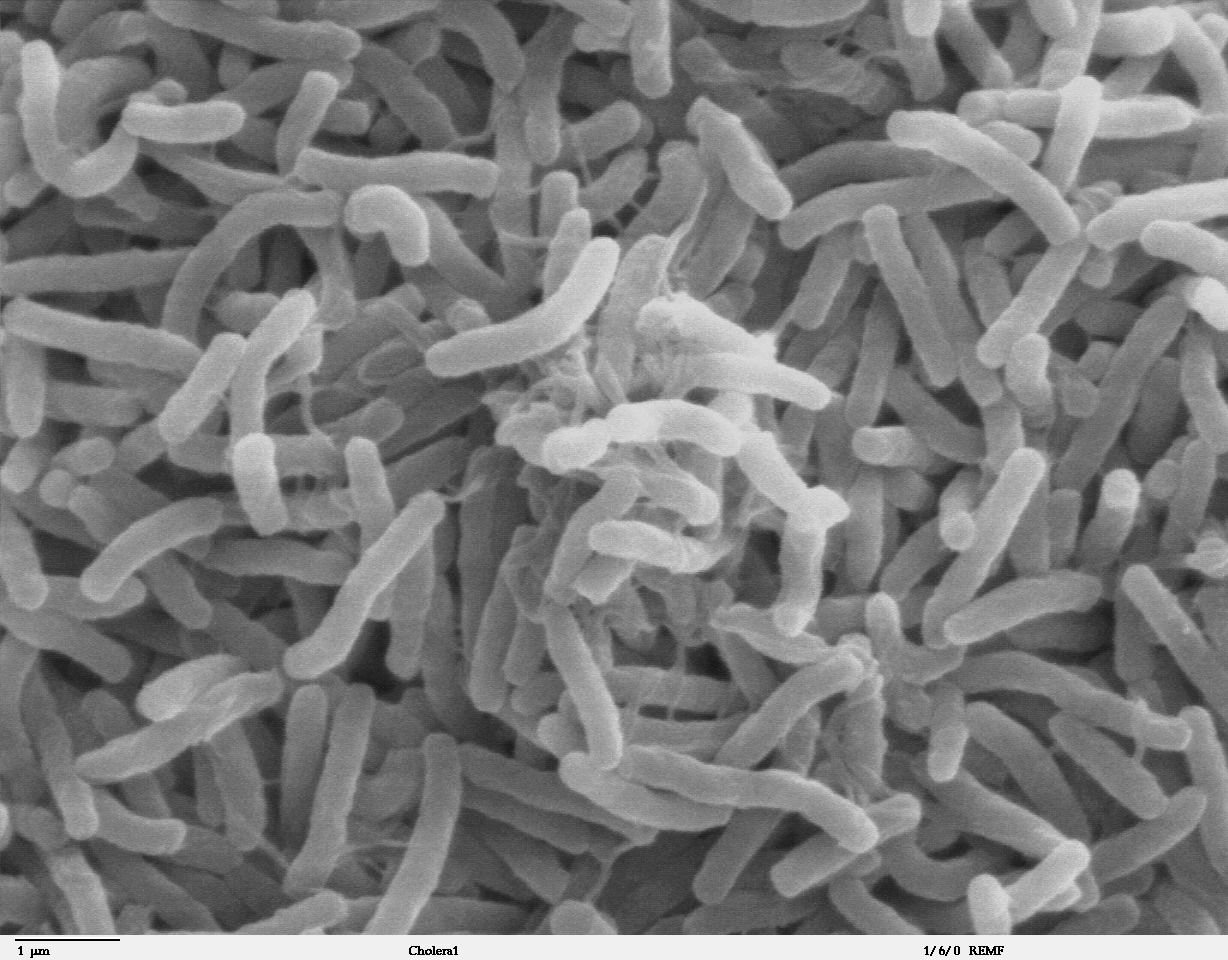
Image source: Wikipedia/Wikimedia
| Ecology, Host, and Life Cycle | |
|---|---|
| Oxygen requirements | Facultative anaerobe |
| Optimal temperature | 20 |
| Temperature range | Mesophilic |
| Habitat | Multiple |
| Biotic relationship | Free living |
| Host(s) | Homo sapiens, Mollusca, Mammalia |
| Cell arrangement | Singles |
| Sporulation | Nonsporulating |
| Energy source | Heterotroph |
| Pathogenicity | Human |
Genome Summary
Vibrio cholerae strain TSY216 chromosome 3, complete sequence.
Gene Summary
Adenine Count
284676 bp
Thymine Count
277531 bp
Guanine Count
161986 bp
Cytosine Count
171813 bp
Genome Length
896006 bp
Protein-coding Genes
1004 genes
Non-Coding Genes
67 genes
# of Chromosomes/Plasmids
3
Genes
| Name | Locus Tag | UniProt ID | Strand Orientation | Gene Start/End | Protein Molecular Weight |
|---|---|---|---|---|---|
| replication initiator protein rctb domain-containing protein | EN12_RS14175 | Not Available | Positive | 746 - 2722 | 75282.5 |
| hypothetical protein | EN12_RS14180 | Not Available | Negative | 2942 - 3403 | 17775.1 |
| pa3496 family putative envelope integrity protein | EN12_RS14185 | Not Available | Positive | 3766 - 3963 | 7533.86 |
| duf3283 family protein | EN12_RS14190 | Not Available | Positive | 4126 - 4335 | 7946.66 |
| yebc/pmpr family dna-binding transcriptional regulator | EN12_RS14195 | A5F1N4 | Positive | 4423 - 5142 | 26355.0 |
| nad(p)-dependent oxidoreductase | EN12_RS14200 | O33730 | Positive | 5257 - 6132 | 30599.2 |
| methyl-accepting chemotaxis protein | EN12_RS14205 | Q9I0I6 | Negative | 6236 - 7897 | 60875.3 |
| hypothetical protein | EN12_RS14210 | Not Available | Positive | 7900 - 8094 | 7148.67 |
| yibl family ribosome-associated protein | EN12_RS14215 | P0ADL0 | Positive | 8175 - 8531 | 13424.5 |
| hth-type transcriptional regulator malt | EN12_RS14220 | Q9KNF3 | Negative | 8598 - 11306 | 103595.0 |
Pathways
0 pathways
No pathways found
No metabolic pathways have been associated with this bacterium yet.
Health Effects
| Health Condition | Relation | Reference |
|---|---|---|
| Cholera | Causes | PMC10103850 |
| Ear infections | Causes | PMC10103850 |
| Wound infections | Causes | PMC10103850 |
| Septicaemia | Causes | PMC10103850 |
| Gastrointestinal infections | Causes | PMC10103850 |
| Necrotizing fasciitis | Causes | PMC10103850 |
| Vibriosis | Causes | PMC10472736 |
| Pneumonia | Causes | PMC12801787 |
| Gastroenteritis | Causes | PMC12801787 |
| Sinusitis | Causes | PMC12801787 |




