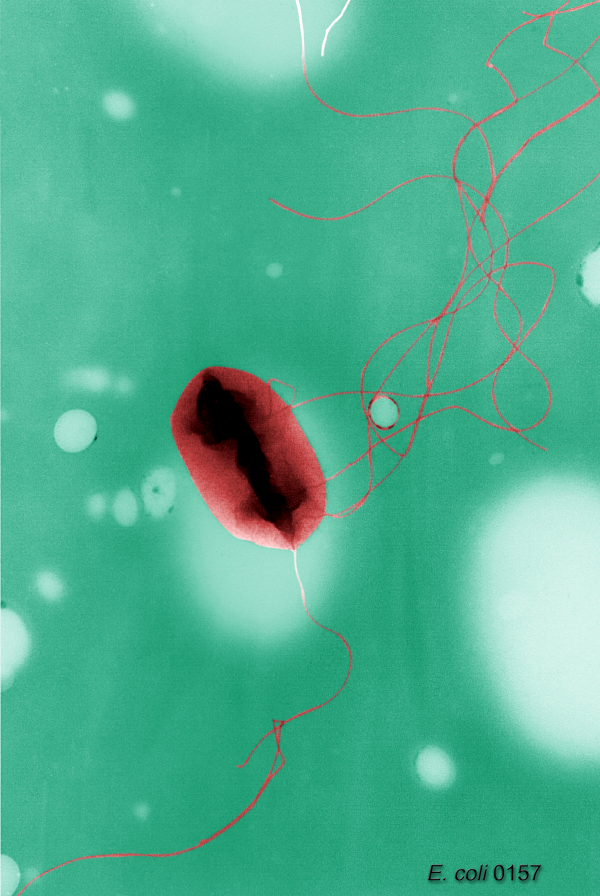
Escherichia coli strain CRE1540

Gram-negativeRodMotileFacultative anaerobe

Kingdom

Pseudomonadati

Phylum

Pseudomonadota

Class

Gammaproteobacteria

Order

Enterobacterales

Family

Enterobacteriaceae

Genus

Escherichia

Description

Escherichia coli strain CRE1540 is a Gram-negative, rod-shaped bacterium that is characterized as a facultative anaerobe, capable of thriving in both aerobic and anaerobic environments. This strain is notable for its mobility, attributed to the presence of flagella, and it typically exists in pairs or singles. The optimal growth temperature for CRE1540 is 37°C, placing it within the mesophilic range. CRE1540 is primarily host-associated, exhibiting a diverse range of biotic relationships with various hosts, including Homo sapiens, Gallus gallus, Bos taurus, and many others, spanning multiple taxa such as mammals, birds, and reptiles. This strain possesses three replicons and two membranes, which are characteristic of its complex genetic structure. The health implications of E. coli strain CRE1540 are significant, as it is associated with numerous pathogenic effects in humans. It can cause urinary tract infections (UTIs), gastrointestinal infections, neonatal meningitis, and various other serious health conditions such as septicemia and hemolytic uremic syndrome (HUS). The presence of this strain in various hosts indicates its adaptability and potential for cross-species transmission, which could pose risks for zoonotic infections. Ecologically, the versatility of E. coli strain CRE1540 in inhabiting diverse environments and its ability to affect multiple host species highlight its role in microbial ecosystems. Its pathogenicity and presence in both domestic and wild animals suggest that monitoring this strain is crucial for public health and animal health management.

Taxonomy

KingdomPseudomonadati
PhylumPseudomonadota
ClassGammaproteobacteria
OrderEnterobacterales
FamilyEnterobacteriaceae
GenusEscherichia
SpeciesEscherichia coli
Strainstrain CRE1540

Profile

Physiology
Gram staining propertiesNegative
ShapeRod
MobilityYes
Flagellar presenceYes
Number of membranes2
Image of Escherichia coli strain CRE1540
Image source: Wikipedia/Wikimedia
Ecology, Host, and Life Cycle
Oxygen requirementsFacultative anaerobe
Optimal temperature37
Temperature rangeMesophilic
HabitatHostAssociated
Biotic relationshipFree living
Host(s)Homo sapiens, Gallus gallus, Bos taurus
Cell arrangementPairs - Singles
SporulationNot Available
Energy sourceNot Available
PathogenicityHuman

Genome Summary

Escherichia coli strain CRE1540


Gene Summary

Adenine Count

29142 bp

Thymine Count

29860 bp

Guanine Count

28358 bp

Cytosine Count

28668 bp

Genome Length

116028 bp

Protein-coding Genes

20 genes

Non-Coding Genes

111 genes

# of Chromosomes/Plasmids

3

Genes

NameLocus TagUniProt IDStrand OrientationGene Start/EndProtein Molecular Weight
Major tail tube protein tubbBVL39_RS26985Not AvailableNegative547 - 115822318.7
PmgcBVL39_RS26990Not AvailableNegative1169 - 173521065.3
Conserved membrane protein of unknown functionBVL39_RS26995Not AvailableNegative1816 - 235520299.8
Putative outer membrane lipoproteinBVL39_RS27000Not AvailableNegative2359 - 287117155.5
Cell division repressor icdBVL39_RS27010Not AvailablePositive3493 - 37148313.71
Ant1BVL39_RS27015Not AvailablePositive3711 - 475438312.7
Putative host killing proteinBVL39_RS27020Not AvailablePositive4918 - 571829547.7
ReplBVL39_RS27025Not AvailablePositive5748 - 659330927.3
Hypothetical proteinBVL39_RS27030Not AvailablePositive6644 - 68899518.98
Host killer proteinBVL39_RS27035Not AvailablePositive7071 - 72265784.31

Displaying genes 1 – 10 of 414 in total

Pathways

0 pathways

No pathways found

No metabolic pathways have been associated with this bacterium yet.

Metabolites

4785 records
Metabolite IDMetabolite nameStructureCAS number
BASm0000173(R)-3-Hydroxybutyric acidC4H8O3Chemical structure of (R)-3-Hydroxybutyric acid625-72-3
Average104.0473Da
Monoisotopic104.047344122Da
BASm0000217alpha-ribazoleC14H18N2O4Chemical structure of alpha-ribazoleNot available
Average278.3037Da
Monoisotopic278.126657074Da
BASm0000237(R)-4'-phosphopantothenateC9H18NO8PChemical structure of (R)-4'-phosphopantothenateNot available
Average299.2149Da
Monoisotopic299.0770031Da
BASm0000238(R)-3-phenyllactateC9H9O3Chemical structure of (R)-3-phenyllactateNot available
Average165.169Da
Monoisotopic165.05571773Da
BASm00002482,3-dihydroxy-3-methylbutanoateC5H10O4Chemical structure of 2,3-dihydroxy-3-methylbutanoate1756-18-9
Average134.1305Da
Monoisotopic134.0579088Da
BASm00002502,5-didehydro-D-gluconateC6H7O7Chemical structure of 2,5-didehydro-D-gluconate53736-12-2
Average191.1156Da
Monoisotopic191.019177578Da
BASm00002512-dehydropantoateC6H9O4Chemical structure of 2-dehydropantoateNot available
Average145.1333Da
Monoisotopic145.050083776Da
BASm00002532-oxopent-4-enoateC5H5O3Chemical structure of 2-oxopent-4-enoateNot available
Average113.093Da
Monoisotopic113.024417601Da
BASm00002593alpha,12alpha-dihydroxy-7-oxo-5beta-cholanateC24H37O5Chemical structure of 3alpha,12alpha-dihydroxy-7-oxo-5beta-cholanateNot available
Average405.556Da
Monoisotopic405.264647871Da
BASm00002603alpha,7alpha-dihydroxy-12-oxo-5beta-cholanateC24H37O5Chemical structure of 3alpha,7alpha-dihydroxy-12-oxo-5beta-cholanateNot available
Average405.556Da
Monoisotopic405.264647871Da

Displaying 1–10 of 4785 metabolites

Health Effects

Health ConditionRelationReference
Gi diseaseCausesPMC11149725
UtisCausesPMC11434687
Colorectal cancerCausesPMC12198655
Pyogenic liver abscessesCausesPMC12392612
UtiCausesPMC13014981
ColibacillosisCausesPMC13255289
Enteric infectionsCausesPMC13255289
Foodborne infectionsCausesPMC13255289
Clinical mastitisCausesPMC13293316
DiarrheaCausesPMC3035056

Displaying health effects 1 – 10 of 74 in total