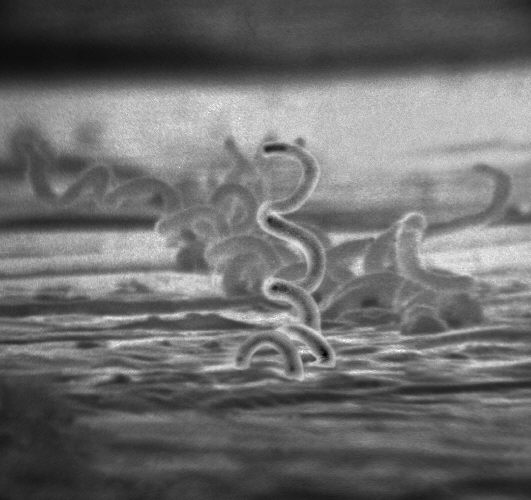
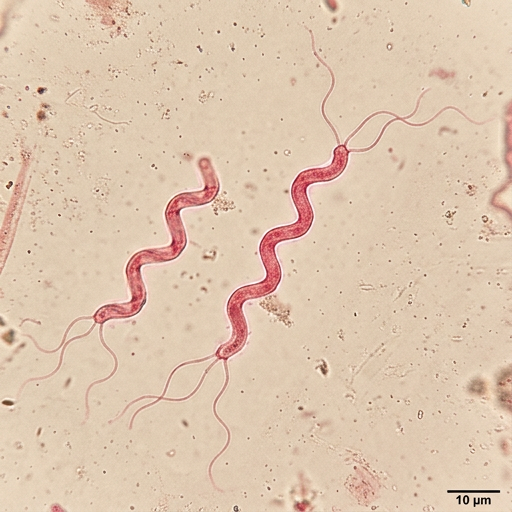
Kingdom
Pseudomonadati
Phylum
Spirochaetota
Class
Spirochaetia
Order
Spirochaetales
Family
Treponemataceae
Genus
Treponema
Description
Taxonomy
| Kingdom | Pseudomonadati |
|---|---|
| Phylum | Spirochaetota |
| Class | Spirochaetia |
| Order | Spirochaetales |
| Family | Treponemataceae |
| Genus | Treponema |
| Species | Treponema pallidum |
| Strain | subsp. endemicum Bosnia A |
Profile
| Physiology | |
|---|---|
| Gram staining properties | Negative |
| Shape | Spirilla |
| Mobility | No |
| Flagellar presence | Yes |
| Number of membranes | 2 |
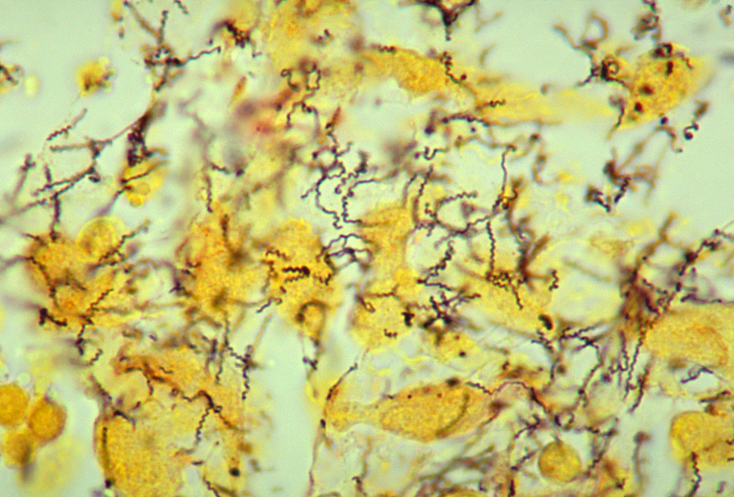
Image source: Wikipedia/Wikimedia
| Ecology, Host, and Life Cycle | |
|---|---|
| Oxygen requirements | Anaerobe |
| Optimal temperature | Not Available |
| Temperature range | Mesophilic |
| Habitat | HostAssociated |
| Biotic relationship | Free living |
| Host(s) | Not Available |
| Cell arrangement | Singles |
| Sporulation | Not Available |
| Energy source | Not Available |
| Pathogenicity | Not Available |
Gene Summary
Adenine Count
267807 bp
Thymine Count
269324 bp
Guanine Count
302207 bp
Cytosine Count
298136 bp
Genome Length
1137653 bp
Protein-coding Genes
984 genes
Non-Coding Genes
54 genes
# of Chromosomes/Plasmids
1
Genes
| Name | Locus Tag | UniProt ID | Strand Orientation | Gene Start/End | Protein Molecular Weight |
|---|---|---|---|---|---|
| dmt family transporter | TENDBA_RS04855 | Not Available | Positive | 1070206 - 1071090 | 32367.2 |
| hypothetical protein | TENDBA_RS04860 | Not Available | Negative | 1071136 - 1071519 | 14196.3 |
| marc family protein | TENDBA_RS04865 | Not Available | Positive | 1071610 - 1072209 | 21707.7 |
| glycogen-binding domain-containing protein | TENDBA_RS04870 | Not Available | Negative | 1072245 - 1072949 | 25815.5 |
| periplasmic flagellar collar protein flca | TENDBA_RS04875 | Not Available | Positive | 1073164 - 1076265 | 116814.0 |
| rubredoxin | TENDBA_RS04880 | Not Available | Positive | 1076329 - 1076487 | 5568.52 |
| hypothetical protein | TENDBA_RS04885 | Not Available | Positive | 1076520 - 1076807 | 10148.0 |
| septal ring lytic transglycosylase rlpa family protein | TENDBA_RS04890 | Not Available | Negative | 1076876 - 1077901 | 36158.7 |
| Trna-leu | Not Available | Not Available | Positive | 1078019 - 1078104 | Not Available |
| tatd family hydrolase | TENDBA_RS04900 | Not Available | Positive | 1078185 - 1079066 | 32426.9 |
Pathways
0 pathways
No pathways found
No metabolic pathways have been associated with this bacterium yet.
Health Effects
No health effects information available for this bacterium.