Kingdom
Pseudomonadati
Phylum
Pseudomonadota
Class
Gammaproteobacteria
Order
Enterobacterales
Family
Enterobacteriaceae
Genus
Escherichia
Description
Taxonomy
| Kingdom | Pseudomonadati |
|---|---|
| Phylum | Pseudomonadota |
| Class | Gammaproteobacteria |
| Order | Enterobacterales |
| Family | Enterobacteriaceae |
| Genus | Escherichia |
| Species | Escherichia coli |
| Strain | strain SJRP/Ec42695 Cotig_84 |
Profile
| Physiology | |
|---|---|
| Gram staining properties | Negative |
| Shape | Rod |
| Mobility | Yes |
| Flagellar presence | Yes |
| Number of membranes | 2 |

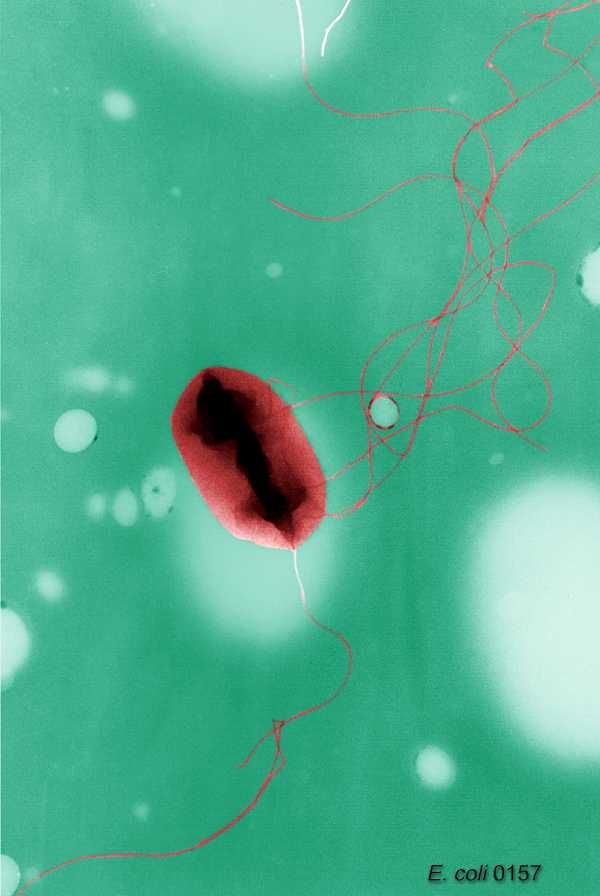
Image source: Wikipedia/Wikimedia
| Ecology, Host, and Life Cycle | |
|---|---|
| Oxygen requirements | Facultative anaerobe |
| Optimal temperature | 37 |
| Temperature range | Mesophilic |
| Habitat | HostAssociated |
| Biotic relationship | Free living |
| Host(s) | Homo sapiens, Gallus gallus, Bos taurus |
| Cell arrangement | Pairs - Singles |
| Sporulation | Not Available |
| Energy source | Not Available |
| Pathogenicity | Human |
Gene Summary
Adenine Count
1425857 bp
Thymine Count
1426936 bp
Guanine Count
1454646 bp
Cytosine Count
1451584 bp
Genome Length
5759023 bp
Protein-coding Genes
5291 genes
Non-Coding Genes
581 genes
# of Chromosomes/Plasmids
1
Genes
| Name | Locus Tag | UniProt ID | Strand Orientation | Gene Start/End | Protein Molecular Weight |
|---|---|---|---|---|---|
| dnaa regulatory inactivator hda | BZL69_24070 | Not Available | Negative | 4556576 - 4557322 | 28371.4 |
| uracil permease | BZL69_24075 | Not Available | Negative | 4557372 - 4558661 | 45033.0 |
| uracil phosphoribosyltransferase | BZL69_24080 | Not Available | Negative | 4558747 - 4559373 | 22534.6 |
| hypothetical protein | BZL69_24085 | Not Available | Positive | 4559497 - 4559679 | 7096.96 |
| phosphoribosylformylglycinamidine cyclo-ligase | BZL69_24090 | Not Available | Positive | 4559698 - 4560735 | 36875.2 |
| phosphoribosylglycinamide formyltransferase | BZL69_24095 | Not Available | Positive | 4560735 - 4561373 | 23253.6 |
| polyphosphate kinase | BZL69_24100 | Not Available | Positive | 4561544 - 4563610 | 80436.1 |
| exopolyphosphatase | BZL69_24105 | Not Available | Positive | 4563615 - 4565156 | 58139.5 |
| sensor domain-containing phosphodiesterase | BZL69_24110 | Not Available | Negative | 4565195 - 4567438 | 85741.9 |
| type iii effector protein | BZL69_24115 | Not Available | Negative | 4567675 - 4568146 | 17889.2 |
Pathways
1297 pathways
Health Effects
| Health Condition | Relation | Reference |
|---|---|---|
| Gi disease | Causes | PMC11149725 |
| Utis | Causes | PMC11434687 |
| Colorectal cancer | Causes | PMC12198655 |
| Pyogenic liver abscesses | Causes | PMC12392612 |
| Uti | Causes | PMC13014981 |
| Colibacillosis | Causes | PMC13255289 |
| Enteric infections | Causes | PMC13255289 |
| Foodborne infections | Causes | PMC13255289 |
| Clinical mastitis | Causes | PMC13293316 |
| Diarrhea | Causes | PMC3035056 |