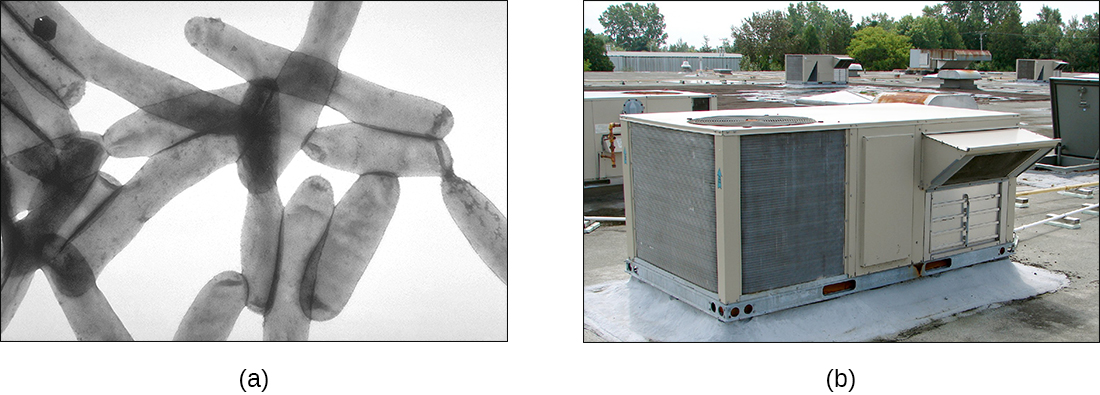
Legionella erythra strain SE-32A-C8

Rodmicroaerophile

Kingdom

Pseudomonadati

Phylum

Pseudomonadota

Class

Gammaproteobacteria

Order

Legionellales

Family

Legionellaceae

Genus

Legionella

Description

Legionella erythra strain SE-32A-C8 is a microaerophilic, thermophilic rod-shaped bacterium characterized by its presence in various water environments, including bath and shower water, cooling towers, decorative fountains, and dental unit water. This strain has true flagella, which may contribute to its motility in these aquatic habitats. As a pathogen, Legionella erythra strain SE-32A-C8 is noteworthy due to its potential health effects on humans, primarily causing pneumonia, Legionnaires' disease, and legionellosis. The strain can infect both Homo sapiens and amoebae, indicating its adaptability and potential for transmission through water systems that come into contact with humans. The strain possesses a single replicon, which is an important characteristic for its genetic stability and replication within its aquatic environments. Its thermophilic nature suggests that it thrives in warmer water conditions, making it particularly relevant in settings such as cooling towers and hot water systems where temperature regulation is essential for both human comfort and microbial control. In summary, Legionella erythra strain SE-32A-C8 exemplifies a significant ecological concern in water systems due to its pathogenic potential and adaptability to various hosts. Understanding its habitat preferences and biological characteristics is crucial for managing risks associated with Legionella infections in public health contexts.

Taxonomy

KingdomPseudomonadati
PhylumPseudomonadota
ClassGammaproteobacteria
OrderLegionellales
FamilyLegionellaceae
GenusLegionella
SpeciesLegionella erythra
Strainstrain SE-32A-C8

Profile

Physiology
Gram staining propertiesNot Available
ShapeRod
MobilityNot Available
Flagellar presenceYes
Number of membranesNot Available
Image of Legionella erythra strain SE-32A-C8
Image source: Wikipedia/Wikimedia
Ecology, Host, and Life Cycle
Oxygen requirementsmicroaerophile
Optimal temperatureNot Available
Temperature rangethermophilic
Habitatbath and shower water; bath water; baths; cooling towers; decorative fountains; dental unit water; shower water; showers; water environments
Biotic relationshipNot Available
Host(s)Homo sapiens, Amoeba
Cell arrangementNot Available
SporulationNot Available
Energy sourceNot Available
PathogenicityNot Available

Genome Summary

Legionella erythra strain SE-32A-C8


Gene Summary

Adenine Count

861312 bp

Thymine Count

864705 bp

Guanine Count

759637 bp

Cytosine Count

751889 bp

Genome Length

3239140 bp

Protein-coding Genes

2931 genes

Non-Coding Genes

42 genes

# of Chromosomes/Plasmids

1

Genes

NameLocus TagUniProt IDStrand OrientationGene Start/EndProtein Molecular Weight
ribonuclease eLery_0001P44443Negative525 - 248073599.8
ribosomal large subunit (23s rrna) pseudouridine synthase cLery_0002P44433Positive3119 - 406335506.2
hydrolaseLery_0003Q2RPW9Positive4056 - 473324903.2
cdp-diacylglycerol--glycerol-3-phosphate 3-phosphatidyltransferaseLery_0004P45419Positive4730 - 529620698.0
Trna-glyNot AvailableNot AvailablePositive5345 - 5420Not Available
Trna-cysNot AvailableNot AvailablePositive5464 - 5537Not Available
Trna-leuNot AvailableNot AvailablePositive5543 - 5631Not Available
hypothetical proteinLery_0005Not AvailablePositive6572 - 723425175.5
choline kinaseLery_0006Not AvailableNegative7186 - 820238605.1
Trna-glyNot AvailableNot AvailablePositive8402 - 8475Not Available

Displaying genes 1 – 10 of 2973 in total

Pathways

0 pathways

No pathways found

No metabolic pathways have been associated with this bacterium yet.

Metabolites

157 records
Metabolite IDMetabolite nameStructureCAS number
BASm0000237(R)-4'-phosphopantothenateC9H18NO8PChemical structure of (R)-4'-phosphopantothenateNot available
Average299.2149Da
Monoisotopic299.0770031Da
BASm00002512-dehydropantoateC6H9O4Chemical structure of 2-dehydropantoateNot available
Average145.1333Da
Monoisotopic145.050083776Da
BASm00002543-hydroxy-2-methylpropanoateC4H7O3Chemical structure of 3-hydroxy-2-methylpropanoateNot available
Average103.098Da
Monoisotopic103.0400677Da
BASm00002593alpha,12alpha-dihydroxy-7-oxo-5beta-cholanateC24H37O5Chemical structure of 3alpha,12alpha-dihydroxy-7-oxo-5beta-cholanateNot available
Average405.556Da
Monoisotopic405.264647871Da
BASm0000377(S)-malateC4H4O5Chemical structure of (S)-malateNot available
Average132.0716Da
Monoisotopic132.005873238Da
BASm0000387(6R)-5,10-methylene-5,6,7,8-tetrahydrofolateC20H21N7O6Chemical structure of (6R)-5,10-methylene-5,6,7,8-tetrahydrofolateNot available
Average455.432Da
Monoisotopic455.1564286Da
BASm0000401(S)-2-succinylamino-6-oxoheptanedioateC11H12NO8Chemical structure of (S)-2-succinylamino-6-oxoheptanedioateNot available
Average286.218Da
Monoisotopic286.0579371Da
BASm0000430hercynineC9H15N3O2Chemical structure of hercynineNot available
Average197.238Da
Monoisotopic197.1164267Da
BASm0000542HgHgChemical structure of HgNot available
Average200.59Da
Monoisotopic201.9706256Da
BASm0000642S-adenosyl-4-methylsulfanyl-2-oxobutanoateC15H19N5O6SChemical structure of S-adenosyl-4-methylsulfanyl-2-oxobutanoateNot available
Average397.406Da
Monoisotopic397.105604055Da

Displaying 1–10 of 157 metabolites

Health Effects

Health ConditionRelationReference
Legionnaires diseaseCausesPMC10986325
LegionellosisCausesPMC10986325
PneumoniaCausesPMC10986325

Displaying health effects 1 – 3 of 3 in total