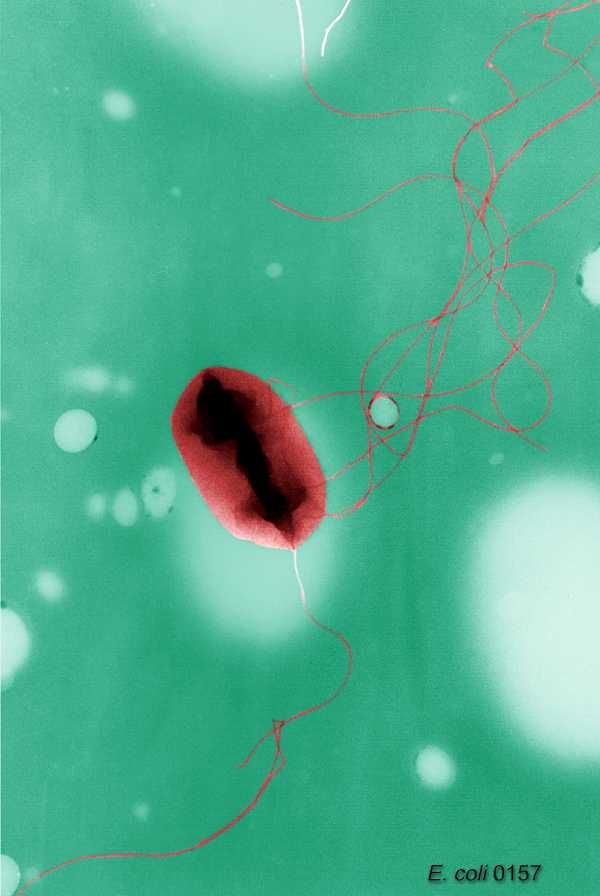
Escherichia coli PCN033

Gram-negativeRodMotileFacultative anaerobe

Kingdom

Pseudomonadati

Phylum

Pseudomonadota

Class

Gammaproteobacteria

Order

Enterobacterales

Family

Enterobacteriaceae

Genus

Escherichia

Description

Escherichia coli PCN033 is a Gram-negative, rod-shaped bacterium that exhibits a facultative anaerobic lifestyle, allowing it to thrive in environments with or without oxygen. This organism is typically found in host-associated habitats, indicating its role in the microbiota of various hosts. E. coli PCN033 can exist in pairs or singles, showcasing a versatile cell arrangement that may facilitate its adaptation to different ecological niches. This strain is motile, possessing flagella that enable movement, which can be crucial for colonization and interaction with the host environment. The optimal growth temperature for E. coli PCN033 is 37°C, which aligns with the body temperature of many mammals, further emphasizing its association with host organisms. It falls within the mesophilic temperature range, indicating it thrives in moderate temperature environments. E. coli PCN033 possesses four replicons and has a double-membrane structure, characteristic of Gram-negative bacteria. The presence of multiple replicons may suggest a complex genetic landscape that could contribute to its adaptability and resilience in diverse environments. As a free-living organism, E. coli PCN033 plays a significant role in the microbial ecosystem, potentially contributing to nutrient cycling and influencing the health of its host. Its adaptability to various oxygen levels and its motility highlight its ecological versatility, which is essential for its survival and function in host-associated habitats. The accessions associated with this strain (NZ_CP006632.1; NZ_CP006633.1; NZ_CP006634.1; NZ_CP006635.1) provide resources for further genomic studies that may elucidate its biological significance.

Taxonomy

KingdomPseudomonadati
PhylumPseudomonadota
ClassGammaproteobacteria
OrderEnterobacterales
FamilyEnterobacteriaceae
GenusEscherichia
SpeciesEscherichia coli
StrainPCN033

Profile

Physiology
Gram staining propertiesNegative
ShapeRod
MobilityYes
Flagellar presenceYes
Number of membranes2
Image of Escherichia coli PCN033
Image source: Wikipedia/Wikimedia
Ecology, Host, and Life Cycle
Oxygen requirementsFacultative anaerobe
Optimal temperature37
Temperature rangeMesophilic
HabitatHostAssociated
Biotic relationshipFree living
Host(s)Not Available
Cell arrangementPairs - Singles
SporulationNot Available
Energy sourceNot Available
PathogenicityNot Available

Genome Summary

Escherichia coli PCN033 chromosome, complete genome.

Gene Summary

Adenine Count

1229002 bp

Thymine Count

1229083 bp

Guanine Count

1264457 bp

Cytosine Count

1265415 bp

Genome Length

4987957 bp

Protein-coding Genes

4442 genes

Non-Coding Genes

391 genes

# of Chromosomes/Plasmids

4

Genes

NameLocus TagUniProt IDStrand OrientationGene Start/EndProtein Molecular Weight
site-specific tyrosine recombinase xerdPPECC33_RS15660P0A8P9Negative3186510 - 318740634280.4
flavodoxin fldbPPECC33_RS15665P0ABY6Positive3187518 - 318803919713.3
protein ygfxPPECC33_RS15670Q46824Negative3188079 - 318848616095.0
fad assembly factor sdhePPECC33_RS15675P64561Negative3188467 - 318873310547.7
trna-modifying protein ygfzPPECC33_RS15680B7N7E2Positive3188976 - 318995636156.2
hemolysin iii family proteinPPECC33_RS15685P67155Negative3190033 - 319069223878.3
n(4)-acetylcytidine aminohydrolasePPECC33_RS15690P67604Negative3190856 - 319116711921.0
6-phospho-beta-glucosidase bglaPPECC33_RS15695Q46829Positive3191212 - 319264555123.4
sdr family oxidoreductasePPECC33_RS15700P52037Negative3192707 - 319345025833.9
aminomethyl-transferring glycine dehydrogenasePPECC33_RS15705Q32BW5Negative3193717 - 3196590104295.0

Displaying genes 3151 – 3160 of 5020 in total

Metabolites

4785 records
Metabolite IDMetabolite nameStructureCAS number
BASm0000173(R)-3-Hydroxybutyric acidC4H8O3Chemical structure of (R)-3-Hydroxybutyric acid625-72-3
Average104.0473Da
Monoisotopic104.047344122Da
BASm0000217alpha-ribazoleC14H18N2O4Chemical structure of alpha-ribazoleNot available
Average278.3037Da
Monoisotopic278.126657074Da
BASm0000237(R)-4'-phosphopantothenateC9H18NO8PChemical structure of (R)-4'-phosphopantothenateNot available
Average299.2149Da
Monoisotopic299.0770031Da
BASm0000238(R)-3-phenyllactateC9H9O3Chemical structure of (R)-3-phenyllactateNot available
Average165.169Da
Monoisotopic165.05571773Da
BASm00002482,3-dihydroxy-3-methylbutanoateC5H10O4Chemical structure of 2,3-dihydroxy-3-methylbutanoate1756-18-9
Average134.1305Da
Monoisotopic134.0579088Da
BASm00002502,5-didehydro-D-gluconateC6H7O7Chemical structure of 2,5-didehydro-D-gluconate53736-12-2
Average191.1156Da
Monoisotopic191.019177578Da
BASm00002512-dehydropantoateC6H9O4Chemical structure of 2-dehydropantoateNot available
Average145.1333Da
Monoisotopic145.050083776Da
BASm00002532-oxopent-4-enoateC5H5O3Chemical structure of 2-oxopent-4-enoateNot available
Average113.093Da
Monoisotopic113.024417601Da
BASm00002593alpha,12alpha-dihydroxy-7-oxo-5beta-cholanateC24H37O5Chemical structure of 3alpha,12alpha-dihydroxy-7-oxo-5beta-cholanateNot available
Average405.556Da
Monoisotopic405.264647871Da
BASm00002603alpha,7alpha-dihydroxy-12-oxo-5beta-cholanateC24H37O5Chemical structure of 3alpha,7alpha-dihydroxy-12-oxo-5beta-cholanateNot available
Average405.556Da
Monoisotopic405.264647871Da

Displaying 1–10 of 4785 metabolites

Health Effects

No health effects information available for this bacterium.