Kingdom
Pseudomonadati
Phylum
Pseudomonadota
Class
Gammaproteobacteria
Order
Enterobacterales
Family
Enterobacteriaceae
Genus
Escherichia
Description
Taxonomy
| Kingdom | Pseudomonadati |
|---|---|
| Phylum | Pseudomonadota |
| Class | Gammaproteobacteria |
| Order | Enterobacterales |
| Family | Enterobacteriaceae |
| Genus | Escherichia |
| Species | Escherichia coli |
| Strain | 1303 |
Profile
| Physiology | |
|---|---|
| Gram staining properties | Negative |
| Shape | Rod |
| Mobility | Yes |
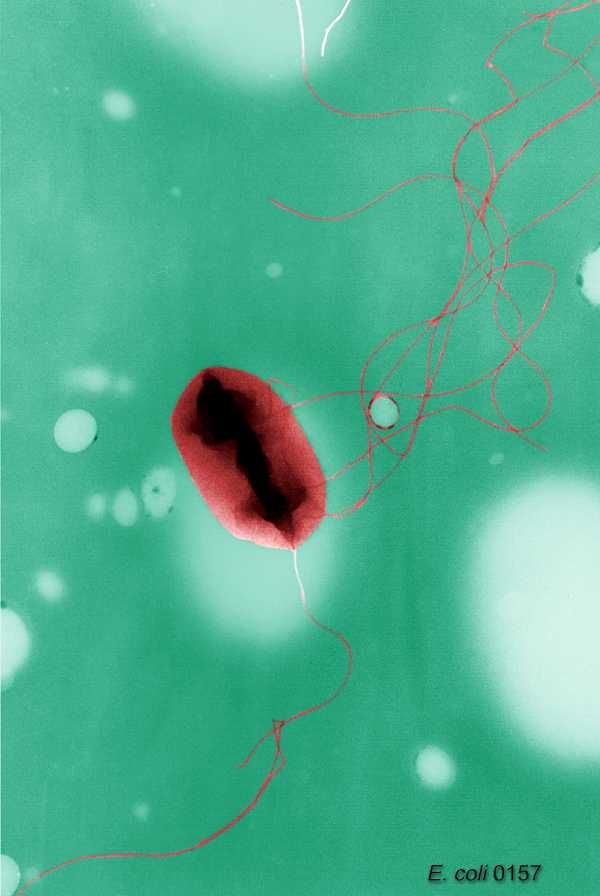
| Flagellar presence | Yes |
| Number of membranes | 2 |

Image source: Wikipedia/Wikimedia
| Ecology, Host, and Life Cycle | |
|---|---|
| Oxygen requirements | Facultative anaerobe |
| Optimal temperature | 37 |
| Temperature range | Mesophilic |
| Habitat | HostAssociated |
| Biotic relationship | Free living |
| Host(s) | Not Available |
| Cell arrangement | Pairs - Singles |
| Sporulation | Not Available |
| Energy source | Not Available |
| Pathogenicity | Not Available |
Genome Summary
Escherichia coli 1303 chromosome, complete genome.
Gene Summary
Adenine Count
1221843 bp
Thymine Count
1216553 bp
Guanine Count
1255494 bp
Cytosine Count
1254907 bp
Genome Length
4948797 bp
Protein-coding Genes
4469 genes
Non-Coding Genes
309 genes
# of Chromosomes/Plasmids
4
Genes
| Name | Locus Tag | UniProt ID | Strand Orientation | Gene Start/End | Protein Molecular Weight |
|---|---|---|---|---|---|
| dna repair protein recn | EC1303_RS14405 | Not Available | Positive | 2942771 - 2944432 | 61400.1 |
| outer membrane protein assembly factor bame | EC1303_RS14410 | Not Available | Positive | 2944581 - 2944922 | 12302.8 |
| rnfh family protein | EC1303_RS14415 | Not Available | Negative | 2944984 - 2945274 | 10790.0 |
| type ii toxin-antitoxin system toxin rata | EC1303_RS14420 | Not Available | Negative | 2945264 - 2945701 | 16220.6 |
| ssra-binding protein smpb | EC1303_RS14425 | Not Available | Positive | 2945872 - 2946354 | 18270.1 |
| Tmrna,resume consensus sequence (at 83): aatagtcgcaaacgacga | Not Available | Not Available | Positive | 2946569 - 2946931 | Not Available |
| adhesin-like autotransporter ypja/ehad | EC1303_RS25750 | Not Available | Negative | 2947092 - 2951672 | 157468.0 |
| hypothetical protein | EC1303_RS26880 | Not Available | Negative | 2951737 - 2951856 | 4328.2 |
| tail fiber assembly protein | EC1303_RS26890 | Not Available | Negative | 2952080 - 2952238 | 5922.45 |
| tail fiber assembly protein | EC1303_RS28880 | Not Available | Negative | 2952584 - 2953957 | 51476.4 |
Pathways
12367 pathways
Health Effects
No health effects information available for this bacterium.