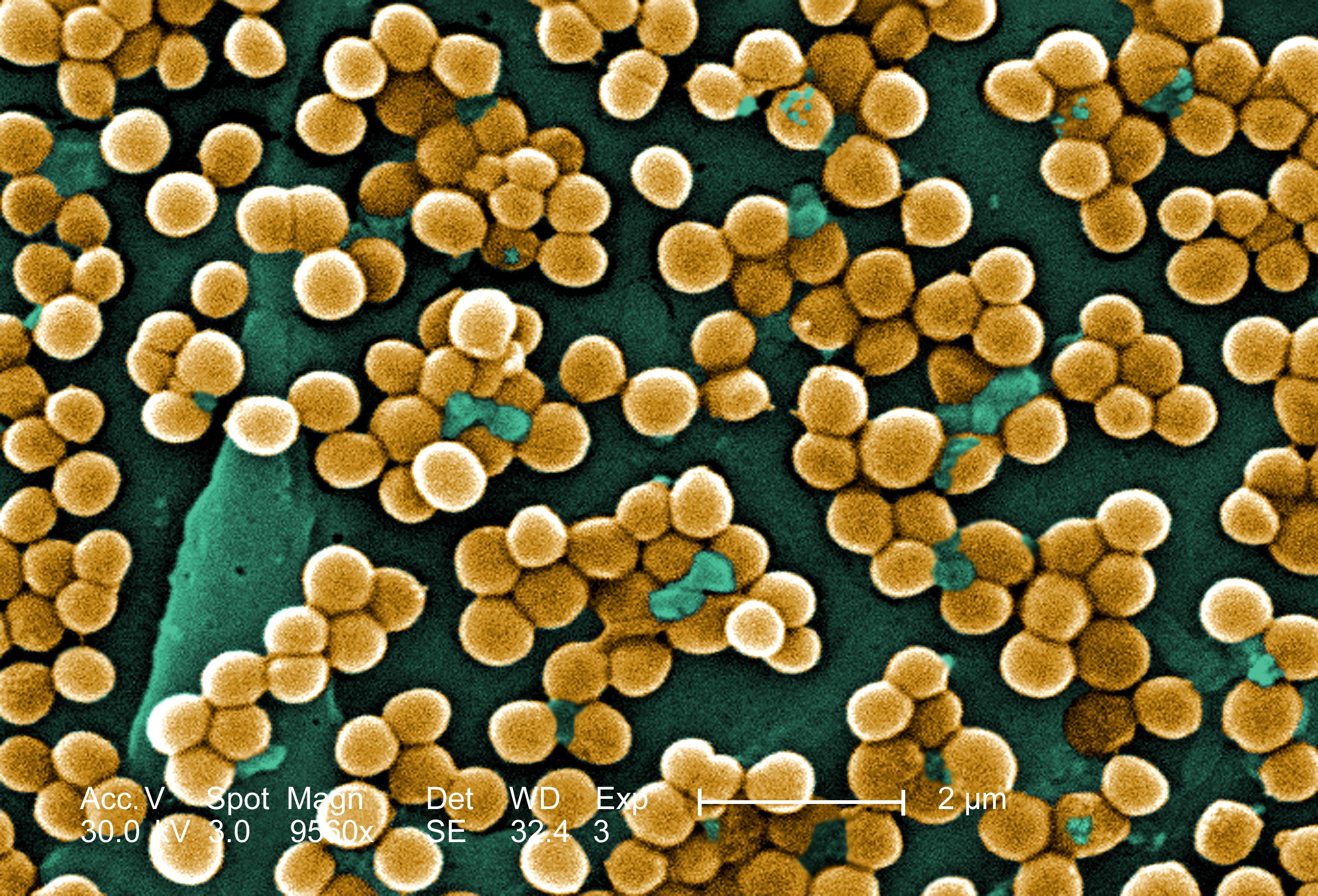
Staphylococcus aureus subsp. aureus COL

Gram-positiveCocciNon-motileFacultative anaerobe

Kingdom

Bacillati

Phylum

Bacillota

Class

Bacilli

Order

Caryophanales

Family

Staphylococcaceae

Genus

Staphylococcus

Description

Staphylococcus aureus subsp. aureus COL is a Gram-positive bacterium with a coccal shape, classified as a mesophile favoring moderate temperatures between 20°C and 45°C, a chemoheterotroph that derives energy from organic compounds. This opportunistic pathogen colonizes various body sites in humans, including the skin, nasal passages, throat, and mucous membranes.As a Gram-positive organism, S. aureus COL possesses a thick peptidoglycan layer in its cell wall, which retains the crystal violet stain during the Gram staining process, appearing purple under microscopic examination. Its coccal shape allows S. aureus to form clusters reminiscent of grapes, a characteristic that aids in its identification in laboratory settings. Being a mesophilic microorganism, it thrives optimally within the human body, where temperatures are conducive to its growth. As a chemoheterotroph, S. aureus COL requires organic substances for both carbon and energy, primarily utilizing sugars, amino acids, and lipids found in host tissues or extracellular fluids. It is classified as a facultative anaerobe, enabling it to survive and grow in both the presence and absence of oxygen. This adaptability allows the bacterium to colonize diverse environments within the human body, from aerobic surfaces of the skin to the anaerobic conditions of deeper tissues. Beyond its pathogenic potential, S. aureus COL is notable for its capacity to form biofilms, making it particularly difficult to eradicate from surfaces, both biological and synthetic. Its ability to produce a variety of virulence factors, including toxins and enzymes, contributes to a wide range of infections, from minor skin conditions to severe systemic diseases. Furthermore, S. aureus COL has been instrumental in research as a model organism for studying antibiotic resistance mechanisms due to its notorious strain, MRSA (Methicillin-resistant Staphylococcus aureus).

Taxonomy

KingdomBacillati
PhylumBacillota
ClassBacilli
OrderCaryophanales
FamilyStaphylococcaceae
GenusStaphylococcus
SpeciesStaphylococcus aureus
StrainCOL

Profile

Physiology
Gram staining propertiesPositive
ShapeCocci
MobilityNo
Flagellar presenceYes
Number of membranes1
Image of Staphylococcus aureus subsp. aureus COL
Image source: Wikipedia/Wikimedia
Ecology, Host, and Life Cycle
Oxygen requirementsFacultative anaerobe
Optimal temperature30
Temperature rangeMesophilic
HabitatHostAssociated
Biotic relationshipFree living
Host(s)Not Available
Cell arrangementClusters - Singles
SporulationNonsporulating
Energy sourceNot Available
PathogenicityNot Available

Genome Summary

Staphylococcus aureus subsp. aureus COL plasmid pT181, complete

Gene Summary

Adenine Count

1649 bp

Thymine Count

1457 bp

Guanine Count

793 bp

Cytosine Count

541 bp

Genome Length

4440 bp

Protein-coding Genes

3 genes

Non-Coding Genes

0 genes

# of Chromosomes/Plasmids

2

Genes

NameLocus TagUniProt IDStrand OrientationGene Start/EndProtein Molecular Weight
replication initiation factor domain-containing proteinSACOL_RS00005Not AvailablePositive32 - 97637644.5
tetracycline efflux mfs transporter tet(k)SACOL_RS00010Not AvailablePositive1138 - 251750698.1
mobv family relaxaseSACOL_RS00015Not AvailablePositive2703 - 394448528.6
AttlNot AvailableNot AvailablePositive354767 - 354779Not Available
Site-specific integraseSACOL_RS01605Not AvailableNegative354785 - 35599046976.1
Hypothetical proteinSACOL_RS01610Not AvailableNegative356184 - 35689727831.7
Hypothetical proteinSACOL_RS01615Not AvailableNegative356975 - 3571576951.34
Ci-like repressorSACOL_RS01620Not AvailableNegative357357 - 35807627157.3
Orf073SACOL_RS01625Not AvailablePositive358218 - 3584368683.5
Orf049SACOL_RS01630Not AvailablePositive358451 - 35875911944.3

Displaying genes 1 – 10 of 21 in total

Metabolites

1605 records
Metabolite IDMetabolite nameStructureCAS number
BASm00002502,5-didehydro-D-gluconateC6H7O7Chemical structure of 2,5-didehydro-D-gluconate53736-12-2
Average191.1156Da
Monoisotopic191.019177578Da
BASm00002532-oxopent-4-enoateC5H5O3Chemical structure of 2-oxopent-4-enoateNot available
Average113.093Da
Monoisotopic113.024417601Da
BASm00002603alpha,7alpha-dihydroxy-12-oxo-5beta-cholanateC24H37O5Chemical structure of 3alpha,7alpha-dihydroxy-12-oxo-5beta-cholanateNot available
Average405.556Da
Monoisotopic405.264647871Da
BASm0000553biphenyl-2,3-diolC12H10O2Chemical structure of biphenyl-2,3-diolNot available
Average186.2066Da
Monoisotopic186.0680796Da
BASm0000592(S)-1-phenylethanolC8H10OChemical structure of (S)-1-phenylethanolNot available
Average122.1644Da
Monoisotopic122.0731649Da
BASm0000989GlycerolC3H8O3Chemical structure of Glycerol56-81-5
Average92.0938Da
Monoisotopic92.04734412Da
BASm0001225dodecanoateC12H23O2Chemical structure of dodecanoateNot available
Average199.3098Da
Monoisotopic199.169805Da
BASm00012442-succinylbenzoateC11H8O5Chemical structure of 2-succinylbenzoate27415-09-04
Average220.181Da
Monoisotopic220.038270517Da
BASm0001462ubiquinone-0C9H10O4Chemical structure of ubiquinone-0605-94-7
Average182.1733Da
Monoisotopic182.057908808Da
BASm0001661Cu(2+)CuChemical structure of Cu(2+)7440-50-8
Average63.546Da
Monoisotopic62.929601079Da

Displaying 1–10 of 1605 metabolites

Health Effects

No health effects information available for this bacterium.