Kingdom
Bacillati
Phylum
Bacillota
Class
Bacilli
Order
Lactobacillales
Family
Streptococcaceae
Genus
Streptococcus
Description
Taxonomy
| Kingdom | Bacillati |
|---|---|
| Phylum | Bacillota |
| Class | Bacilli |
| Order | Lactobacillales |
| Family | Streptococcaceae |
| Genus | Streptococcus |
| Species | Streptococcus sanguinis |
| Strain | No strain |
Profile
| Physiology | |
|---|---|
| Gram staining properties | Positive |
| Shape | Cocci |
| Mobility | No |
| Flagellar presence | Yes |
| Number of membranes | 1 |

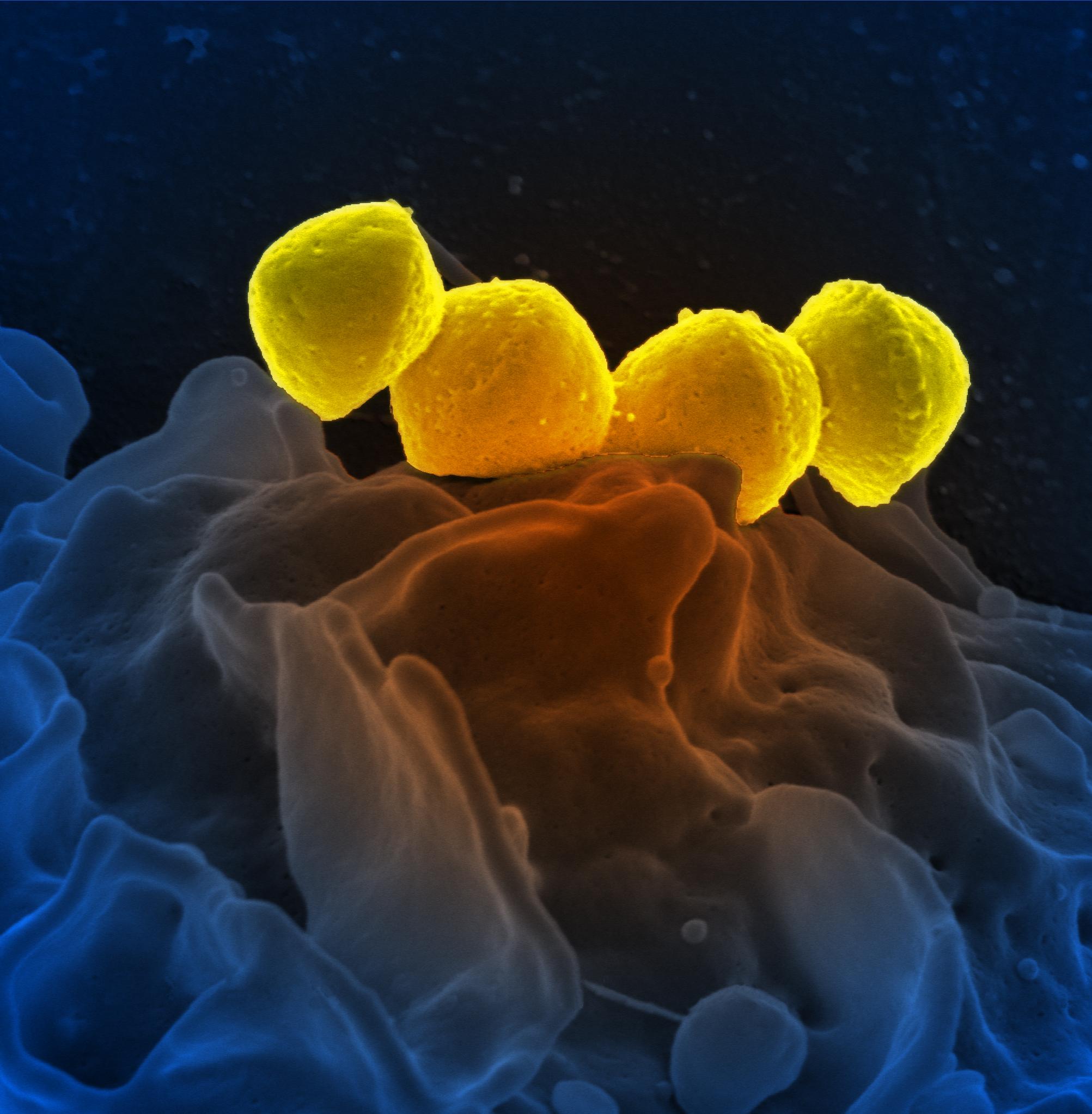
Image source: Wikipedia/Wikimedia
| Ecology, Host, and Life Cycle | |
|---|---|
| Oxygen requirements | Facultative anaerobe |
| Optimal temperature | Not Available |
| Temperature range | Mesophilic |
| Habitat | HostAssociated |
| Biotic relationship | Free living |
| Host(s) | Homo sapiens, Oryctolagus cuniculus |
| Cell arrangement | Chains - Pairs |
| Sporulation | Nonsporulating |
| Energy source | Not Available |
| Pathogenicity | Human |
Genome Summary
Streptococcus sanguinis strain BCC64 D8875_contig083, whole genome
Gene Summary
Adenine Count
668774 bp
Thymine Count
673657 bp
Guanine Count
502311 bp
Cytosine Count
519568 bp
Genome Length
2370463 bp
Protein-coding Genes
2283 genes
Non-Coding Genes
51 genes
# of Chromosomes/Plasmids
4
Genes
| Name | Locus Tag | UniProt ID | Strand Orientation | Gene Start/End | Protein Molecular Weight |
|---|---|---|---|---|---|
| dihydrolipoyl dehydrogenase | EII39_01880 | Not Available | Positive | 382895 - 384601 | 60463.2 |
| lipoate--protein ligase | EII39_01885 | Not Available | Positive | 384668 - 385657 | 37838.9 |
| hypothetical protein | EII39_01890 | Not Available | Positive | 385823 - 386461 | 24399.3 |
| tyrosine recombinase xers | EII39_01895 | Not Available | Negative | 386541 - 387611 | 41335.8 |
| hypothetical protein | EII39_01900 | Not Available | Negative | 387790 - 388233 | 17529.2 |
| alpha/beta hydrolase | EII39_01905 | Not Available | Negative | 388286 - 389086 | 30514.2 |
| signal recognition particle protein | EII39_01910 | Not Available | Negative | 389165 - 390739 | 57629.6 |
| 2-oxoglutarate:acceptor oxidoreductase | EII39_01915 | Not Available | Negative | 390768 - 390983 | 8156.86 |
| putative dna-binding protein | EII39_01920 | Not Available | Negative | 390986 - 391318 | 13163.4 |
| gntr family transcriptional regulator | EII39_01925 | Not Available | Negative | 391471 - 392169 | 26840.1 |
Pathways
0 pathways
No pathways found
No metabolic pathways have been associated with this bacterium yet.
Health Effects
| Health Condition | Relation | Reference |
|---|---|---|
| Infective endocarditis | Causes | PMC4862721 |
| Ie | Causes | PMC4862721 |
| Bacterial endocarditis | Causes | PMC4862721 |
| Endocarditis | Causes | PMC4862721 |
| Infective endocarditis | Causes | PMC5288394 |
| Meningitis | Causes | PMC5288394 |
| Bacteremia | Causes | PMC5288394 |
| Infective endocarditis | Causes | PMC6060398 |
| Endocarditis | Causes | PMC6060398 |
| Infective endocarditis | Causes | PMC3178606 |