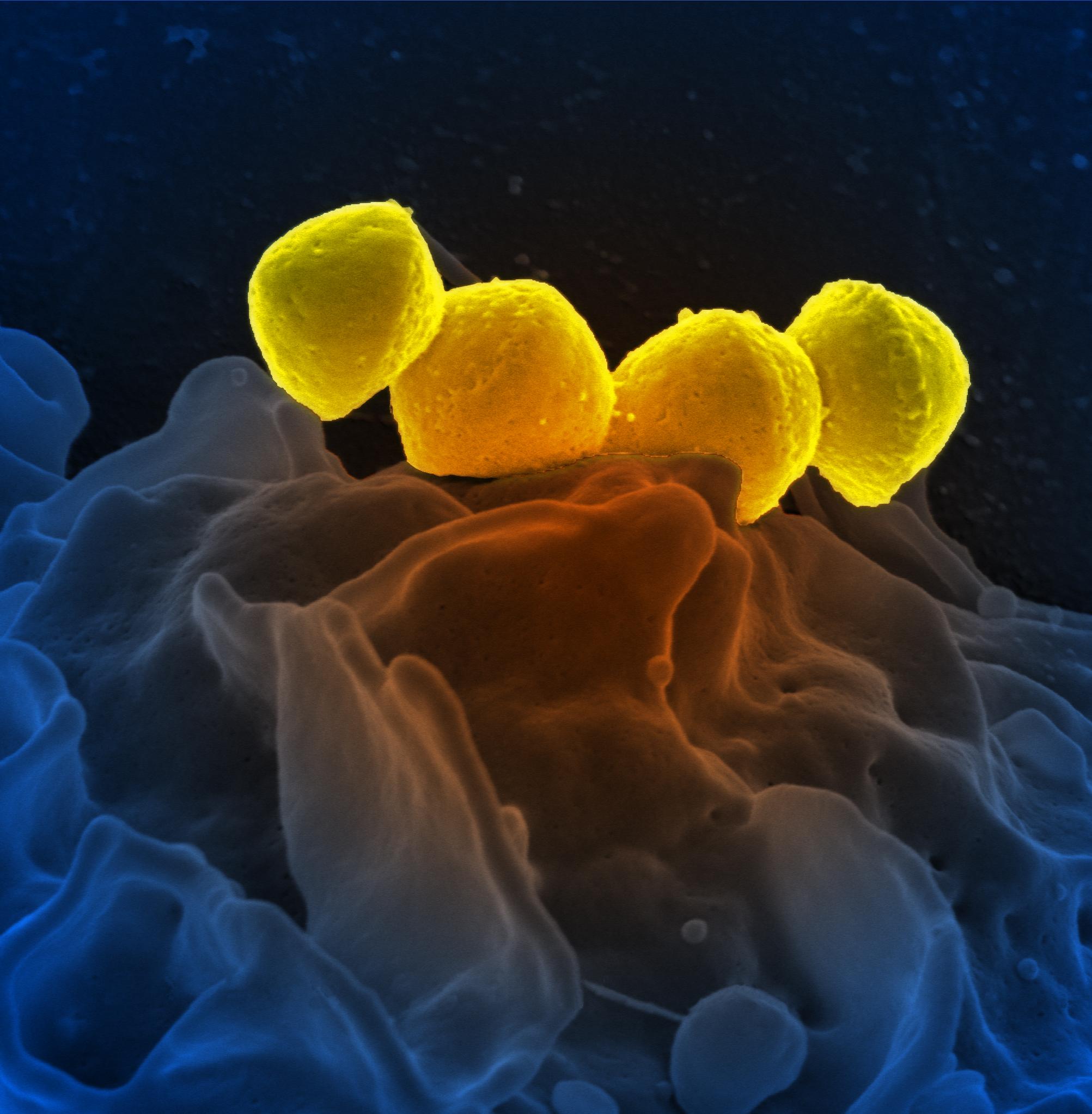
Kingdom
Bacillati
Phylum
Bacillota
Class
Bacilli
Order
Lactobacillales
Family
Streptococcaceae
Genus
Streptococcus
Description
Taxonomy
| Kingdom | Bacillati |
|---|---|
| Phylum | Bacillota |
| Class | Bacilli |
| Order | Lactobacillales |
| Family | Streptococcaceae |
| Genus | Streptococcus |
| Species | Streptococcus sanguinis |
| Strain | No strain |
Profile
| Physiology | |
|---|---|
| Gram staining properties | Positive |
| Shape | Cocci |
| Mobility | No |
| Flagellar presence | Yes |
| Number of membranes | 1 |

Image source: Wikipedia/Wikimedia
| Ecology, Host, and Life Cycle | |
|---|---|
| Oxygen requirements | Facultative anaerobe |
| Optimal temperature | Not Available |
| Temperature range | Mesophilic |
| Habitat | HostAssociated |
| Biotic relationship | Free living |
| Host(s) | Homo sapiens, Oryctolagus cuniculus |
| Cell arrangement | Chains - Pairs |
| Sporulation | Nonsporulating |
| Energy source | Not Available |
| Pathogenicity | Human |
Genome Summary
Streptococcus sanguinis strain BCC64 D8875_contig083, whole genome
Gene Summary
Adenine Count
668774 bp
Thymine Count
673657 bp
Guanine Count
502311 bp
Cytosine Count
519568 bp
Genome Length
2370463 bp
Protein-coding Genes
2283 genes
Non-Coding Genes
51 genes
# of Chromosomes/Plasmids
4
Genes
| Name | Locus Tag | UniProt ID | Strand Orientation | Gene Start/End | Protein Molecular Weight |
|---|---|---|---|---|---|
| hypothetical protein | D8883_02110 | Not Available | Negative | 467276 - 468925 | 62607.1 |
| abc transporter substrate binding protein | D8883_02115 | Not Available | Positive | 469458 - 470465 | 35292.4 |
| spovt / abrb like domain protein | D8883_02120 | Not Available | Positive | 470646 - 470876 | 8655.28 |
| daunorubicin/doxorubicin resistance atp-binding protein drra | D8883_02125 | Not Available | Positive | 471115 - 471840 | 26757.4 |
| abc-2 type transporter | D8883_02130 | Not Available | Positive | 471843 - 472577 | 26549.6 |
| phenylalanine--trna ligase alpha subunit | D8883_02135 | Not Available | Positive | 472859 - 473908 | 39445.5 |
| protease synthase and sporulation negative regulatory protein pai 1 | D8883_02140 | Not Available | Positive | 473954 - 474463 | 20012.6 |
| phenylalanine--trna ligase beta subunit | D8883_02145 | Not Available | Positive | 474613 - 477018 | 87030.1 |
| hypothetical protein | D8883_02150 | Not Available | Positive | 477190 - 477582 | 14990.8 |
| arylesterase | D8883_02155 | Not Available | Positive | 477748 - 478560 | 30311.6 |
Pathways
0 pathways
No pathways found
No metabolic pathways have been associated with this bacterium yet.
Health Effects
| Health Condition | Relation | Reference |
|---|---|---|
| Infective endocarditis | Causes | PMC4862721 |
| Ie | Causes | PMC4862721 |
| Bacterial endocarditis | Causes | PMC4862721 |
| Endocarditis | Causes | PMC4862721 |
| Infective endocarditis | Causes | PMC5288394 |
| Meningitis | Causes | PMC5288394 |
| Bacteremia | Causes | PMC5288394 |
| Infective endocarditis | Causes | PMC6060398 |
| Endocarditis | Causes | PMC6060398 |
| Infective endocarditis | Causes | PMC3178606 |