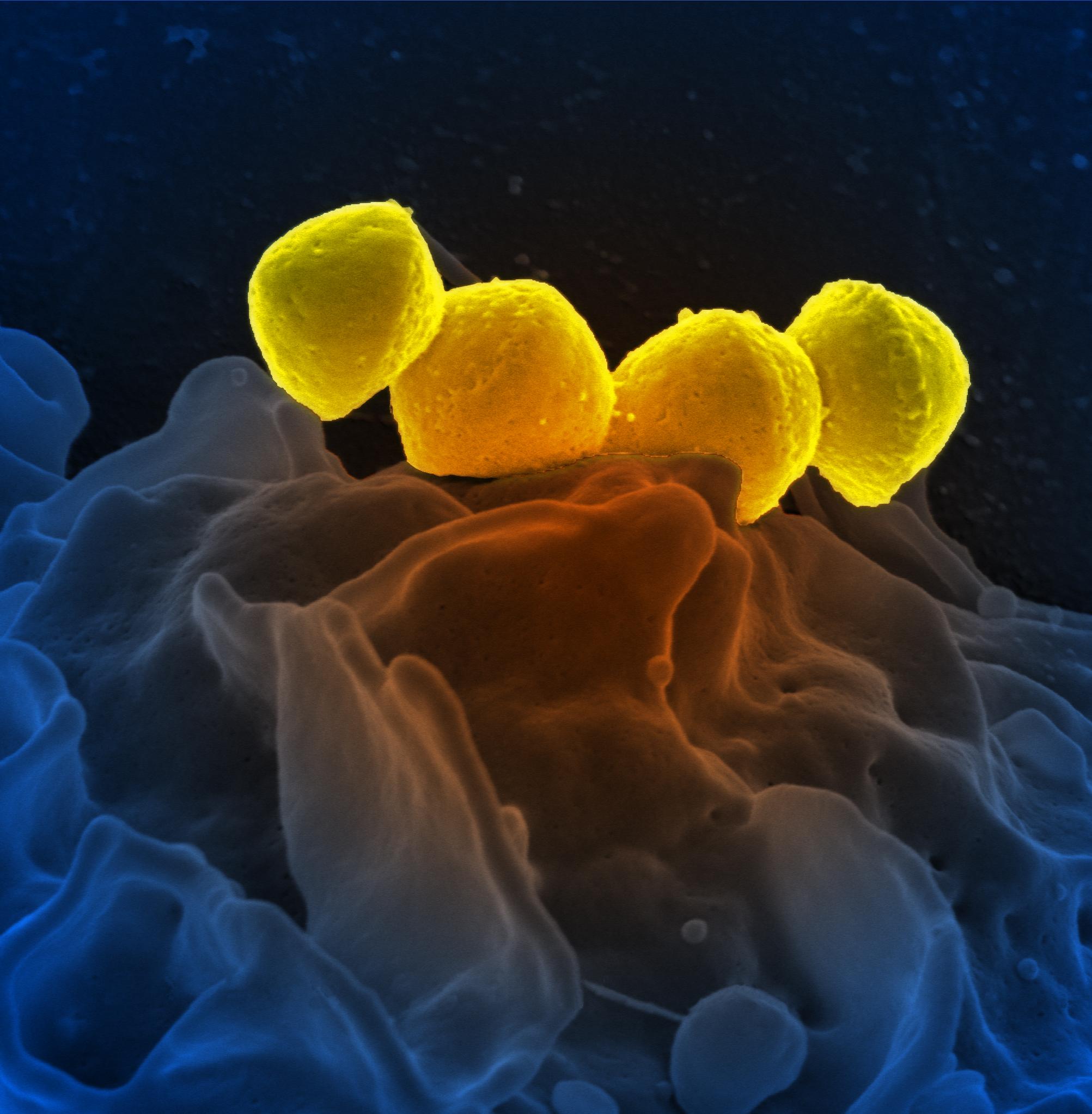
Kingdom
Bacillati
Phylum
Bacillota
Class
Bacilli
Order
Lactobacillales
Family
Streptococcaceae
Genus
Streptococcus
Description
Taxonomy
| Kingdom | Bacillati |
|---|---|
| Phylum | Bacillota |
| Class | Bacilli |
| Order | Lactobacillales |
| Family | Streptococcaceae |
| Genus | Streptococcus |
| Species | Streptococcus sanguinis |
| Strain | No strain |
Profile
| Physiology | |
|---|---|
| Gram staining properties | Positive |
| Shape | Cocci |
| Mobility | No |
| Flagellar presence | Yes |
| Number of membranes | 1 |

Image source: Wikipedia/Wikimedia
| Ecology, Host, and Life Cycle | |
|---|---|
| Oxygen requirements | Facultative anaerobe |
| Optimal temperature | Not Available |
| Temperature range | Mesophilic |
| Habitat | HostAssociated |
| Biotic relationship | Free living |
| Host(s) | Homo sapiens, Oryctolagus cuniculus |
| Cell arrangement | Chains - Pairs |
| Sporulation | Nonsporulating |
| Energy source | Not Available |
| Pathogenicity | Human |
Genome Summary
Streptococcus sanguinis strain BCC64 D8875_contig083, whole genome
Gene Summary
Adenine Count
668774 bp
Thymine Count
673657 bp
Guanine Count
502311 bp
Cytosine Count
519568 bp
Genome Length
2370463 bp
Protein-coding Genes
2283 genes
Non-Coding Genes
51 genes
# of Chromosomes/Plasmids
4
Genes
| Name | Locus Tag | UniProt ID | Strand Orientation | Gene Start/End | Protein Molecular Weight |
|---|---|---|---|---|---|
| high-affinity zinc uptake system binding-protein znua precursor | D8875_09705 | Not Available | Negative | 1960500 - 1961438 | 34679.9 |
| carbamoyl-phosphate synthase large chain | D8875_09710 | Not Available | Negative | 1961707 - 1964886 | 116330.0 |
| carbamoyl-phosphate synthase small chain | D8875_09715 | Not Available | Negative | 1964910 - 1965986 | 39919.4 |
| aspartate carbamoyltransferase | D8875_09720 | Not Available | Negative | 1966101 - 1967018 | 34659.5 |
| uracil permease | D8875_09725 | Not Available | Negative | 1967125 - 1968408 | 44867.5 |
| bifunctional protein pyrr | D8875_09730 | Not Available | Negative | 1968417 - 1968935 | 19499.6 |
| internalin-a precursor | D8875_09735 | Not Available | Negative | 1969168 - 1970487 | 48261.5 |
| hypothetical protein | D8875_09740 | Not Available | Negative | 1970497 - 1971708 | 44211.5 |
| hypothetical protein | D8875_09745 | Not Available | Negative | 1971846 - 1972478 | 24723.2 |
| hypothetical protein | D8875_09750 | Not Available | Negative | 1972486 - 1972824 | 12341.7 |
Pathways
0 pathways
No pathways found
No metabolic pathways have been associated with this bacterium yet.
Health Effects
| Health Condition | Relation | Reference |
|---|---|---|
| Infective endocarditis | Causes | PMC4862721 |
| Ie | Causes | PMC4862721 |
| Bacterial endocarditis | Causes | PMC4862721 |
| Endocarditis | Causes | PMC4862721 |
| Infective endocarditis | Causes | PMC5288394 |
| Meningitis | Causes | PMC5288394 |
| Bacteremia | Causes | PMC5288394 |
| Infective endocarditis | Causes | PMC6060398 |
| Endocarditis | Causes | PMC6060398 |
| Infective endocarditis | Causes | PMC3178606 |