Kingdom
Pseudomonadati
Phylum
Pseudomonadota
Class
Gammaproteobacteria
Order
Enterobacterales
Family
Enterobacteriaceae
Genus
Escherichia
Description
Taxonomy
| Kingdom | Pseudomonadati |
|---|---|
| Phylum | Pseudomonadota |
| Class | Gammaproteobacteria |
| Order | Enterobacterales |
| Family | Enterobacteriaceae |
| Genus | Escherichia |
| Species | Escherichia coli |
| Strain | 3385 |
Profile
| Physiology | |
|---|---|
| Gram staining properties | Negative |
| Shape | Rod |
| Mobility | Yes |
| Flagellar presence | Yes |
| Number of membranes | 2 |

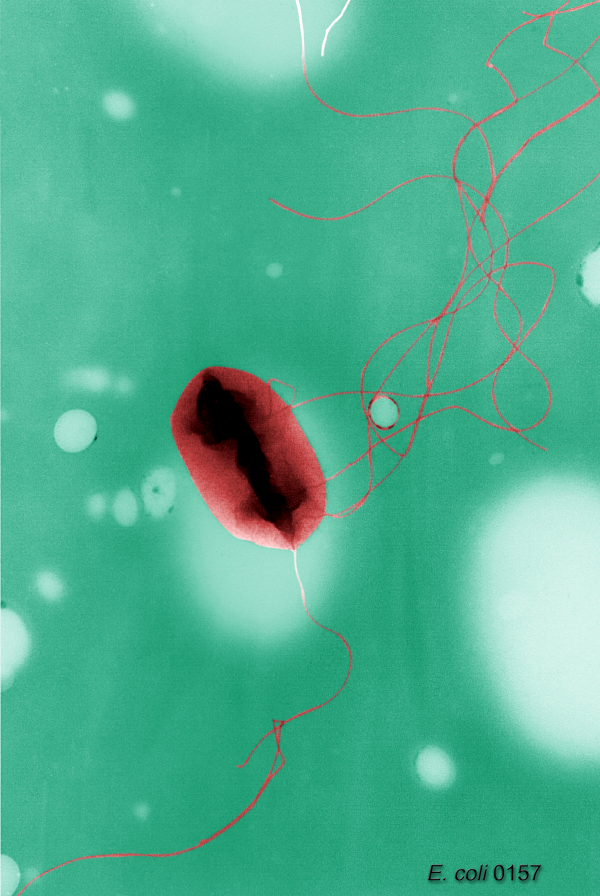
Image source: Wikipedia/Wikimedia
| Ecology, Host, and Life Cycle | |
|---|---|
| Oxygen requirements | Facultative anaerobe |
| Optimal temperature | 37 |
| Temperature range | Mesophilic |
| Habitat | HostAssociated |
| Biotic relationship | Free living |
| Host(s) | Homo sapiens, Gallus gallus, Bos taurus |
| Cell arrangement | Pairs - Singles |
| Sporulation | Not Available |
| Energy source | Not Available |
| Pathogenicity | Human |
Genome Summary
Escherichia coli strain 3385 plasmid unnamed2, complete sequence.
Gene Summary
Adenine Count
22678 bp
Thymine Count
21551 bp
Guanine Count
23522 bp
Cytosine Count
21572 bp
Genome Length
89323 bp
Protein-coding Genes
94 genes
Non-Coding Genes
12 genes
# of Chromosomes/Plasmids
3
Genes
| Name | Locus Tag | UniProt ID | Strand Orientation | Gene Start/End | Protein Molecular Weight |
|---|---|---|---|---|---|
| Is5 transposase and trans-activator | DFS94_RS25065 | Not Available | Positive | 23287 - 24267 | 37798.6 |
| type i restriction endonuclease | DFS94_RS25070 | Not Available | Positive | 24414 - 24752 | 13133.6 |
| Putative transposase orfb | DFS94_RS25075 | Not Available | Negative | 24762 - 25175 | 15974.7 |
| Conserved protein of unknown function pdcb | DFS94_RS25080 | Not Available | Negative | 25180 - 25458 | 10600.9 |
| Attl | Not Available | Not Available | Positive | 25484 - 25496 | Not Available |
| Pdca | DFS94_RS25085 | Not Available | Negative | 25486 - 25665 | 6748.57 |
| Toxin doc | DFS94_RS25090 | Not Available | Negative | 25670 - 26050 | 13616.1 |
| Prevention of host death by doc toxicity | DFS94_RS25095 | Not Available | Negative | 26050 - 26271 | 8133.53 |
| Putative restriction-modification protein | DFS94_RS25100 | Not Available | Positive | 26454 - 28010 | 57736.1 |
| Restriction endonuclease subunit s | DFS94_RS25105 | Not Available | Positive | 28007 - 29278 | 48202.5 |
Pathways
12367 pathways
Health Effects
| Health Condition | Relation | Reference |
|---|---|---|
| Gi disease | Causes | PMC11149725 |
| Utis | Causes | PMC11434687 |
| Colorectal cancer | Causes | PMC12198655 |
| Pyogenic liver abscesses | Causes | PMC12392612 |
| Uti | Causes | PMC13014981 |
| Colibacillosis | Causes | PMC13255289 |
| Enteric infections | Causes | PMC13255289 |
| Foodborne infections | Causes | PMC13255289 |
| Clinical mastitis | Causes | PMC13293316 |
| Diarrhea | Causes | PMC3035056 |