Kingdom
Pseudomonadati
Phylum
Pseudomonadota
Class
Gammaproteobacteria
Order
Enterobacterales
Family
Enterobacteriaceae
Genus
Escherichia
Description
Taxonomy
| Kingdom | Pseudomonadati |
|---|---|
| Phylum | Pseudomonadota |
| Class | Gammaproteobacteria |
| Order | Enterobacterales |
| Family | Enterobacteriaceae |
| Genus | Escherichia |
| Species | Escherichia coli |
| Strain | 256 |
Profile
| Physiology | |
|---|---|
| Gram staining properties | Negative |
| Shape | Rod |
| Mobility | Yes |
| Flagellar presence | Yes |
| Number of membranes | 2 |

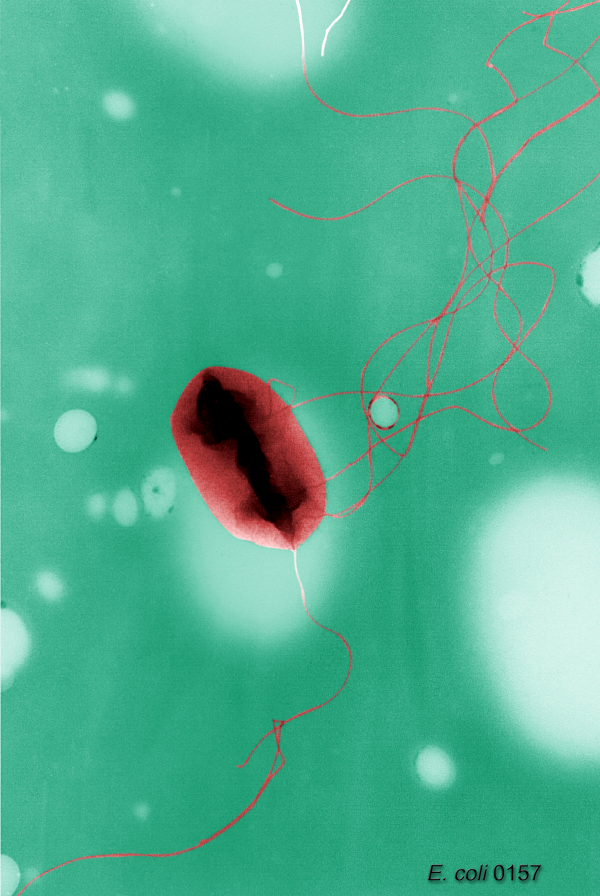
Image source: Wikipedia/Wikimedia
| Ecology, Host, and Life Cycle | |
|---|---|
| Oxygen requirements | Facultative anaerobe |
| Optimal temperature | 37 |
| Temperature range | Mesophilic |
| Habitat | HostAssociated |
| Biotic relationship | Free living |
| Host(s) | Homo sapiens, Gallus gallus, Bos taurus |
| Cell arrangement | Pairs - Singles |
| Sporulation | Not Available |
| Energy source | Not Available |
| Pathogenicity | Human |
Genome Summary
Escherichia coli strain 256 plasmid unnamed2, whole genome shotgun
Gene Summary
Adenine Count
26830 bp
Thymine Count
25246 bp
Guanine Count
25640 bp
Cytosine Count
28611 bp
Genome Length
106327 bp
Protein-coding Genes
125 genes
Non-Coding Genes
0 genes
# of Chromosomes/Plasmids
3
Genes
| Name | Locus Tag | UniProt ID | Strand Orientation | Gene Start/End | Protein Molecular Weight |
|---|---|---|---|---|---|
| fertility inhibition protein fino | BMT53_RS00005 | Not Available | Negative | 142 - 699 | 21212.7 |
| transposase | BMT53_RS00010 | Not Available | Negative | 735 - 1046 | 11087.4 |
| hypothetical protein | BMT53_RS31570 | Not Available | Negative | 998 - 1153 | 5791.18 |
| transposase | BMT53_RS00015 | Not Available | Negative | 1191 - 1926 | 26917.5 |
| transposase | BMT53_RS31070 | Not Available | Negative | 1946 - 7202 | 182204.0 |
| type iv conjugative transfer system coupling protein trad | BMT53_RS00035 | Not Available | Negative | 7202 - 9472 | 86088.7 |
| hypothetical protein | BMT53_RS00040 | Not Available | Negative | 9529 - 10260 | 27623.8 |
| hypothetical protein | BMT53_RS00045 | Not Available | Negative | 10428 - 10688 | 9940.78 |
| conjugal transfer complement resistance protein trat | BMT53_RS00050 | Not Available | Negative | 10748 - 11479 | 26040.3 |
| hypothetical protein | BMT53_RS00055 | Not Available | Negative | 11528 - 12007 | 18283.3 |
Pathways
12367 pathways
Health Effects
| Health Condition | Relation | Reference |
|---|---|---|
| Gi disease | Causes | PMC11149725 |
| Utis | Causes | PMC11434687 |
| Colorectal cancer | Causes | PMC12198655 |
| Pyogenic liver abscesses | Causes | PMC12392612 |
| Uti | Causes | PMC13014981 |
| Colibacillosis | Causes | PMC13255289 |
| Enteric infections | Causes | PMC13255289 |
| Foodborne infections | Causes | PMC13255289 |
| Clinical mastitis | Causes | PMC13293316 |
| Diarrhea | Causes | PMC3035056 |