Kingdom
Pseudomonadati
Phylum
Pseudomonadota
Class
Gammaproteobacteria
Order
Enterobacterales
Family
Enterobacteriaceae
Genus
Escherichia
Description
Taxonomy
| Kingdom | Pseudomonadati |
|---|---|
| Phylum | Pseudomonadota |
| Class | Gammaproteobacteria |
| Order | Enterobacterales |
| Family | Enterobacteriaceae |
| Genus | Escherichia |
| Species | Escherichia coli |
| Strain | O157:H7 |
Profile
| Physiology | |
|---|---|
| Gram staining properties | Negative |
| Shape | Rod |
| Mobility | Yes |
| Flagellar presence | Yes |
| Number of membranes | 2 |

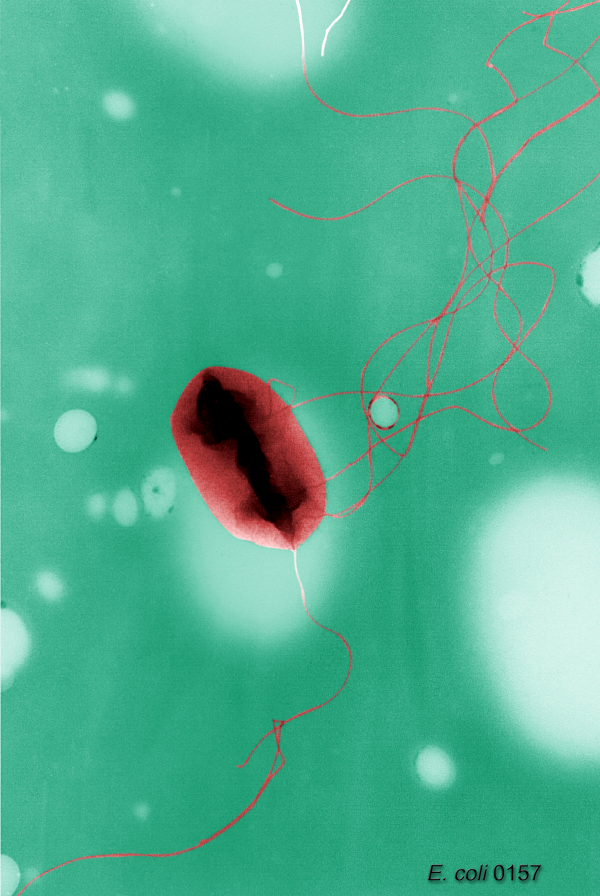
Image source: Wikipedia/Wikimedia
| Ecology, Host, and Life Cycle | |
|---|---|
| Oxygen requirements | Facultative anaerobe |
| Optimal temperature | 37 |
| Temperature range | Mesophilic |
| Habitat | HostAssociated |
| Biotic relationship | Free living |
| Host(s) | Homo sapiens, Gallus gallus, Bos taurus |
| Cell arrangement | Pairs - Singles |
| Sporulation | Not Available |
| Energy source | Not Available |
| Pathogenicity | Human |
Genome Summary
Escherichia coli O157:H7 strain FWSEC0004 plasmid unnamed13,
Gene Summary
Adenine Count
24897 bp
Thymine Count
23755 bp
Guanine Count
23849 bp
Cytosine Count
20253 bp
Genome Length
92754 bp
Protein-coding Genes
97 genes
Non-Coding Genes
0 genes
# of Chromosomes/Plasmids
3
Genes
| Name | Locus Tag | UniProt ID | Strand Orientation | Gene Start/End | Protein Molecular Weight |
|---|---|---|---|---|---|
| marr family transcriptional regulator | CAM50_RS28655 | Not Available | Positive | 43679 - 43963 | 11030.4 |
| hypothetical protein | CAM50_RS27605 | Not Available | Positive | 44132 - 44362 | 8978.82 |
| tyrosine-type recombinase/integrase | CAM50_RS27610 | Not Available | Positive | 44483 - 45223 | 28225.5 |
| repb family plasmid replication initiator protein | CAM50_RS27615 | Not Available | Negative | 45508 - 46485 | 37238.0 |
| hypothetical protein | CAM50_RS27625 | Not Available | Negative | 46893 - 47093 | 7619.05 |
| hypothetical protein | CAM50_RS27630 | Not Available | Negative | 47090 - 47710 | 23740.7 |
| hypothetical protein | CAM50_RS28945 | Not Available | Negative | 47921 - 48130 | 7327.56 |
| dna-binding protein | CAM50_RS28950 | Not Available | Negative | 48164 - 48325 | 5598.7 |
| type ii toxin-antitoxin system antitoxin ccda | CAM50_RS27640 | Not Available | Positive | 48868 - 49086 | 8372.8 |
| type ii toxin-antitoxin system toxin ccdb | CAM50_RS27645 | Not Available | Positive | 49088 - 49393 | 11707.2 |
Pathways
12367 pathways
Health Effects
| Health Condition | Relation | Reference |
|---|---|---|
| Gi disease | Causes | PMC11149725 |
| Utis | Causes | PMC11434687 |
| Colorectal cancer | Causes | PMC12198655 |
| Pyogenic liver abscesses | Causes | PMC12392612 |
| Uti | Causes | PMC13014981 |
| Colibacillosis | Causes | PMC13255289 |
| Enteric infections | Causes | PMC13255289 |
| Foodborne infections | Causes | PMC13255289 |
| Clinical mastitis | Causes | PMC13293316 |
| Diarrhea | Causes | PMC3035056 |