Kingdom
Pseudomonadati
Phylum
Pseudomonadota
Class
Gammaproteobacteria
Order
Enterobacterales
Family
Enterobacteriaceae
Genus
Escherichia
Description
Taxonomy
| Kingdom | Pseudomonadati |
|---|---|
| Phylum | Pseudomonadota |
| Class | Gammaproteobacteria |
| Order | Enterobacterales |
| Family | Enterobacteriaceae |
| Genus | Escherichia |
| Species | Escherichia coli |
| Strain | O157:H7 |
Profile
| Physiology | |
|---|---|
| Gram staining properties | Negative |
| Shape | Rod |
| Mobility | Yes |
| Flagellar presence | Yes |
| Number of membranes | 2 |

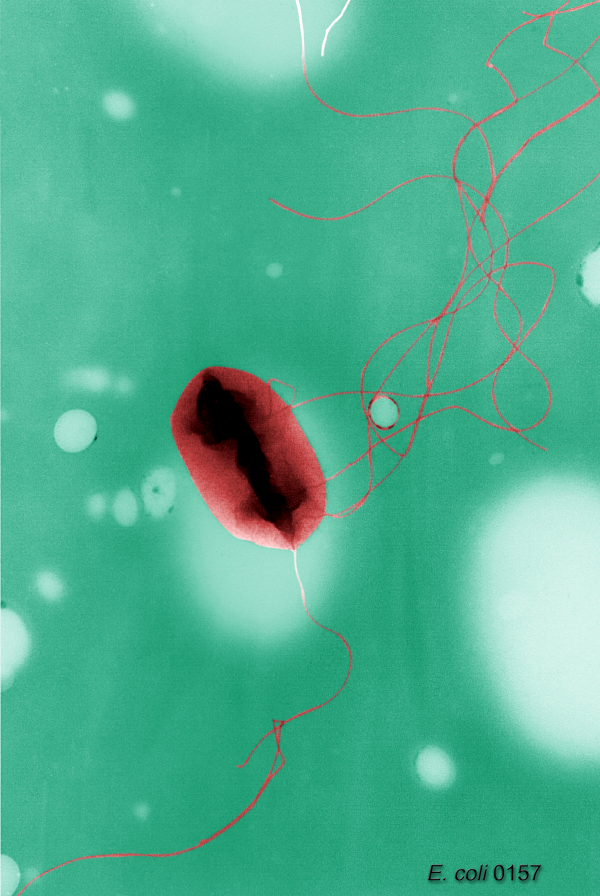
Image source: Wikipedia/Wikimedia
| Ecology, Host, and Life Cycle | |
|---|---|
| Oxygen requirements | Facultative anaerobe |
| Optimal temperature | 37 |
| Temperature range | Mesophilic |
| Habitat | HostAssociated |
| Biotic relationship | Free living |
| Host(s) | Homo sapiens, Gallus gallus, Bos taurus |
| Cell arrangement | Pairs - Singles |
| Sporulation | Not Available |
| Energy source | Not Available |
| Pathogenicity | Human |
Genome Summary
Escherichia coli O157:H7 strain PA20 chromosome, complete genome.
Gene Summary
Adenine Count
1364141 bp
Thymine Count
1368117 bp
Guanine Count
1400977 bp
Cytosine Count
1392611 bp
Genome Length
5525846 bp
Protein-coding Genes
4581 genes
Non-Coding Genes
1004 genes
# of Chromosomes/Plasmids
3
Genes
| Name | Locus Tag | UniProt ID | Strand Orientation | Gene Start/End | Protein Molecular Weight |
|---|---|---|---|---|---|
| incfii family plasmid replication initiator repa | CAM50_RS27370 | Not Available | Positive | 1 - 858 | 32717.6 |
| copg family ribbon-helix-helix protein | CAM50_RS27385 | Not Available | Positive | 1771 - 2055 | 10475.5 |
| type ii toxin-antitoxin system rele/pare family toxin | CAM50_RS27390 | Not Available | Positive | 2055 - 2330 | 10736.0 |
| hypothetical protein | CAM50_RS27395 | Not Available | Positive | 2425 - 2631 | 8001.41 |
| conjugative transfer relaxase/helicase trai domain-containing protein | CAM50_RS27400 | Not Available | Negative | 2731 - 2946 | 8215.67 |
| conjugative transfer relaxase/helicase trai domain-containing protein | CAM50_RS27405 | Not Available | Negative | 2990 - 3556 | 21523.5 |
| conjugative transfer relaxase/helicase trai domain-containing protein | CAM50_RS27410 | Not Available | Negative | 3556 - 3972 | 16036.6 |
| hypothetical protein | CAM50_RS27415 | Not Available | Negative | 3972 - 4157 | 6876.23 |
| catalase/peroxidase katp | CAM50_RS27420 | Not Available | Positive | 4334 - 6544 | 81798.5 |
| cytochrome b562 | CAM50_RS27425 | Not Available | Positive | 6588 - 6977 | 14582.7 |
Pathways
12367 pathways
Health Effects
| Health Condition | Relation | Reference |
|---|---|---|
| Gi disease | Causes | PMC11149725 |
| Utis | Causes | PMC11434687 |
| Colorectal cancer | Causes | PMC12198655 |
| Pyogenic liver abscesses | Causes | PMC12392612 |
| Uti | Causes | PMC13014981 |
| Colibacillosis | Causes | PMC13255289 |
| Enteric infections | Causes | PMC13255289 |
| Foodborne infections | Causes | PMC13255289 |
| Clinical mastitis | Causes | PMC13293316 |
| Diarrhea | Causes | PMC3035056 |