Kingdom
Pseudomonadati
Phylum
Campylobacterota
Class
Epsilonproteobacteria
Order
Campylobacterales
Family
Helicobacteraceae
Genus
Helicobacter
Description
Taxonomy
| Kingdom | Pseudomonadati |
|---|---|
| Phylum | Campylobacterota |
| Class | Epsilonproteobacteria |
| Order | Campylobacterales |
| Family | Helicobacteraceae |
| Genus | Helicobacter |
| Species | Helicobacter pylori |
| Strain | 173/00 |
Profile
| Physiology | |
|---|---|
| Gram staining properties | Negative |
| Shape | Spirilla |
| Mobility | No |
| Flagellar presence | Yes |
| Number of membranes | 2 |

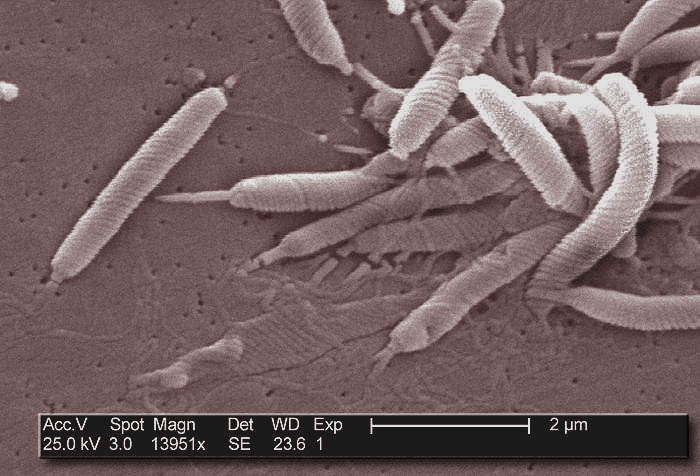
Image source: Wikipedia/Wikimedia
| Ecology, Host, and Life Cycle | |
|---|---|
| Oxygen requirements | Microaerophilic |
| Optimal temperature | 37 |
| Temperature range | Mesophilic |
| Habitat | HostAssociated |
| Biotic relationship | Free living |
| Host(s) | Homo sapiens, Gallus gallus, Aves |
| Cell arrangement | Singles |
| Sporulation | Not Available |
| Energy source | Not Available |
| Pathogenicity | Human |
Genome Summary
Helicobacter pylori strain 173/00 Contig79, whole genome shotgun
Gene Summary
Adenine Count
Not Available
Thymine Count
Not Available
Guanine Count
Not Available
Cytosine Count
Not Available
Genome Length
Not Available
Protein-coding Genes
1438 genes
Non-Coding Genes
41 genes
# of Chromosomes/Plasmids
2
Genes
| Name | Locus Tag | UniProt ID | Strand Orientation | Gene Start/End | Protein Molecular Weight |
|---|---|---|---|---|---|
| carbon storage regulator | HPY173_07415 | Not Available | Positive | 1516562 - 1516792 | 8396.29 |
| 4-diphosphocytidyl-2c-methyl-d-erythritol kinase | HPY173_07420 | Not Available | Positive | 1516792 - 1517595 | 29984.1 |
| single-stranded dna-binding protein | HPY173_07425 | Not Available | Positive | 1517592 - 1517887 | 11553.2 |
| hypothetical protein | HPY173_07430 | Not Available | Negative | 1517888 - 1518330 | 16896.2 |
| hypothetical protein | HPY173_07435 | Not Available | Negative | 1518327 - 1518758 | 16827.1 |
| hypothetical protein | HPY173_07440 | Not Available | Negative | 1518762 - 1520818 | 78284.6 |
| catalase | HPY173_07445 | Not Available | Positive | 1521043 - 1522560 | 58652.1 |
| tat pathway signal protein | HPY173_07450 | Not Available | Positive | 1522705 - 1523580 | 32726.1 |
| membrane protein | HPY173_07455 | Not Available | Positive | 1523667 - 1523882 | 8691.05 |
| hypothetical protein | HPY173_07460 | Not Available | Negative | 1523934 - 1524263 | 12197.6 |
Pathways
1109 pathways
Health Effects
| Health Condition | Relation | Reference |
|---|---|---|
| Chronic gastric inflammation | Causes | PMC10226649 |
| Gastric cancer | Causes | PMC10226649 |
| Gastric ulcers | Causes | PMC10420633 |
| Stomach carcinoma | Causes | PMC10420633 |
| Ulcers | Causes | PMC10420633 |
| Adenocarcinoma | Causes | PMC10420633 |
| Mucosa-associated lymphoid tissue lymphoma | Causes | PMC10420633 |
| Gerd | Causes | PMC10712878 |
| Gastritis | Causes | PMC10712878 |
| Gastric cancer | Causes | PMC10732068 |