
Kingdom
Pseudomonadati
Phylum
Pseudomonadota
Class
Gammaproteobacteria
Order
Pseudomonadales
Family
Pseudomonadaceae
Genus
Pseudomonas
Description
Taxonomy
| Kingdom | Pseudomonadati |
|---|---|
| Phylum | Pseudomonadota |
| Class | Gammaproteobacteria |
| Order | Pseudomonadales |
| Family | Pseudomonadaceae |
| Genus | Pseudomonas |
| Species | Pseudomonas aeruginosa |
| Strain | PRD-10 |
Profile
| Physiology | |
|---|---|
| Gram staining properties | Negative |
| Shape | Rod |
| Mobility | Yes |
| Flagellar presence | Yes |
| Number of membranes | Not Available |
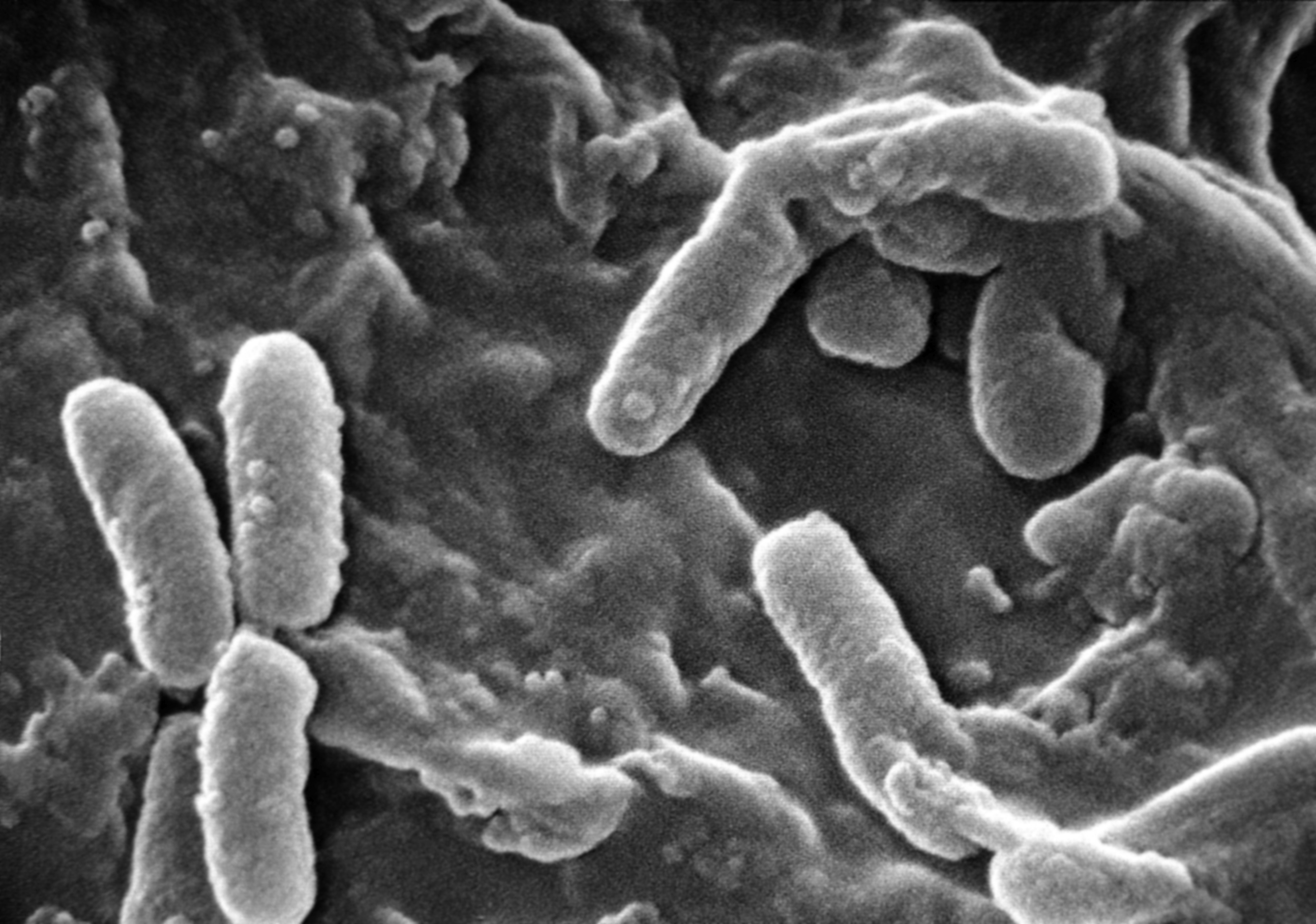
Image source: Wikipedia/Wikimedia
| Ecology, Host, and Life Cycle | |
|---|---|
| Oxygen requirements | Aerobe |
| Optimal temperature | 25 |
| Temperature range | Mesophilic |
| Habitat | Not Available |
| Biotic relationship | Free living |
| Host(s) | Not Available |
| Cell arrangement | Singles |
| Sporulation | Not Available |
| Energy source | Heterotroph |
| Pathogenicity | Not Available |
Gene Summary
Adenine Count
1152339 bp
Thymine Count
1152954 bp
Guanine Count
2253469 bp
Cytosine Count
2252827 bp
Genome Length
6811689 bp
Protein-coding Genes
6206 genes
Non-Coding Genes
406 genes
# of Chromosomes/Plasmids
1
Genes
| Name | Locus Tag | UniProt ID | Strand Orientation | Gene Start/End | Protein Molecular Weight |
|---|---|---|---|---|---|
| non-ribosomal peptide synthetase | FA030_11710 | P0C064 | Positive | 2410121 - 2416594 | 240211.0 |
| amino acid adenylation domain-containing protein | FA030_11715 | O30409 | Positive | 2416606 - 2423952 | 273725.0 |
| tonb-dependent siderophore receptor | FA030_11720 | P48632 | Negative | 2424116 - 2426563 | 91171.9 |
| pyoverdine export abc transporter pvde | FA030_11725 | P33951 | Negative | 2426666 - 2428315 | 60913.2 |
| n(5)-hydroxyornithine transformylase pvdf | FA030_11730 | Q5HH12 | Positive | 2428693 - 2429520 | 31040.8 |
| formylglycine-generating enzyme family protein | FA030_11735 | Q8R0F3 | Negative | 2429589 - 2430443 | 31039.1 |
| aminotransferase class v-fold plp-dependent enzyme | FA030_11740 | P18549 | Negative | 2430472 - 2431755 | 47984.3 |
| membrane dipeptidase | FA030_11745 | M1VV65 | Negative | 2431778 - 2433124 | 49365.1 |
| twin-arginine translocation signal domain-containing protein | FA030_11750 | Not Available | Positive | 2433340 - 2434974 | 62244.4 |
| pyoverdine export/recycling transporter outer membrane subunit ompq | FA030_11755 | P0C071 | Negative | 2435023 - 2436447 | 51283.5 |
Pathways
0 pathways
No pathways found
No metabolic pathways have been associated with this bacterium yet.
Health Effects
No health effects information available for this bacterium.


