
Kingdom
Pseudomonadati
Phylum
Pseudomonadota
Class
Gammaproteobacteria
Order
Pasteurellales
Family
Pasteurellaceae
Genus
Actinobacillus
Description
Taxonomy
| Kingdom | Pseudomonadati |
|---|---|
| Phylum | Pseudomonadota |
| Class | Gammaproteobacteria |
| Order | Pasteurellales |
| Family | Pasteurellaceae |
| Genus | Actinobacillus |
| Species | Actinobacillus suis |
| Strain | 1276/61 |
Profile
| Physiology | |
|---|---|
| Gram staining properties | Not Available |
| Shape | Rod |
| Mobility | Not Available |
| Flagellar presence | Yes |
| Number of membranes | Not Available |
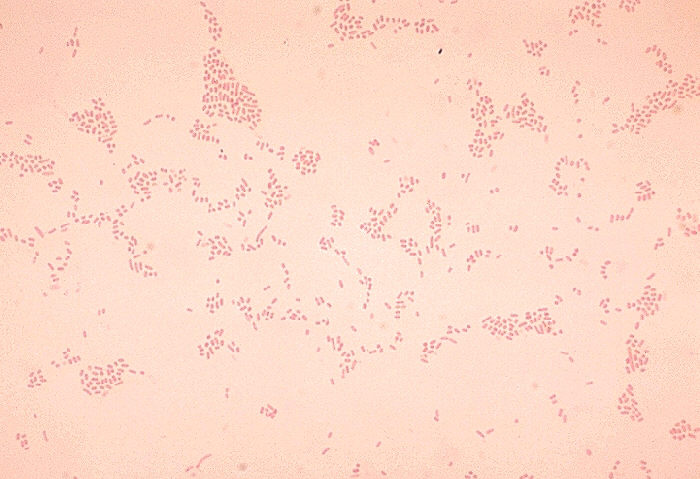
Image source: Wikipedia/Wikimedia
| Ecology, Host, and Life Cycle | |
|---|---|
| Oxygen requirements | microaerophile |
| Optimal temperature | Not Available |
| Temperature range | Not Available |
| Habitat | Not Available |
| Biotic relationship | Not Available |
| Host(s) | Not Available |
| Cell arrangement | Not Available |
| Sporulation | Not Available |
| Energy source | Not Available |
| Pathogenicity | Not Available |
Gene Summary
Adenine Count
747767 bp
Thymine Count
747809 bp
Guanine Count
503069 bp
Cytosine Count
502953 bp
Genome Length
2501598 bp
Protein-coding Genes
2229 genes
Non-Coding Genes
103 genes
# of Chromosomes/Plasmids
2
Genes
| Name | Locus Tag | UniProt ID | Strand Orientation | Gene Start/End | Protein Molecular Weight |
|---|---|---|---|---|---|
| 1-deoxy-d-xylulose 5-phosphate reductoisomerase | SAMEA4504061_01087 | B0BTR0 | Negative | 1154722 - 1155912 | 42920.3 |
| gtp pyrophosphokinase | SAMEA4504061_01088 | P44644 | Negative | 1155983 - 1158190 | 83459.6 |
| glutamyl-trna reductase | SAMEA4504061_01089 | B3H0R8 | Positive | 1158522 - 1159832 | 49339.1 |
| putative oxidoreductase | SAMEA4504061_01090 | P96651 | Negative | 1159965 - 1160954 | 36843.7 |
| gtp-binding protein enga | SAMEA4504061_01091 | A3MZC1 | Positive | 1161155 - 1162672 | 55947.8 |
| bifunctional heptose 7-phosphate kinase/heptose 1-phosphate adenyltransferase | SAMEA4504061_01092 | A3MZC0 | Positive | 1162783 - 1164213 | 51772.1 |
| bifunctional pyrimidine regulatory protein pyrr uracil phosphoribosyltransferase | SAMEA4504061_01093 | A3MZB9 | Positive | 1164229 - 1164768 | 20456.6 |
| peptidyl-prolyl cis-trans isomerase sura | SAMEA4504061_01094 | P44721 | Positive | 1164853 - 1165797 | 34396.0 |
| dimethyladenosine transferase | SAMEA4504061_01095 | A3MZB7 | Positive | 1165851 - 1166720 | 33188.1 |
| uracil phosphoribosyltransferase | SAMEA4504061_01096 | A3MZB6 | Negative | 1166845 - 1167471 | 22521.7 |
Pathways
0 pathways
No pathways found
No metabolic pathways have been associated with this bacterium yet.
Health Effects
No health effects information available for this bacterium.

