
Kingdom
Pseudomonadati
Phylum
Pseudomonadota
Class
Gammaproteobacteria
Order
Pasteurellales
Family
Pasteurellaceae
Genus
Actinobacillus
Description
Taxonomy
| Kingdom | Pseudomonadati |
|---|---|
| Phylum | Pseudomonadota |
| Class | Gammaproteobacteria |
| Order | Pasteurellales |
| Family | Pasteurellaceae |
| Genus | Actinobacillus |
| Species | Actinobacillus suis |
| Strain | 1276/61 |
Profile
| Physiology | |
|---|---|
| Gram staining properties | Not Available |
| Shape | Rod |
| Mobility | Not Available |
| Flagellar presence | Yes |
| Number of membranes | Not Available |
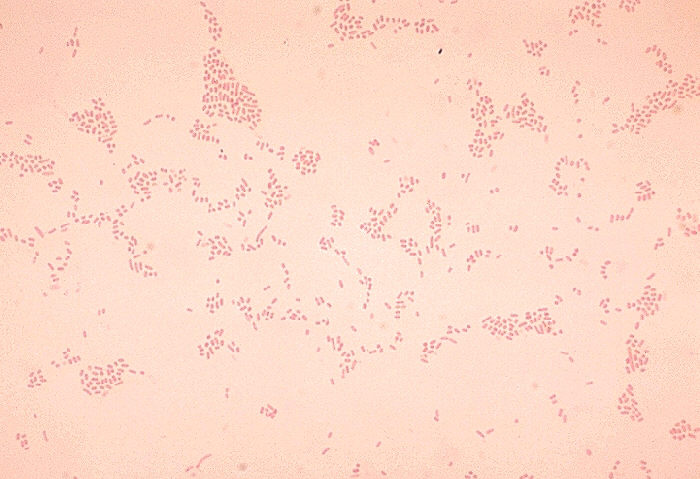
Image source: Wikipedia/Wikimedia
| Ecology, Host, and Life Cycle | |
|---|---|
| Oxygen requirements | microaerophile |
| Optimal temperature | Not Available |
| Temperature range | Not Available |
| Habitat | Not Available |
| Biotic relationship | Not Available |
| Host(s) | Not Available |
| Cell arrangement | Not Available |
| Sporulation | Not Available |
| Energy source | Not Available |
| Pathogenicity | Not Available |
Gene Summary
Adenine Count
747767 bp
Thymine Count
747809 bp
Guanine Count
503069 bp
Cytosine Count
502953 bp
Genome Length
2501598 bp
Protein-coding Genes
2229 genes
Non-Coding Genes
103 genes
# of Chromosomes/Plasmids
2
Genes
| Name | Locus Tag | UniProt ID | Strand Orientation | Gene Start/End | Protein Molecular Weight |
|---|---|---|---|---|---|
| outer membrane lipoprotein | SAMEA4504061_00431 | Q08868 | Positive | 468009 - 468824 | 29219.7 |
| outer membrane lipoprotein 2 | SAMEA4504061_00432 | Q08869 | Positive | 468939 - 469757 | 29841.8 |
| dl-methionine transporter substrate-binding subunit/outer membrane lipoprotein 3 (plp3) | SAMEA4504061_00433 | Q08870 | Positive | 469831 - 469947 | 4109.2 |
| dl-methionine transporter substrate-binding subunit/outer membrane lipoprotein 3 (plp3) | SAMEA4504061_00434 | Q08870 | Positive | 469963 - 470754 | 29101.1 |
| putative transcriptional regulator | SAMEA4504061_00435 | Q01610 | Negative | 470794 - 471678 | 33516.8 |
| alpha/beta fold family hydrolase | SAMEA4504061_00436 | Q01609 | Positive | 471837 - 472985 | 41659.0 |
| acetyltransferase | SAMEA4504061_00437 | P37515 | Positive | 473069 - 473644 | 20701.1 |
| uncharacterized conserved protein | SAMEA4504061_00438 | Not Available | Positive | 473634 - 474041 | 15335.7 |
| 3-deoxy-d-manno-octulosonic-acid kinase | SAMEA4504061_00439 | A6VQT5 | Negative | 474121 - 474825 | 27486.0 |
| gtp cyclohydrolase i | SAMEA4504061_00440 | A3N0R3 | Positive | 474926 - 475582 | 24873.0 |
Pathways
0 pathways
No pathways found
No metabolic pathways have been associated with this bacterium yet.
Health Effects
No health effects information available for this bacterium.

