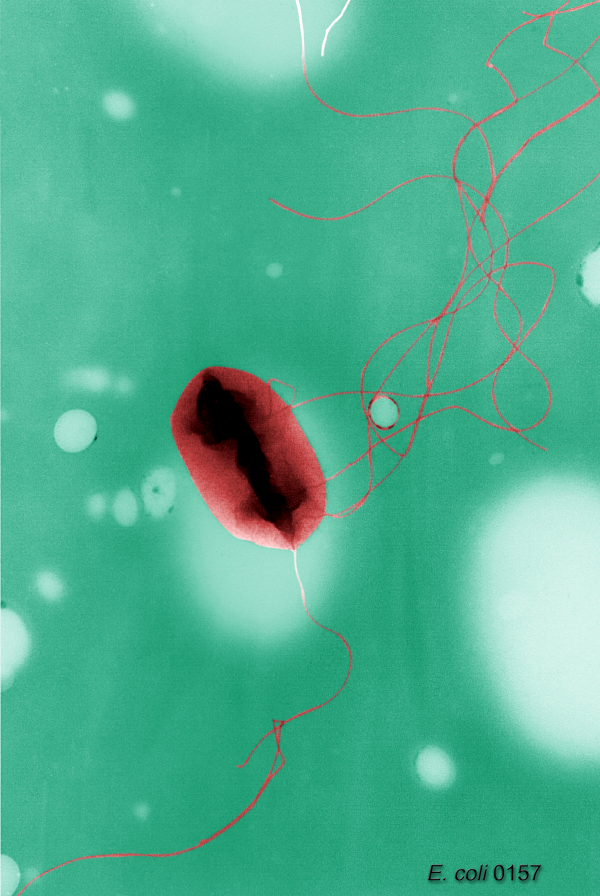
Escherichia coli Crooks, Crookes

Gram-negativeRod

Kingdom

Pseudomonadati

Phylum

Pseudomonadota

Class

Gammaproteobacteria

Order

Enterobacterales

Family

Enterobacteriaceae

Genus

Escherichia

Description

Escherichia coli Crooks, Crookes is a Gram-negative, rod-shaped bacterium that possesses flagella, allowing for motility. This species thrives optimally at 37°C, placing it within a mesophilic temperature range, which is characteristic of many bacteria that inhabit warm-blooded hosts, including humans. E. coli Crooks, Crookes is noted for its free-living biotic relationship, indicating that it does not rely on a host organism for survival. This trait is significant as it suggests a versatile ecological role, potentially contributing to nutrient cycling in various environments. The organism has multiple replicons, specifically five, which may play a role in its genetic diversity and adaptability. This genetic characteristic can provide insights into the evolutionary mechanisms that allow E. coli to thrive in different ecological niches and respond to environmental stresses. The available genomic accessions for E. coli Crooks, Crookes—CP043852.1, CP043851.1, CP022959.1, CP000946.1, and CP033020.1—indicate a rich source of genetic information that could facilitate further research into its biology, ecology, and potential applications in biotechnology. In conclusion, the traits of E. coli Crooks, Crookes, including its Gram-negative status, rod shape, flagella presence, optimal temperature, and free-living nature, highlight its role in microbial ecosystems and its potential for further study in diverse biological contexts.

Taxonomy

KingdomPseudomonadati
PhylumPseudomonadota
ClassGammaproteobacteria
OrderEnterobacterales
FamilyEnterobacteriaceae
GenusEscherichia
SpeciesEscherichia coli
StrainCrooks, Crookes

Profile

Physiology
Gram staining propertiesNegative
ShapeRod
MobilityNot Available
Flagellar presenceYes
Number of membranesNot Available
Image of Escherichia coli Crooks, Crookes
Image source: Wikipedia/Wikimedia
Ecology, Host, and Life Cycle
Oxygen requirementsNot Available
Optimal temperature37
Temperature rangeMesophilic
HabitatNot Available
Biotic relationshipFree living
Host(s)Not Available
Cell arrangementNot Available
SporulationNot Available
Energy sourceNot Available
PathogenicityNot Available

Genome Summary

Escherichia coli Crooks, Crookes, Complete Genome

Gene Summary

Adenine Count

1185288 bp

Thymine Count

1181229 bp

Guanine Count

1215742 bp

Cytosine Count

1222053 bp

Genome Length

4804312 bp

Protein-coding Genes

4380 genes

Non-Coding Genes

276 genes

# of Chromosomes/Plasmids

5

Genes

NameLocus TagUniProt IDStrand OrientationGene Start/EndProtein Molecular Weight
2',3'-cyclic-nucleotide 2'-phosphodiesteraseD9Q99_20115P08331Positive4148229 - 415017270816.9
transcriptional regulatorD9Q99_20120P0ACN2Negative4150295 - 415067514076.0
sdr family oxidoreductaseD9Q99_20125P39315Positive4150764 - 415162429898.5
dmt family transporterD9Q99_20130P39314Positive4151733 - 415269835251.6
iron-sulfur cluster repair protein ytfeD9Q99_20135A7ZV87Positive4152806 - 415346824884.1
d-serine/d-alanine/glycine transporterD9Q99_20140P0AAE1Negative4153513 - 415492551662.6
peptidylprolyl isomeraseD9Q99_20145P0A9L3Negative4155234 - 415585422216.5
peptidylprolyl isomeraseD9Q99_20150Not AvailableNegative4155868 - 41560145494.88
hypothetical proteinD9Q99_20155P39310Positive4156073 - 415671123520.9
tetr/acrr family transcriptional regulatorD9Q99_20160P39309Negative4156695 - 415734224757.7

Displaying genes 18011 – 18020 of 18552 in total

Pathways

0 pathways

No pathways found

No metabolic pathways have been associated with this bacterium yet.

Metabolites

4785 records
Metabolite IDMetabolite nameStructureCAS number
BASm0000173(R)-3-Hydroxybutyric acidC4H8O3Chemical structure of (R)-3-Hydroxybutyric acid625-72-3
Average104.0473Da
Monoisotopic104.047344122Da
BASm0000217alpha-ribazoleC14H18N2O4Chemical structure of alpha-ribazoleNot available
Average278.3037Da
Monoisotopic278.126657074Da
BASm0000237(R)-4'-phosphopantothenateC9H18NO8PChemical structure of (R)-4'-phosphopantothenateNot available
Average299.2149Da
Monoisotopic299.0770031Da
BASm0000238(R)-3-phenyllactateC9H9O3Chemical structure of (R)-3-phenyllactateNot available
Average165.169Da
Monoisotopic165.05571773Da
BASm00002482,3-dihydroxy-3-methylbutanoateC5H10O4Chemical structure of 2,3-dihydroxy-3-methylbutanoate1756-18-9
Average134.1305Da
Monoisotopic134.0579088Da
BASm00002502,5-didehydro-D-gluconateC6H7O7Chemical structure of 2,5-didehydro-D-gluconate53736-12-2
Average191.1156Da
Monoisotopic191.019177578Da
BASm00002512-dehydropantoateC6H9O4Chemical structure of 2-dehydropantoateNot available
Average145.1333Da
Monoisotopic145.050083776Da
BASm00002532-oxopent-4-enoateC5H5O3Chemical structure of 2-oxopent-4-enoateNot available
Average113.093Da
Monoisotopic113.024417601Da
BASm00002593alpha,12alpha-dihydroxy-7-oxo-5beta-cholanateC24H37O5Chemical structure of 3alpha,12alpha-dihydroxy-7-oxo-5beta-cholanateNot available
Average405.556Da
Monoisotopic405.264647871Da
BASm00002603alpha,7alpha-dihydroxy-12-oxo-5beta-cholanateC24H37O5Chemical structure of 3alpha,7alpha-dihydroxy-12-oxo-5beta-cholanateNot available
Average405.556Da
Monoisotopic405.264647871Da

Displaying 1–10 of 4785 metabolites

Health Effects

No health effects information available for this bacterium.