
Kingdom
Pseudomonadati
Phylum
Pseudomonadota
Class
Betaproteobacteria
Order
Burkholderiales
Family
Alcaligenaceae
Genus
Taylorella
Description
Taxonomy
| Kingdom | Pseudomonadati |
|---|---|
| Phylum | Pseudomonadota |
| Class | Betaproteobacteria |
| Order | Burkholderiales |
| Family | Alcaligenaceae |
| Genus | Taylorella |
| Species | Taylorella equigenitalis |
| Strain | 61717/77 |
Profile
| Physiology | |
|---|---|
| Gram staining properties | Negative |
| Shape | Cocci |
| Mobility | No |
| Flagellar presence | Yes |
| Number of membranes | Not Available |
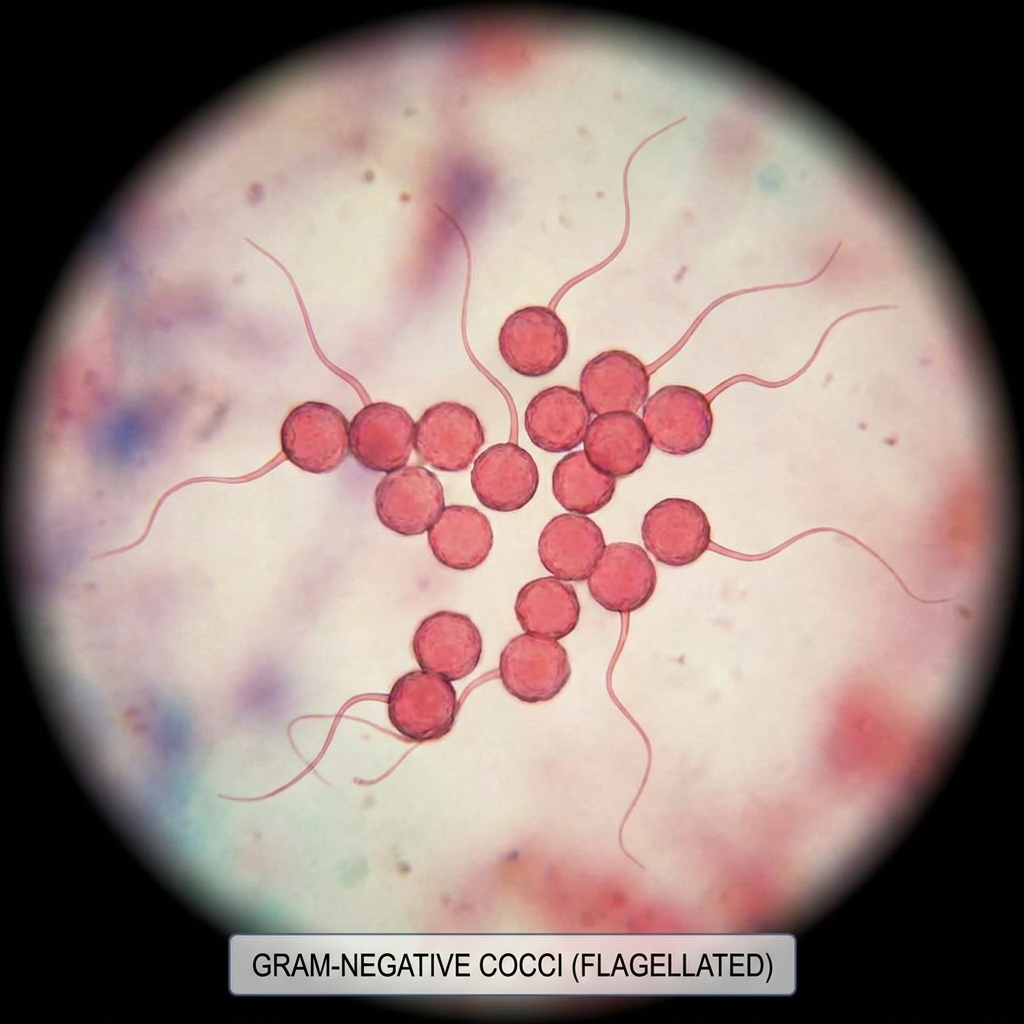
AI-generated image based on bacteria physiology
| Ecology, Host, and Life Cycle | |
|---|---|
| Oxygen requirements | Microaerophilic |
| Optimal temperature | Not Available |
| Temperature range | Mesophilic |
| Habitat | Not Available |
| Biotic relationship | Free living |
| Host(s) | Equidae |
| Cell arrangement | Not Available |
| Sporulation | Not Available |
| Energy source | Not Available |
| Pathogenicity | Not Available |
Gene Summary
Adenine Count
543781 bp
Thymine Count
541559 bp
Guanine Count
325304 bp
Cytosine Count
321599 bp
Genome Length
1732243 bp
Protein-coding Genes
1577 genes
Non-Coding Genes
48 genes
# of Chromosomes/Plasmids
2
Genes
| Name | Locus Tag | UniProt ID | Strand Orientation | Gene Start/End | Protein Molecular Weight |
|---|---|---|---|---|---|
| glutaredoxin-3 | NCTC11184_00121 | P0AC64 | Negative | 114763 - 115116 | 12260.3 |
| molybdopterin biosynthesis protein moeb | NCTC11184_00122 | P0AG29 | Negative | 115119 - 115535 | 15161.4 |
| 2,3-bisphosphoglycerate-dependent phosphoglycerate mutase | NCTC11184_00123 | A9IFJ0 | Positive | 115627 - 116373 | 28397.8 |
| septal ring factor | NCTC11184_00124 | P37690 | Positive | 116373 - 117971 | 59842.7 |
| carboxy-terminal processing protease ctpb precursor | NCTC11184_00125 | Q44879 | Positive | 117973 - 119535 | 57355.5 |
| molybdopterin-synthase adenylyltransferase | NCTC11184_00126 | P12282 | Positive | 119516 - 120424 | 33012.2 |
| extracytoplasmic solute receptor protein yiao | NCTC11184_00127 | A1WPV4 | Positive | 120421 - 121392 | 36346.0 |
| predicted protease with the c-terminal pdz domain | NCTC11184_00128 | Not Available | Negative | 121348 - 123144 | 67770.2 |
| atp synthase i chain | NCTC11184_00129 | Not Available | Positive | 123248 - 123658 | 15409.5 |
| f-atpase subunit 6 | NCTC11184_00130 | A9HY34 | Positive | 123687 - 124568 | 31890.6 |
Pathways
0 pathways
No pathways found
No metabolic pathways have been associated with this bacterium yet.
Health Effects
| Health Condition | Relation | Reference |
|---|---|---|
| Contagious equine metritis | Causes | PMC13474744 |
| Cem | Causes | PMC13474744 |
| Contagious equine metritis (cem) | Causes | PMC13474744 |