
Kingdom
Pseudomonadati
Phylum
Spirochaetota
Class
Spirochaetia
Order
Treponematales
Family
Treponemataceae
Genus
Treponema
Description
Taxonomy
| Kingdom | Pseudomonadati |
|---|---|
| Phylum | Spirochaetota |
| Class | Spirochaetia |
| Order | Treponematales |
| Family | Treponemataceae |
| Genus | Treponema |
| Species | Treponema peruense |
| Strain | No strain |
Profile
| Physiology | |
|---|---|
| Gram staining properties | Negative |
| Shape | Spirilla |
| Mobility | Not Available |
| Flagellar presence | Yes |
| Number of membranes | Not Available |
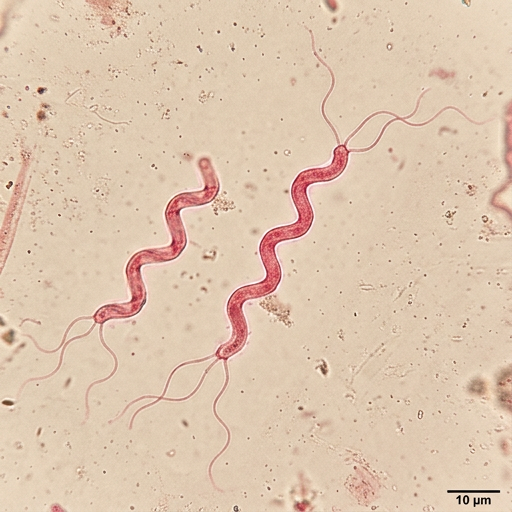
AI-generated image based on bacteria physiology
| Ecology, Host, and Life Cycle | |
|---|---|
| Oxygen requirements | Not Available |
| Optimal temperature | Not Available |
| Temperature range | Not Available |
| Habitat | Not Available |
| Biotic relationship | Not Available |
| Host(s) | Homo sapiens |
| Cell arrangement | Not Available |
| Sporulation | Not Available |
| Energy source | Not Available |
| Pathogenicity | Not Available |
Gene Summary
Adenine Count
801821 bp
Thymine Count
806995 bp
Guanine Count
562622 bp
Cytosine Count
566628 bp
Genome Length
2738066 bp
Protein-coding Genes
2406 genes
Non-Coding Genes
102 genes
# of Chromosomes/Plasmids
1
Genes
| Name | Locus Tag | UniProt ID | Strand Orientation | Gene Start/End | Protein Molecular Weight |
|---|---|---|---|---|---|
| chemotaxis protein chew | IWA51_00315 | Not Available | Positive | 64672 - 65097 | 16015.1 |
| hypothetical protein | IWA51_00320 | Not Available | Positive | 65084 - 65470 | 14496.6 |
| hypothetical protein | IWA51_00325 | Q9WYN9 | Positive | 65467 - 66498 | 36748.3 |
| hypothetical protein | IWA51_00330 | Q9KS61 | Positive | 66495 - 67883 | 53195.3 |
| response regulator | IWA51_00335 | O25153 | Positive | 67870 - 69945 | 78035.5 |
| guanylate cyclase | IWA51_00340 | P40137 | Positive | 69935 - 71770 | 69256.1 |
| hypothetical protein | IWA51_00345 | P43500 | Positive | 71778 - 73553 | 65435.3 |
| hypothetical protein | IWA51_00350 | P43500 | Positive | 73556 - 75364 | 67125.4 |
| hypothetical protein | IWA51_00355 | Not Available | Positive | 75444 - 76691 | 48300.3 |
| bifunctional hydroxymethylpyrimidine kinase/phosphomethylpyrimidine kinase | IWA51_00360 | P44697 | Negative | 76733 - 77530 | 27408.1 |
Pathways
0 pathways
No pathways found
No metabolic pathways have been associated with this bacterium yet.
Health Effects
No health effects information available for this bacterium.
