Kingdom
Pseudomonadati
Phylum
Pseudomonadota
Class
Betaproteobacteria
Order
Burkholderiales
Family
Oxalobacteraceae
Genus
Massilia
Description
Taxonomy
| Kingdom | Pseudomonadati |
|---|---|
| Phylum | Pseudomonadota |
| Class | Betaproteobacteria |
| Order | Burkholderiales |
| Family | Oxalobacteraceae |
| Genus | Massilia |
| Species | Massilia antarctica |
| Strain | P8398 |
Profile
| Physiology | |
|---|---|
| Gram staining properties | Gram-negative |
| Shape | rod |
| Mobility | Not Available |
| Flagellar presence | Not Available |
| Number of membranes | Not Available |

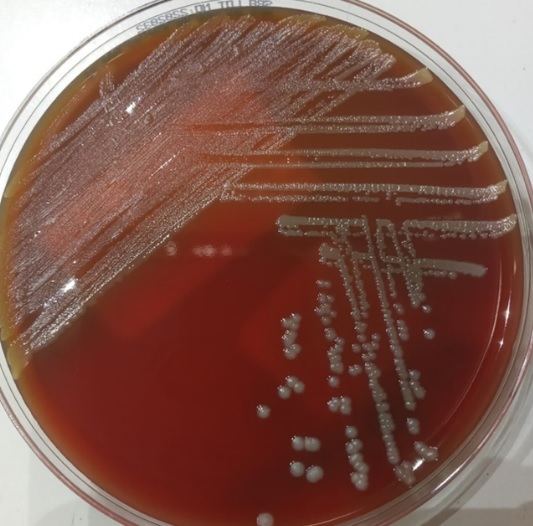
Image source: Wikipedia/Wikimedia
| Ecology, Host, and Life Cycle | |
|---|---|
| Oxygen requirements | Not Available |
| Optimal temperature | Not Available |
| Temperature range | Not Available |
| Habitat | Not Available |
| Biotic relationship | Not Available |
| Host(s) | Not Available |
| Cell arrangement | Not Available |
| Sporulation | Not Available |
| Energy source | Not Available |
| Pathogenicity | Not Available |
Gene Summary
Adenine Count
1351388 bp
Thymine Count
1340499 bp
Guanine Count
2369260 bp
Cytosine Count
2371258 bp
Genome Length
7432405 bp
Protein-coding Genes
6364 genes
Non-Coding Genes
147 genes
# of Chromosomes/Plasmids
1
Genes
| Name | Locus Tag | UniProt ID | Strand Orientation | Gene Start/End | Protein Molecular Weight |
|---|---|---|---|---|---|
| polyphosphate kinase 1 | IV454_19890 | Q9JXS9 | Negative | 4466434 - 4468536 | 78881.2 |
| phosphate abc transporter substrate-binding protein psts | IV454_19895 | Q9CNJ4 | Positive | 4468768 - 4469811 | 36516.7 |
| phosphate abc transporter permease subunit pstc | IV454_19900 | P0AGH9 | Positive | 4469959 - 4470972 | 35981.5 |
| phosphate abc transporter permease psta | IV454_19905 | P58655 | Positive | 4470969 - 4471829 | 30918.4 |
| phosphate abc transporter atp-binding protein pstb | IV454_19910 | Q7WMC3 | Positive | 4471855 - 4472640 | 29178.2 |
| phosphate signaling complex protein phou | IV454_19915 | O32488 | Positive | 4472672 - 4473379 | 26326.6 |
| response regulator | IV454_19920 | P23620 | Positive | 4473385 - 4474074 | 26024.7 |
| phosphate regulon sensor histidine kinase phor | IV454_19925 | P23621 | Positive | 4474218 - 4475498 | 48258.5 |
| hypothetical protein | IV454_19930 | Not Available | Negative | 4475473 - 4475787 | 11558.5 |
| class i sam-dependent methyltransferase | IV454_19935 | A0A0M4KDW1 | Negative | 4475843 - 4476523 | 25166.6 |
Pathways
0 pathways
No pathways found
No metabolic pathways have been associated with this bacterium yet.
Health Effects
No health effects information available for this bacterium.