Kingdom
Pseudomonadati
Phylum
Pseudomonadota
Class
Betaproteobacteria
Order
Burkholderiales
Family
Oxalobacteraceae
Genus
Massilia
Description
Taxonomy
| Kingdom | Pseudomonadati |
|---|---|
| Phylum | Pseudomonadota |
| Class | Betaproteobacteria |
| Order | Burkholderiales |
| Family | Oxalobacteraceae |
| Genus | Massilia |
| Species | Massilia antarctica |
| Strain | P8398 |
Profile
| Physiology | |
|---|---|
| Gram staining properties | Gram-negative |
| Shape | rod |
| Mobility | Not Available |
| Flagellar presence | Not Available |
| Number of membranes | Not Available |

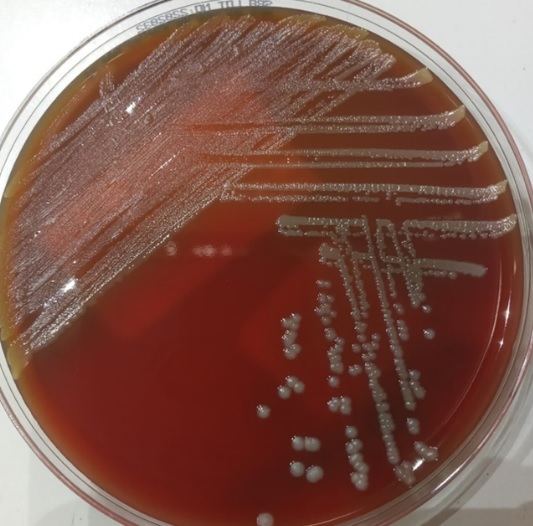
Image source: Wikipedia/Wikimedia
| Ecology, Host, and Life Cycle | |
|---|---|
| Oxygen requirements | Not Available |
| Optimal temperature | Not Available |
| Temperature range | Not Available |
| Habitat | Not Available |
| Biotic relationship | Not Available |
| Host(s) | Not Available |
| Cell arrangement | Not Available |
| Sporulation | Not Available |
| Energy source | Not Available |
| Pathogenicity | Not Available |
Gene Summary
Adenine Count
1351388 bp
Thymine Count
1340499 bp
Guanine Count
2369260 bp
Cytosine Count
2371258 bp
Genome Length
7432405 bp
Protein-coding Genes
6364 genes
Non-Coding Genes
147 genes
# of Chromosomes/Plasmids
1
Genes
| Name | Locus Tag | UniProt ID | Strand Orientation | Gene Start/End | Protein Molecular Weight |
|---|---|---|---|---|---|
| hypothetical protein | IV454_16030 | Not Available | Negative | 3557973 - 3558257 | 10621.4 |
| rna-binding s4 domain-containing protein | IV454_16035 | P0AAS7 | Negative | 3558417 - 3558650 | 8033.72 |
| class ii fumarate hydratase | IV454_16040 | Q7W0A2 | Negative | 3558736 - 3560127 | 49449.5 |
| hypothetical protein | IV454_16045 | Q9HZA6 | Positive | 3560245 - 3561285 | 36274.4 |
| aminotransferase class i/ii-fold pyridoxal phosphate-dependent enzyme | IV454_16050 | A0R5R7 | Positive | 3561645 - 3562865 | 43167.9 |
| is1182 family transposase | IV454_16055 | Not Available | Positive | 3562957 - 3564573 | 59855.3 |
| flagellar protein flit | IV454_16060 | Not Available | Negative | 3564986 - 3565264 | 9951.05 |
| hdod domain-containing protein | IV454_16065 | O83112 | Negative | 3565379 - 3566206 | 29773.0 |
| lysr family transcriptional regulator | IV454_16070 | P67664 | Negative | 3566297 - 3567202 | 33268.7 |
| hydrolase | IV454_16075 | P21367 | Positive | 3567371 - 3568009 | 23286.0 |
Pathways
0 pathways
No pathways found
No metabolic pathways have been associated with this bacterium yet.
Health Effects
No health effects information available for this bacterium.