Kingdom
Bacillati
Phylum
Bacillota
Class
Bacilli
Order
Lactobacillales
Family
Lactobacillaceae
Genus
Lactobacillus
Description
Taxonomy
| Kingdom | Bacillati |
|---|---|
| Phylum | Bacillota |
| Class | Bacilli |
| Order | Lactobacillales |
| Family | Lactobacillaceae |
| Genus | Lactobacillus |
| Species | Lactobacillus delbrueckii |
| Strain | subsp. indicus |
Profile
| Physiology | |
|---|---|
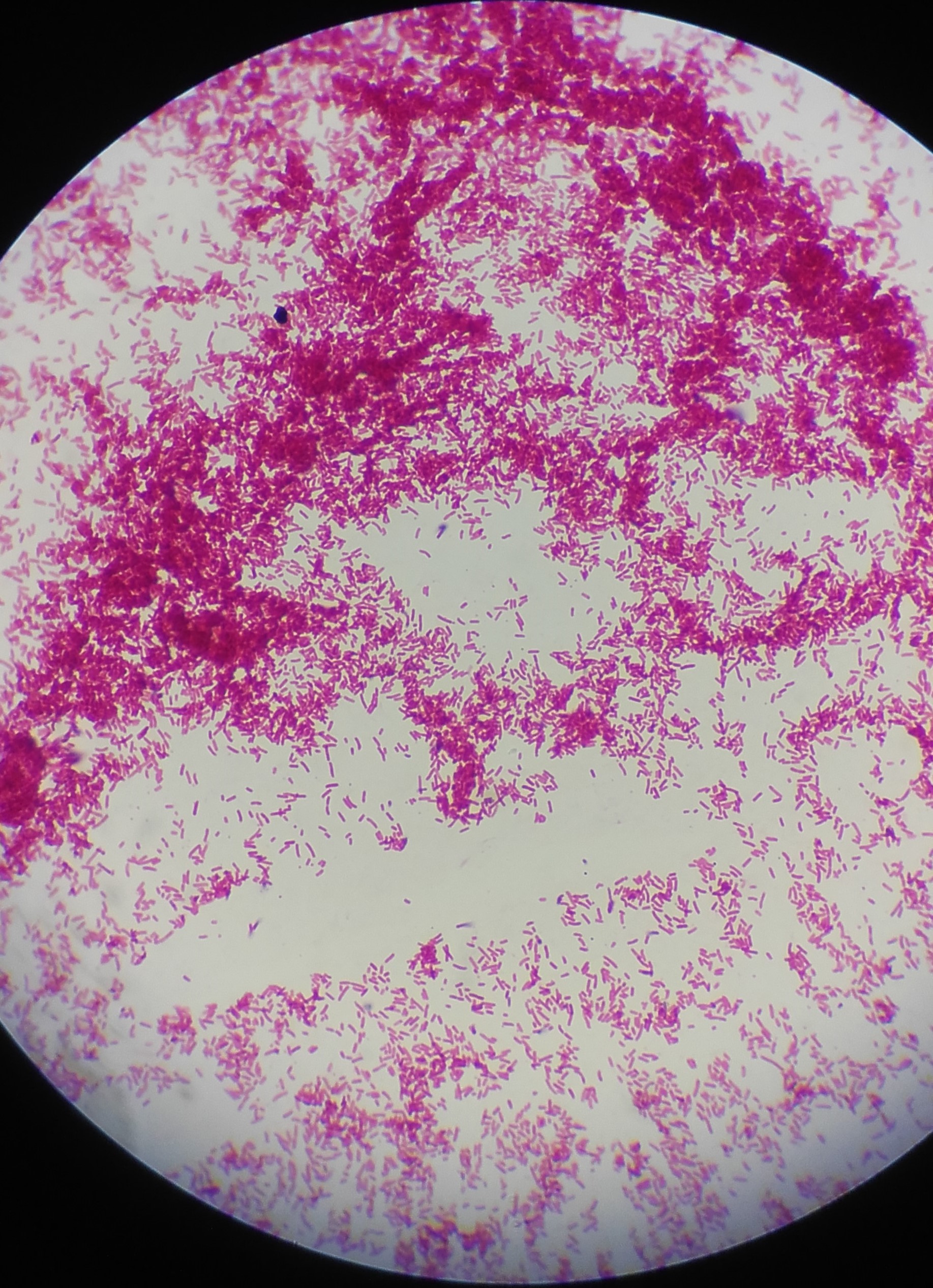
| Gram staining properties | Positive |
| Shape | Rod |
| Mobility | No |
| Flagellar presence | Yes |
| Number of membranes | Not Available |

Image source: Wikipedia/Wikimedia
| Ecology, Host, and Life Cycle | |
|---|---|
| Oxygen requirements | Facultative anaerobe |
| Optimal temperature | 42 |
| Temperature range | Mesophilic |
| Habitat | Not Available |
| Biotic relationship | Free living |
| Host(s) | Not Available |
| Cell arrangement | Chains |
| Sporulation | Not Available |
| Energy source | Not Available |
| Pathogenicity | Not Available |
Genome Summary
Lactobacillus delbrueckii subsp. indicus , Complete Genome
Gene Summary
Adenine Count
503788 bp
Thymine Count
490473 bp
Guanine Count
488915 bp
Cytosine Count
484044 bp
Genome Length
1967220 bp
Protein-coding Genes
1877 genes
Non-Coding Genes
127 genes
# of Chromosomes/Plasmids
3
Genes
| Name | Locus Tag | UniProt ID | Strand Orientation | Gene Start/End | Protein Molecular Weight |
|---|---|---|---|---|---|
| thiopurine s-methyltransferase | LI610_01315 | Not Available | Positive | 203363 - 203509 | 5511.04 |
| amidase | LI610_01320 | P37710 | Positive | 203610 - 204812 | 43256.1 |
| n-acetylmuramoyl-l-alanine amidase | LI610_01325 | O33983 | Positive | 204814 - 206406 | 57815.1 |
| potassium transporter | LI610_01330 | O31615 | Positive | 206517 - 208355 | 67502.2 |
| nad(p)-dependent oxidoreductase | LI610_01335 | O05265 | Negative | 208467 - 209432 | 35045.0 |
| hypothetical protein | LI610_01340 | Not Available | Negative | 209479 - 210228 | 28529.7 |
| phosphoglyceromutase | LI610_01345 | Q74LL9 | Positive | 210392 - 211081 | 26073.8 |
| lytr family transcriptional regulator | LI610_01350 | Q836A6 | Positive | 211334 - 212617 | 46898.3 |
| hypothetical protein | LI610_01355 | Q5FMI9 | Positive | 212620 - 213237 | 22566.7 |
| glucan modification protein | LI610_01360 | P72302 | Positive | 213316 - 216318 | 114762.0 |
Pathways
0 pathways
No pathways found
No metabolic pathways have been associated with this bacterium yet.
Health Effects
No health effects information available for this bacterium.