
Kingdom
Pseudomonadati
Phylum
Pseudomonadota
Class
Alphaproteobacteria
Order
Hyphomicrobiales
Family
Bartonellaceae
Genus
Bartonella
Description
Taxonomy
| Kingdom | Pseudomonadati |
|---|---|
| Phylum | Pseudomonadota |
| Class | Alphaproteobacteria |
| Order | Hyphomicrobiales |
| Family | Bartonellaceae |
| Genus | Bartonella |
| Species | Bartonella mastomydis |
| Strain | CL41/66, CL 41/66 |
Profile
| Physiology | |
|---|---|
| Gram staining properties | Not Available |
| Shape | Not Available |
| Mobility | Not Available |
| Flagellar presence | Yes |
| Number of membranes | Not Available |
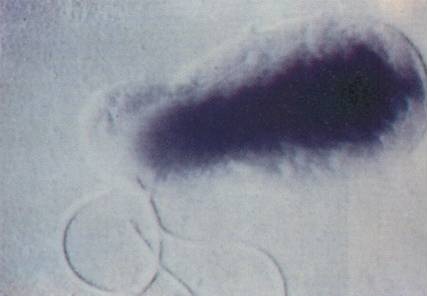
Image source: Wikipedia/Wikimedia
| Ecology, Host, and Life Cycle | |
|---|---|
| Oxygen requirements | Not Available |
| Optimal temperature | Not Available |
| Temperature range | Not Available |
| Habitat | Not Available |
| Biotic relationship | Not Available |
| Host(s) | Not Available |
| Cell arrangement | Not Available |
| Sporulation | Not Available |
| Energy source | Not Available |
| Pathogenicity | Not Available |
Gene Summary
Adenine Count
1344265 bp
Thymine Count
1331300 bp
Guanine Count
748046 bp
Cytosine Count
744111 bp
Genome Length
4167722 bp
Protein-coding Genes
3523 genes
Non-Coding Genes
159 genes
# of Chromosomes/Plasmids
1
Genes
| Name | Locus Tag | UniProt ID | Strand Orientation | Gene Start/End | Protein Molecular Weight |
|---|---|---|---|---|---|
| dna polymerase iii subunit alpha | I6I89_04185 | O34623 | Negative | 907178 - 910144 | 113147.0 |
| dna polymerase iv | I6I89_04190 | Q3ABL2 | Negative | 910147 - 911304 | 43551.2 |
| lexa family transcriptional regulator | I6I89_04195 | P45902 | Positive | 911388 - 912155 | 29746.7 |
| peptide chain release factor 2 | I6I89_04200 | Q02ZM8 | Negative | 912563 - 913658 | 41875.8 |
| plp-dependent transferase | I6I89_04205 | O07051 | Positive | 913705 - 914730 | 38130.2 |
| diacylglyceryl transferase | I6I89_04210 | Not Available | Positive | 914835 - 915152 | 12253.7 |
| tlpa family protein disulfide reductase | I6I89_04215 | Q8CXF3 | Positive | 915317 - 915817 | 19216.3 |
| thioredoxin family protein | I6I89_04220 | A4IQF5 | Positive | 915830 - 916504 | 24733.7 |
| voc family protein | I6I89_04225 | Not Available | Negative | 916642 - 917025 | 14540.4 |
| sam-dependent methyltransferase | I6I89_04230 | Q8KA29 | Negative | 917034 - 917756 | 26972.0 |
Pathways
0 pathways
No pathways found
No metabolic pathways have been associated with this bacterium yet.
Health Effects
No health effects information available for this bacterium.