Kingdom
Pseudomonadati
Phylum
Spirochaetota
Class
Leptospiria
Order
Leptospirales
Family
Leptospiraceae
Genus
Leptospira
Description
Taxonomy
| Kingdom | Pseudomonadati |
|---|---|
| Phylum | Spirochaetota |
| Class | Leptospiria |
| Order | Leptospirales |
| Family | Leptospiraceae |
| Genus | Leptospira |
| Species | Leptospira biflexa |
| Strain | LEP1342 |
Profile
| Physiology | |
|---|---|
| Gram staining properties | Not Available |
| Shape | Not Available |
| Mobility | Not Available |
| Flagellar presence | Yes |
| Number of membranes | Not Available |

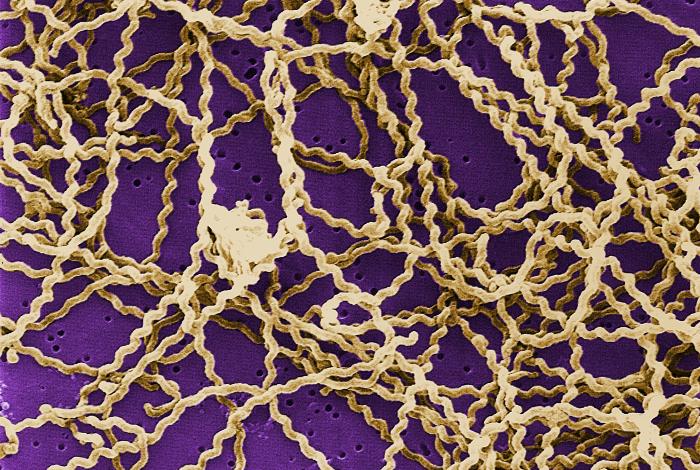
Image source: Wikipedia/Wikimedia
| Ecology, Host, and Life Cycle | |
|---|---|
| Oxygen requirements | Not Available |
| Optimal temperature | Not Available |
| Temperature range | Not Available |
| Habitat | H. cricumcincta |
| Biotic relationship | Not Available |
| Host(s) | Not Available |
| Cell arrangement | Not Available |
| Sporulation | Not Available |
| Energy source | Not Available |
| Pathogenicity | Not Available |
Genome Summary
Leptospira biflexa LEP1342, Complete Genome
Gene Summary
Adenine Count
1102866 bp
Thymine Count
1099470 bp
Guanine Count
698105 bp
Cytosine Count
703536 bp
Genome Length
3603977 bp
Protein-coding Genes
3277 genes
Non-Coding Genes
42 genes
# of Chromosomes/Plasmids
6
Genes
| Name | Locus Tag | UniProt ID | Strand Orientation | Gene Start/End | Protein Molecular Weight |
|---|---|---|---|---|---|
| putative acriflavine resistance protein d | LEPBI_II0087 | P25197 | Positive | 83858 - 87061 | 117377.0 |
| hypothetical protein | LEPBI_II0088 | Not Available | Positive | 87143 - 87505 | 13837.7 |
| hypothetical protein | LEPBI_II0089 | Not Available | Positive | 87554 - 88798 | 48340.9 |
| putative response regulatory protein | LEPBI_II0090 | P13800 | Positive | 88795 - 89451 | 24432.7 |
| hypothetical protein | LEPBI_II0091 | Not Available | Positive | 89528 - 89656 | 4981.24 |
| putative transport system kinase | LEPBI_II0092 | P27254 | Negative | 89778 - 90893 | 40430.2 |
| methylmalonyl-coa mutase large subunit | LEPBI_II0094 | Q59677 | Negative | 91031 - 93169 | 78333.8 |
| methylmalonyl-coa mutase small subunit | LEPBI_II0095 | Q59676 | Negative | 93162 - 94982 | 67606.3 |
| hypothetical protein | LEPBI_II0096 | Not Available | Negative | 94984 - 95316 | 12046.8 |
| hypothetical protein | LEPBI_II0097 | Q9D8N3 | Positive | 95359 - 96027 | 24636.1 |
Pathways
0 pathways
No pathways found
No metabolic pathways have been associated with this bacterium yet.