Kingdom
Pseudomonadati
Phylum
Spirochaetota
Class
Leptospiria
Order
Leptospirales
Family
Leptospiraceae
Genus
Leptospira
Description
Taxonomy
| Kingdom | Pseudomonadati |
|---|---|
| Phylum | Spirochaetota |
| Class | Leptospiria |
| Order | Leptospirales |
| Family | Leptospiraceae |
| Genus | Leptospira |
| Species | Leptospira biflexa |
| Strain | LEP1342 |
Profile
| Physiology | |
|---|---|
| Gram staining properties | Not Available |
| Shape | Not Available |
| Mobility | Not Available |
| Flagellar presence | Yes |
| Number of membranes | Not Available |

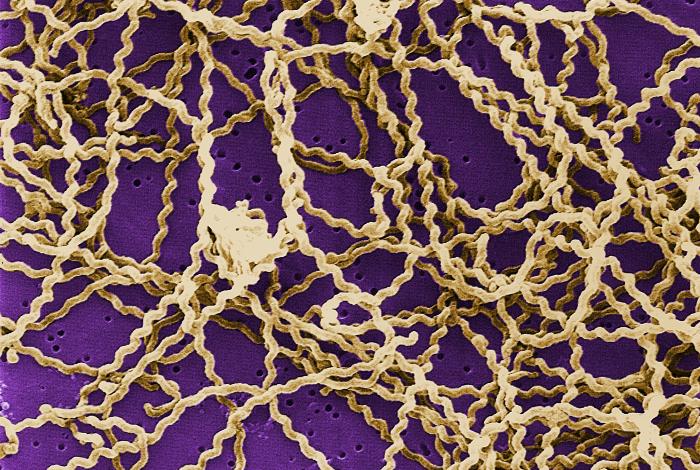
Image source: Wikipedia/Wikimedia
| Ecology, Host, and Life Cycle | |
|---|---|
| Oxygen requirements | Not Available |
| Optimal temperature | Not Available |
| Temperature range | Not Available |
| Habitat | H. cricumcincta |
| Biotic relationship | Not Available |
| Host(s) | Not Available |
| Cell arrangement | Not Available |
| Sporulation | Not Available |
| Energy source | Not Available |
| Pathogenicity | Not Available |
Genome Summary
Leptospira biflexa LEP1342, Complete Genome
Gene Summary
Adenine Count
1102866 bp
Thymine Count
1099470 bp
Guanine Count
698105 bp
Cytosine Count
703536 bp
Genome Length
3603977 bp
Protein-coding Genes
3277 genes
Non-Coding Genes
42 genes
# of Chromosomes/Plasmids
6
Genes
| Name | Locus Tag | UniProt ID | Strand Orientation | Gene Start/End | Protein Molecular Weight |
|---|---|---|---|---|---|
| phosphatidate cytidylyltransferase (cdp-diglyceride synthetase) | LEPBI_I2612 | P0ABG2 | Negative | 2703568 - 2704479 | 33725.1 |
| undecaprenyl pyrophosphate synthetase (di-trans,poly-cis-decaprenylcistransferase) | LEPBI_I2613 | Q72U10 | Negative | 2704476 - 2705189 | 27105.9 |
| ribosome recycling factor (ribosome releasing factor | LEPBI_I2614 | B0SDN4 | Negative | 2705196 - 2705747 | 20698.2 |
| uridylate kinase | LEPBI_I2615 | Q04U70 | Negative | 2705737 - 2706483 | 26948.0 |
| elongation factor ts (ef-ts) | LEPBI_I2616 | B0SDN6 | Negative | 2706473 - 2707069 | 21832.3 |
| 30s ribosomal protein s2 | LEPBI_I2617 | Q04U72 | Negative | 2707069 - 2707971 | 33487.3 |
| conserved hypothetical protein | LEPBI_I2618 | Not Available | Negative | 2707974 - 2708207 | 8266.46 |
| trehalose-6-phosphate synthase | LEPBI_I2619 | G4RK44 | Positive | 2708807 - 2710999 | 83585.2 |
| putative glycosyl hydrolase | LEPBI_I2620 | Q978S7 | Positive | 2710980 - 2712758 | 68534.4 |
| putative two-component sensor histidine kinase | LEPBI_I2621 | O31661 | Positive | 2712889 - 2715936 | 117632.0 |
Pathways
0 pathways
No pathways found
No metabolic pathways have been associated with this bacterium yet.