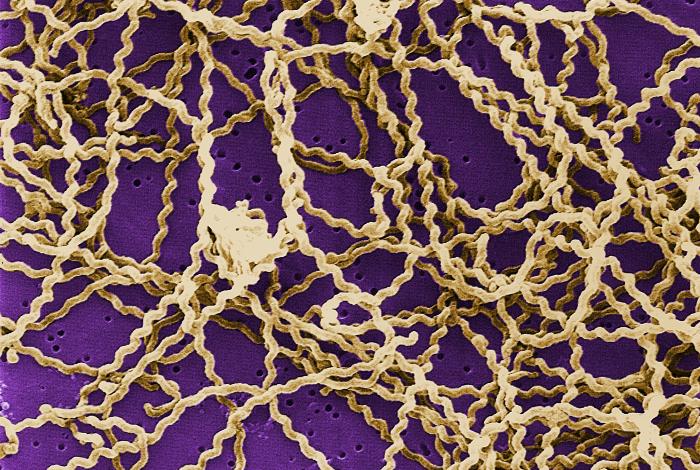
Kingdom
Pseudomonadati
Phylum
Spirochaetota
Class
Leptospiria
Order
Leptospirales
Family
Leptospiraceae
Genus
Leptospira
Description
Taxonomy
| Kingdom | Pseudomonadati |
|---|---|
| Phylum | Spirochaetota |
| Class | Leptospiria |
| Order | Leptospirales |
| Family | Leptospiraceae |
| Genus | Leptospira |
| Species | Leptospira biflexa |
| Strain | LEP1342 |
Profile
| Physiology | |
|---|---|
| Gram staining properties | Not Available |
| Shape | Not Available |
| Mobility | Not Available |
| Flagellar presence | Yes |
| Number of membranes | Not Available |

Image source: Wikipedia/Wikimedia
| Ecology, Host, and Life Cycle | |
|---|---|
| Oxygen requirements | Not Available |
| Optimal temperature | Not Available |
| Temperature range | Not Available |
| Habitat | H. cricumcincta |
| Biotic relationship | Not Available |
| Host(s) | Not Available |
| Cell arrangement | Not Available |
| Sporulation | Not Available |
| Energy source | Not Available |
| Pathogenicity | Not Available |
Genome Summary
Leptospira biflexa LEP1342, Complete Genome
Gene Summary
Adenine Count
1102866 bp
Thymine Count
1099470 bp
Guanine Count
698105 bp
Cytosine Count
703536 bp
Genome Length
3603977 bp
Protein-coding Genes
3277 genes
Non-Coding Genes
42 genes
# of Chromosomes/Plasmids
6
Genes
| Name | Locus Tag | UniProt ID | Strand Orientation | Gene Start/End | Protein Molecular Weight |
|---|---|---|---|---|---|
| putative ferric uptake regulation protein, fur family (ferric uptake regulator) | LEPBI_I2330 | Q48835 | Negative | 2401594 - 2402073 | 18401.8 |
| conserved hypothetical protein | LEPBI_I2331 | Not Available | Negative | 2402099 - 2402650 | 21065.6 |
| putative metalloendopeptidase | LEPBI_I2332 | Not Available | Positive | 2402775 - 2404589 | 68097.8 |
| transcriptional elongation factor, grea/greb family | LEPBI_I2333 | O51157 | Negative | 2404562 - 2407327 | 106394.0 |
| flagellar filament outer layer protein a | LEPBI_I2335 | C0QWY9 | Negative | 2407532 - 2408518 | 36111.8 |
| flagellar filament outer layer protein precursor (sheath protein) | LEPBI_I2336 | C0QWY9 | Negative | 2408535 - 2409260 | 27590.1 |
| hypothetical protein | LEPBI_I2337 | Not Available | Negative | 2409387 - 2409551 | 6319.46 |
| putative camp-binding protein | LEPBI_I2338 | P29281 | Negative | 2409654 - 2410124 | 18568.2 |
| putative two-component regulatory response regulator, luxr family | LEPBI_I2339 | Q4L7J5 | Positive | 2410314 - 2410934 | 23028.0 |
| putative protein with atpase domain of hsp90 | LEPBI_I2340 | Q9HUI3 | Negative | 2410938 - 2413349 | 91879.0 |
Pathways
0 pathways
No pathways found
No metabolic pathways have been associated with this bacterium yet.