Kingdom
Pseudomonadati
Phylum
Spirochaetota
Class
Leptospiria
Order
Leptospirales
Family
Leptospiraceae
Genus
Leptospira
Description
Taxonomy
| Kingdom | Pseudomonadati |
|---|---|
| Phylum | Spirochaetota |
| Class | Leptospiria |
| Order | Leptospirales |
| Family | Leptospiraceae |
| Genus | Leptospira |
| Species | Leptospira biflexa |
| Strain | LEP1342 |
Profile
| Physiology | |
|---|---|
| Gram staining properties | Not Available |
| Shape | Not Available |
| Mobility | Not Available |
| Flagellar presence | Yes |
| Number of membranes | Not Available |

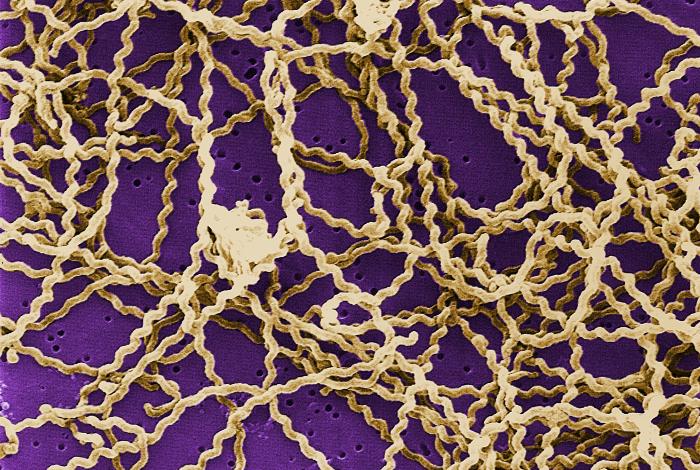
Image source: Wikipedia/Wikimedia
| Ecology, Host, and Life Cycle | |
|---|---|
| Oxygen requirements | Not Available |
| Optimal temperature | Not Available |
| Temperature range | Not Available |
| Habitat | H. cricumcincta |
| Biotic relationship | Not Available |
| Host(s) | Not Available |
| Cell arrangement | Not Available |
| Sporulation | Not Available |
| Energy source | Not Available |
| Pathogenicity | Not Available |
Genome Summary
Leptospira biflexa LEP1342, Complete Genome
Gene Summary
Adenine Count
1102866 bp
Thymine Count
1099470 bp
Guanine Count
698105 bp
Cytosine Count
703536 bp
Genome Length
3603977 bp
Protein-coding Genes
3277 genes
Non-Coding Genes
42 genes
# of Chromosomes/Plasmids
6
Genes
| Name | Locus Tag | UniProt ID | Strand Orientation | Gene Start/End | Protein Molecular Weight |
|---|---|---|---|---|---|
| phosphoribosylaminoimidazole carboxylase atpase subunit (air carboxylase | LEPBI_I1755 | Q5HH19 | Positive | 1832747 - 1833847 | 41763.1 |
| udp-n-acetylmuramate--l-alanine ligase (udp-n-acetylmuramoyl-l-alanine synthetase) | LEPBI_I1756 | A4J2B2 | Negative | 1833867 - 1835276 | 52948.9 |
| udp-n-acetylglucosamine--n-acetylmuramyl- (pentapeptide) pyrophosphoryl-undecaprenol n-acetylglucosamine transferase (undecaprenyl-pp-murnac-pentapeptide-udpglcnac glcnac transferase) | LEPBI_I1757 | Q04V94 | Negative | 1835290 - 1836375 | 39957.6 |
| cell division protein ftsw | LEPBI_I1758 | B3E3Y3 | Negative | 1836372 - 1837520 | 43712.8 |
| phospho-n-acetylmuramoyl-pentapeptide- transferase (udp-murnac-pentapeptide phosphotransferase) | LEPBI_I1759 | B0S986 | Negative | 1837520 - 1838632 | 40505.5 |
| udp-n-acetylmuramoylalanyl-d-glutamate--2, 6-diaminopimelate ligase | LEPBI_I1760 | Q04V91 | Negative | 1838643 - 1840169 | 57292.6 |
| conserved hypothetical protein | LEPBI_I1761 | Not Available | Negative | 1840166 - 1840513 | 13368.5 |
| s-adenosyl-methyltransferase mraw | LEPBI_I1762 | B0S989 | Negative | 1840510 - 1841454 | 35551.1 |
| putative hydrolase | LEPBI_I1763 | P9WMK8 | Positive | 1841476 - 1842042 | 21789.3 |
| chemotaxis protein methyltransferase | LEPBI_I1764 | P21824 | Negative | 1842045 - 1842977 | 36238.5 |
Pathways
0 pathways
No pathways found
No metabolic pathways have been associated with this bacterium yet.