Kingdom
Pseudomonadati
Phylum
Spirochaetota
Class
Leptospiria
Order
Leptospirales
Family
Leptospiraceae
Genus
Leptospira
Description
Taxonomy
| Kingdom | Pseudomonadati |
|---|---|
| Phylum | Spirochaetota |
| Class | Leptospiria |
| Order | Leptospirales |
| Family | Leptospiraceae |
| Genus | Leptospira |
| Species | Leptospira biflexa |
| Strain | LEP1342 |
Profile
| Physiology | |
|---|---|
| Gram staining properties | Not Available |
| Shape | Not Available |
| Mobility | Not Available |
| Flagellar presence | Yes |
| Number of membranes | Not Available |

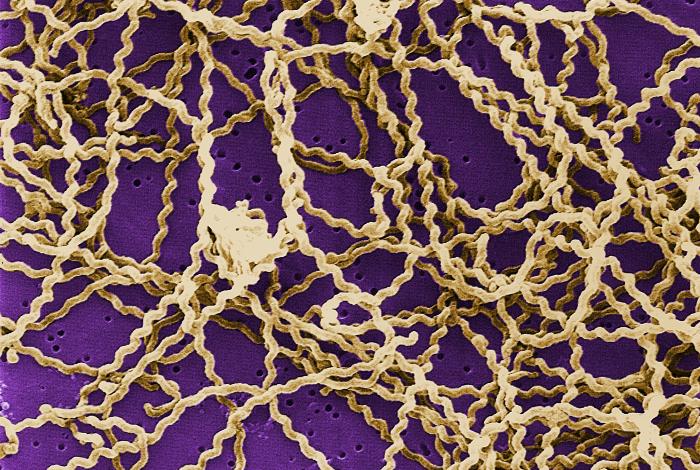
Image source: Wikipedia/Wikimedia
| Ecology, Host, and Life Cycle | |
|---|---|
| Oxygen requirements | Not Available |
| Optimal temperature | Not Available |
| Temperature range | Not Available |
| Habitat | H. cricumcincta |
| Biotic relationship | Not Available |
| Host(s) | Not Available |
| Cell arrangement | Not Available |
| Sporulation | Not Available |
| Energy source | Not Available |
| Pathogenicity | Not Available |
Genome Summary
Leptospira biflexa LEP1342, Complete Genome
Gene Summary
Adenine Count
1102866 bp
Thymine Count
1099470 bp
Guanine Count
698105 bp
Cytosine Count
703536 bp
Genome Length
3603977 bp
Protein-coding Genes
3277 genes
Non-Coding Genes
42 genes
# of Chromosomes/Plasmids
6
Genes
| Name | Locus Tag | UniProt ID | Strand Orientation | Gene Start/End | Protein Molecular Weight |
|---|---|---|---|---|---|
| deoxyguanosinetriphosphate triphosphohydrolase-like protein | LEPBI_I1480 | Q04T48 | Positive | 1538878 - 1540047 | 45000.7 |
| putative glutathione s-transferase | LEPBI_I1481 | P42761 | Positive | 1540085 - 1540693 | 24020.0 |
| conserved hypothetical protein | LEPBI_I1482 | Not Available | Negative | 1540718 - 1541308 | 21929.4 |
| n-acetyl-gamma-glutamyl-phosphate reductase | LEPBI_I1483 | Q72RJ9 | Negative | 1541295 - 1542335 | 38810.1 |
| putative bacterial sensor | LEPBI_I1484 | Q06067 | Positive | 1542430 - 1544061 | 62422.4 |
| hypothetical protein | LEPBI_I1485 | Not Available | Positive | 1544042 - 1544599 | 21220.8 |
| putative sensory transduction histidine kinase | LEPBI_I1486 | Q86CZ2 | Positive | 1544617 - 1547361 | 104217.0 |
| hypothetical protein | LEPBI_I1487 | Not Available | Negative | 1547341 - 1548915 | 58397.4 |
| putative methyl-accepting chemotaxis protein | LEPBI_I1488 | Q88R14 | Positive | 1549030 - 1551135 | 77491.4 |
| conserved hypothetical protein with ankyrin repeat | LEPBI_I1489 | Not Available | Negative | 1551070 - 1551705 | 23807.3 |
Pathways
0 pathways
No pathways found
No metabolic pathways have been associated with this bacterium yet.