Kingdom
Pseudomonadati
Phylum
Spirochaetota
Class
Leptospiria
Order
Leptospirales
Family
Leptospiraceae
Genus
Leptospira
Description
Taxonomy
| Kingdom | Pseudomonadati |
|---|---|
| Phylum | Spirochaetota |
| Class | Leptospiria |
| Order | Leptospirales |
| Family | Leptospiraceae |
| Genus | Leptospira |
| Species | Leptospira biflexa |
| Strain | LEP1342 |
Profile
| Physiology | |
|---|---|
| Gram staining properties | Not Available |
| Shape | Not Available |
| Mobility | Not Available |
| Flagellar presence | Yes |
| Number of membranes | Not Available |

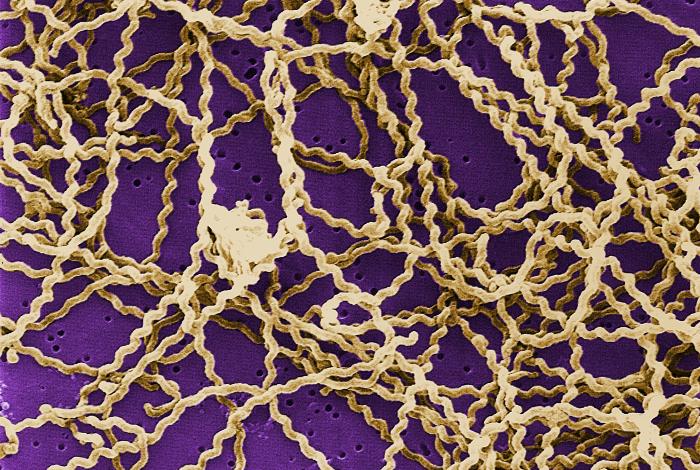
Image source: Wikipedia/Wikimedia
| Ecology, Host, and Life Cycle | |
|---|---|
| Oxygen requirements | Not Available |
| Optimal temperature | Not Available |
| Temperature range | Not Available |
| Habitat | H. cricumcincta |
| Biotic relationship | Not Available |
| Host(s) | Not Available |
| Cell arrangement | Not Available |
| Sporulation | Not Available |
| Energy source | Not Available |
| Pathogenicity | Not Available |
Genome Summary
Leptospira biflexa LEP1342, Complete Genome
Gene Summary
Adenine Count
1102866 bp
Thymine Count
1099470 bp
Guanine Count
698105 bp
Cytosine Count
703536 bp
Genome Length
3603977 bp
Protein-coding Genes
3277 genes
Non-Coding Genes
42 genes
# of Chromosomes/Plasmids
6
Genes
| Name | Locus Tag | UniProt ID | Strand Orientation | Gene Start/End | Protein Molecular Weight |
|---|---|---|---|---|---|
| adenylate/guanylate cyclase | LBF_1454 | P19485 | Positive | 1575766 - 1577934 | 81654.8 |
| methyl-accepting chemotaxis protein | LBF_1455 | P39214 | Positive | 1577988 - 1579790 | 65890.4 |
| oma87 related protein | LBF_1456 | Not Available | Negative | 1579787 - 1581295 | 57318.2 |
| hypothetical protein | LBF_1457 | Not Available | Positive | 1581761 - 1582918 | 44767.3 |
| conserved hypothetical protein | LBF_1458 | Not Available | Positive | 1582944 - 1584749 | 68613.8 |
| hypothetical protein | LBF_1459 | Not Available | Positive | 1584752 - 1585279 | 20541.8 |
| Trna-arg | Not Available | Not Available | Positive | 1585733 - 1585807 | Not Available |
| hypothetical protein | LBF_1461 | Not Available | Negative | 1585827 - 1586675 | 33333.9 |
| hit family hydrolase | LBF_1462 | Not Available | Positive | 1586702 - 1587058 | 13562.4 |
| conserved hypothetical protein | LBF_1464 | Q83XD3 | Positive | 1587855 - 1588595 | 29360.1 |
Pathways
0 pathways
No pathways found
No metabolic pathways have been associated with this bacterium yet.