
Kingdom
Pseudomonadati
Phylum
Spirochaetota
Class
Spirochaetia
Order
Treponematales
Family
Treponemataceae
Genus
Treponema
Description
Taxonomy
| Kingdom | Pseudomonadati |
|---|---|
| Phylum | Spirochaetota |
| Class | Spirochaetia |
| Order | Treponematales |
| Family | Treponemataceae |
| Genus | Treponema |
| Species | Treponema phagedenis |
| Strain | B43.1 |
Profile
| Physiology | |
|---|---|
| Gram staining properties | Negative |
| Shape | Spirilla |
| Mobility | Not Available |
| Flagellar presence | Yes |
| Number of membranes | Not Available |
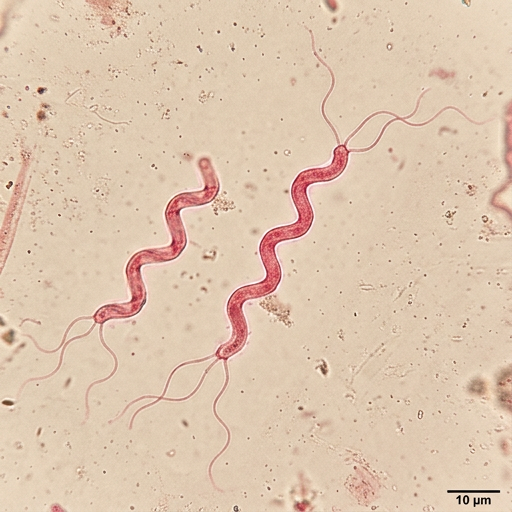
AI-generated image based on bacteria physiology
| Ecology, Host, and Life Cycle | |
|---|---|
| Oxygen requirements | Not Available |
| Optimal temperature | 40 |
| Temperature range | Not Available |
| Habitat | genital tract; skin lesions |
| Biotic relationship | Not Available |
| Host(s) | Homo sapiens, Bos taurus, Bos |
| Cell arrangement | Not Available |
| Sporulation | Not Available |
| Energy source | Not Available |
| Pathogenicity | Not Available |
Gene Summary
Adenine Count
1023882 bp
Thymine Count
1002507 bp
Guanine Count
679219 bp
Cytosine Count
666508 bp
Genome Length
3372116 bp
Protein-coding Genes
2890 genes
Non-Coding Genes
101 genes
# of Chromosomes/Plasmids
1
Genes
| Name | Locus Tag | UniProt ID | Strand Orientation | Gene Start/End | Protein Molecular Weight |
|---|---|---|---|---|---|
| pts sugar transporter subunit iia | FUT79_05600 | P71012 | Negative | 1272013 - 1272489 | 17678.4 |
| preprotein translocase subunit secg | FUT79_05605 | O83547 | Negative | 1272502 - 1272888 | 13761.3 |
| hypothetical protein | FUT79_05610 | Not Available | Negative | 1273330 - 1273689 | 14217.0 |
| fibronectin type iii domain-containing protein | FUT79_05615 | Q97Z97 | Negative | 1273771 - 1275264 | 55632.6 |
| pseudouridine-5'-phosphate glycosidase | FUT79_05620 | Q2SM69 | Negative | 1275475 - 1276398 | 32746.7 |
| marr family transcriptional regulator | FUT79_05625 | P30235 | Negative | 1276429 - 1277532 | 39616.0 |
| division/cell wall cluster transcriptional repressor mraz | FUT79_05630 | Q73NF6 | Positive | 1278046 - 1278495 | 17001.4 |
| 16s rrna (cytosine(1402)-n(4))-methyltransferase rsmh | FUT79_05635 | P62477 | Positive | 1278502 - 1279455 | 35559.0 |
| cell division protein ftsl | FUT79_05640 | Not Available | Positive | 1279452 - 1279742 | 11500.2 |
| udp-n-acetylmuramoyl-tripeptide--d-alanyl-d- alanine ligase | FUT79_05645 | O83401 | Positive | 1279787 - 1281139 | 49389.6 |
Pathways
0 pathways
No pathways found
No metabolic pathways have been associated with this bacterium yet.
