
Kingdom
Pseudomonadati
Phylum
Campylobacterota
Class
Epsilonproteobacteria
Order
Campylobacterales
Family
Arcobacteraceae
Genus
Aliarcobacter
Description
Taxonomy
| Kingdom | Pseudomonadati |
|---|---|
| Phylum | Campylobacterota |
| Class | Epsilonproteobacteria |
| Order | Campylobacterales |
| Family | Arcobacteraceae |
| Genus | Aliarcobacter |
| Species | Aliarcobacter lanthieri |
| Strain | No strain |
Profile
| Physiology | |
|---|---|
| Gram staining properties | Negative |
| Shape | Curved rod |
| Mobility | Not Available |
| Flagellar presence | Yes |
| Number of membranes | Not Available |
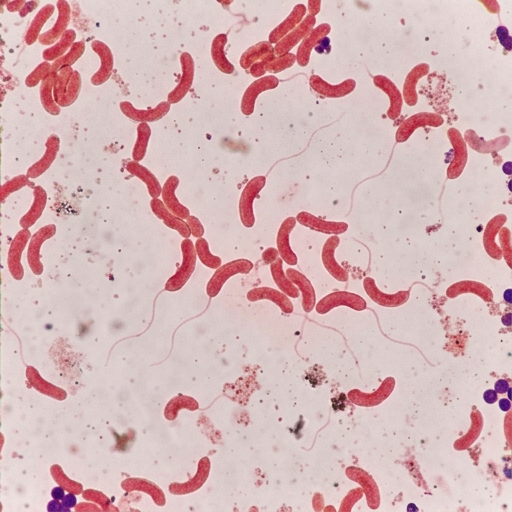
AI-generated image based on bacteria physiology
| Ecology, Host, and Life Cycle | |
|---|---|
| Oxygen requirements | Not Available |
| Optimal temperature | Not Available |
| Temperature range | Not Available |
| Habitat | agricultural surface water; manure |
| Biotic relationship | Not Available |
| Host(s) | Homo sapiens, Metazoa, Sus scrofa |
| Cell arrangement | Not Available |
| Sporulation | Not Available |
| Energy source | Not Available |
| Pathogenicity | Not Available |
Gene Summary
Adenine Count
834953 bp
Thymine Count
835472 bp
Guanine Count
303494 bp
Cytosine Count
302538 bp
Genome Length
2276457 bp
Protein-coding Genes
2195 genes
Non-Coding Genes
68 genes
# of Chromosomes/Plasmids
1
Genes
| Name | Locus Tag | UniProt ID | Strand Orientation | Gene Start/End | Protein Molecular Weight |
|---|---|---|---|---|---|
| n-succinyldiaminopimelate-aminotransferase / acetylornithine transaminase | ALANTH_0313 | Q7MAE6 | Negative | 308011 - 309198 | 43679.2 |
| fatty acid cis/trans isomerase | ALANTH_0314 | Not Available | Negative | 309249 - 311579 | 91635.7 |
| aspartate carbamoyltransferase, catalytic subunit | ALANTH_0315 | A8ERG2 | Positive | 311674 - 312558 | 33203.0 |
| aminodeoxychorismate synthase, component i | ALANTH_0316 | Q57527 | Positive | 312555 - 313514 | 36893.3 |
| cysteine hydrolase | ALANTH_0317 | P96654 | Positive | 313577 - 314134 | 20633.6 |
| signal transduction response regulator, ompr family | ALANTH_0318 | O25918 | Positive | 314139 - 314825 | 26906.0 |
| branched-chain amino acid aminotransferase, possible 4-amino-4-deoxychorismate lyase pabc | ALANTH_0319 | P44118 | Positive | 314827 - 315399 | 22477.2 |
| phna domain-containing protein | ALANTH_0320 | P0AFJ3 | Negative | 315396 - 315950 | 20562.4 |
| hpp family membrane protein | ALANTH_0321 | Q55EF8 | Positive | 316066 - 316662 | 22160.3 |
| putative lipoprotein-anchoring transpeptidase, erfk/srfk family | ALANTH_0322 | P76193 | Negative | 316668 - 317897 | 47068.8 |
Pathways
0 pathways
No pathways found
No metabolic pathways have been associated with this bacterium yet.
Health Effects
No health effects information available for this bacterium.