
Kingdom
Pseudomonadati
Phylum
Pseudomonadota
Class
Gammaproteobacteria
Order
Enterobacterales
Family
Enterobacteriaceae
Genus
Salmonella
Description
Taxonomy
| Kingdom | Pseudomonadati |
|---|---|
| Phylum | Pseudomonadota |
| Class | Gammaproteobacteria |
| Order | Enterobacterales |
| Family | Enterobacteriaceae |
| Genus | Salmonella |
| Species | Salmonella enterica |
| Strain | Mutton |
Profile
| Physiology | |
|---|---|
| Gram staining properties | Negative |
| Shape | Not Available |
| Mobility | Not Available |
| Flagellar presence | Yes |
| Number of membranes | Not Available |
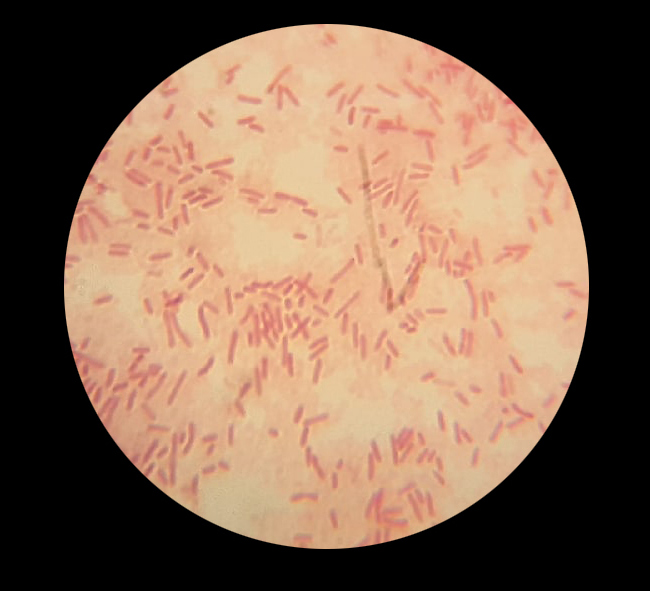
Image source: Wikipedia/Wikimedia
| Ecology, Host, and Life Cycle | |
|---|---|
| Oxygen requirements | Not Available |
| Optimal temperature | 37 |
| Temperature range | Mesophilic |
| Habitat | Not Available |
| Biotic relationship | Free living |
| Host(s) | Not Available |
| Cell arrangement | Not Available |
| Sporulation | Not Available |
| Energy source | Not Available |
| Pathogenicity | Not Available |
Genome Summary
Salmonella enterica subsp. enterica Mutton, Complete Genome
Gene Summary
Adenine Count
1145418 bp
Thymine Count
1145506 bp
Guanine Count
1249383 bp
Cytosine Count
1252992 bp
Genome Length
4793299 bp
Protein-coding Genes
4120 genes
Non-Coding Genes
325 genes
# of Chromosomes/Plasmids
3
Genes
| Name | Locus Tag | UniProt ID | Strand Orientation | Gene Start/End | Protein Molecular Weight |
|---|---|---|---|---|---|
| bifunctional chorismate mutase/prephenate dehydratase | IT784_05535 | P0A9J9 | Negative | 1156946 - 1158106 | 42796.5 |
| phea operon leader peptide phel | IT784_05540 | Not Available | Negative | 1158206 - 1158253 | 1959.51 |
| ribosome-associated translation inhibitor raia | IT784_05545 | P0AD51 | Negative | 1158357 - 1158695 | 12653.2 |
| outer membrane protein assembly factor bamd | IT784_05550 | P0AC04 | Negative | 1158967 - 1159704 | 27828.0 |
| 23s rrna pseudouridine(1911/1915/1917) synthase rlud | IT784_05555 | P65837 | Positive | 1159836 - 1160816 | 37102.7 |
| polyphenol oxidase | IT784_05560 | A0A384KG77 | Positive | 1160813 - 1161544 | 26399.3 |
| atp-dependent chaperone clpb | IT784_05565 | Q7AMH5 | Positive | 1161674 - 1164247 | 95426.6 |
| 16s ribosomal rna | Not Available | Not Available | Positive | 1164702 - 1166243 | Not Available |
| Trna-glu | Not Available | Not Available | Positive | 1166414 - 1166489 | Not Available |
| 23s ribosomal rna | Not Available | Not Available | Positive | 1166683 - 1169587 | Not Available |
Pathways
0 pathways
No pathways found
No metabolic pathways have been associated with this bacterium yet.
Health Effects
No health effects information available for this bacterium.


