Kingdom
Pseudomonadati
Phylum
Pseudomonadota
Class
Gammaproteobacteria
Order
Enterobacterales
Family
Enterobacteriaceae
Genus
Escherichia
Description
Taxonomy
| Kingdom | Pseudomonadati |
|---|---|
| Phylum | Pseudomonadota |
| Class | Gammaproteobacteria |
| Order | Enterobacterales |
| Family | Enterobacteriaceae |
| Genus | Escherichia |
| Species | Escherichia coli |
| Strain | strain KCJK8798 |
Profile
| Physiology | |
|---|---|
| Gram staining properties | Negative |
| Shape | Rod |
| Mobility | Yes |
| Flagellar presence | Yes |
| Number of membranes | 2 |

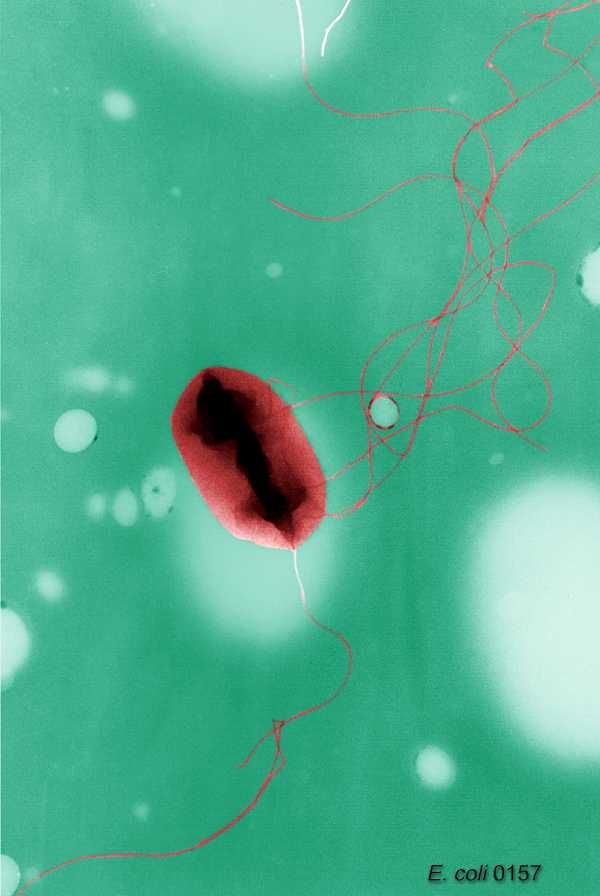
Image source: Wikipedia/Wikimedia
| Ecology, Host, and Life Cycle | |
|---|---|
| Oxygen requirements | Facultative anaerobe |
| Optimal temperature | 37 |
| Temperature range | Mesophilic |
| Habitat | HostAssociated |
| Biotic relationship | Free living |
| Host(s) | Homo sapiens, Gallus gallus, Bos taurus |
| Cell arrangement | Pairs - Singles |
| Sporulation | Not Available |
| Energy source | Not Available |
| Pathogenicity | Human |
Gene Summary
Adenine Count
1156471 bp
Thymine Count
1157353 bp
Guanine Count
1200358 bp
Cytosine Count
1201446 bp
Genome Length
4715725 bp
Protein-coding Genes
4323 genes
Non-Coding Genes
259 genes
# of Chromosomes/Plasmids
1
Genes
| Name | Locus Tag | UniProt ID | Strand Orientation | Gene Start/End | Protein Molecular Weight |
|---|---|---|---|---|---|
| bifunctional methylenetetrahydrofolate dehydrogenase/methenyltetrahydrofolate cyclohydrolase fold | FIB81_12740 | Not Available | Positive | 2671644 - 2672510 | 31015.6 |
| ribosome-associated protein ybcj | FIB81_12745 | Not Available | Positive | 2672512 - 2672724 | 7389.95 |
| metal-dependent hydrolase | FIB81_12750 | Not Available | Positive | 2672832 - 2673353 | 19483.5 |
| cysteine--trna ligase | FIB81_12755 | Not Available | Negative | 2673389 - 2674774 | 52186.9 |
| peptidylprolyl isomerase b | FIB81_12760 | Not Available | Positive | 2674948 - 2675442 | 18168.5 |
| udp-2,3-diacylglucosamine diphosphatase | FIB81_12765 | Not Available | Positive | 2675445 - 2676167 | 26925.8 |
| 5-(carboxyamino)imidazole ribonucleotide mutase | FIB81_12770 | Not Available | Positive | 2676285 - 2676794 | 17781.3 |
| 5-(carboxyamino)imidazole ribonucleotide synthase | FIB81_12775 | Not Available | Positive | 2676791 - 2677858 | 39479.4 |
| carbamate kinase | FIB81_12780 | Not Available | Negative | 2677995 - 2678888 | 31659.1 |
| duf2877 domain-containing protein | FIB81_12785 | Not Available | Negative | 2678885 - 2679700 | 29685.9 |
Pathways
1297 pathways
Health Effects
| Health Condition | Relation | Reference |
|---|---|---|
| Gi disease | Causes | PMC11149725 |
| Utis | Causes | PMC11434687 |
| Colorectal cancer | Causes | PMC12198655 |
| Pyogenic liver abscesses | Causes | PMC12392612 |
| Uti | Causes | PMC13014981 |
| Colibacillosis | Causes | PMC13255289 |
| Enteric infections | Causes | PMC13255289 |
| Foodborne infections | Causes | PMC13255289 |
| Clinical mastitis | Causes | PMC13293316 |
| Diarrhea | Causes | PMC3035056 |