Kingdom
Bacillati
Phylum
Bacillota
Class
Bacilli
Order
Lactobacillales
Family
Lactobacillaceae
Genus
Lactobacillus
Description
Taxonomy
| Kingdom | Bacillati |
|---|---|
| Phylum | Bacillota |
| Class | Bacilli |
| Order | Lactobacillales |
| Family | Lactobacillaceae |
| Genus | Lactobacillus |
| Species | Lactobacillus delbrueckii |
| Strain | subsp. bulgaricus strain FAM 21277 |
Profile
| Physiology | |
|---|---|
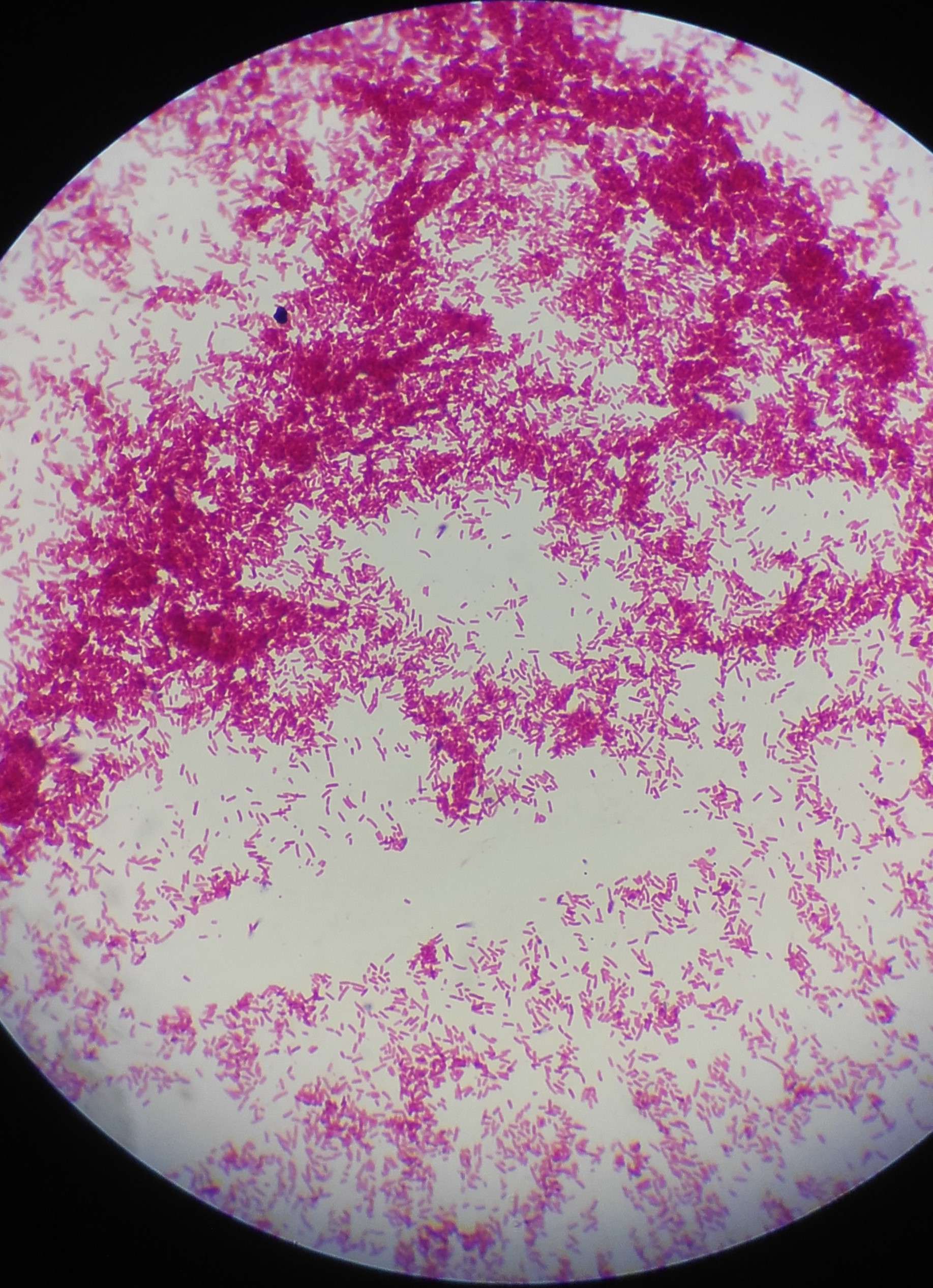
| Gram staining properties | Positive |
| Shape | Rod |
| Mobility | No |
| Flagellar presence | Yes |
| Number of membranes | 1 |

Image source: Wikipedia/Wikimedia
| Ecology, Host, and Life Cycle | |
|---|---|
| Oxygen requirements | Facultative anaerobe |
| Optimal temperature | 42 |
| Temperature range | Mesophilic |
| Habitat | Multiple |
| Biotic relationship | Free living |
| Host(s) | Homo sapiens |
| Cell arrangement | Chains |
| Sporulation | Not Available |
| Energy source | Not Available |
| Pathogenicity | Not Available |
Gene Summary
Adenine Count
514288 bp
Thymine Count
510890 bp
Guanine Count
497608 bp
Cytosine Count
497049 bp
Genome Length
2019838 bp
Protein-coding Genes
1885 genes
Non-Coding Genes
88 genes
# of Chromosomes/Plasmids
1
Genes
| Name | Locus Tag | UniProt ID | Strand Orientation | Gene Start/End | Protein Molecular Weight |
|---|---|---|---|---|---|
| 5-(carboxyamino)imidazole ribonucleotide synthase | FEZ35_00035 | Not Available | Positive | 5805 - 6929 | 40742.0 |
| adenylosuccinate lyase | FEZ35_00040 | Not Available | Positive | 6973 - 8268 | 48920.4 |
| phosphoribosylaminoimidazolesuccinocarboxamide synthase | FEZ35_00045 | Not Available | Positive | 8592 - 9314 | 27707.2 |
| 5s ribosomal rna | Not Available | Not Available | Positive | 8685 - 8801 | Not Available |
| 5s ribosomal rna | Not Available | Not Available | Positive | 9295 - 9411 | Not Available |
| phosphoribosylformylglycinamidine synthase subunit purs | FEZ35_00050 | Not Available | Positive | 9319 - 9567 | 9345.07 |
| phosphoribosylformylglycinamidine synthase subunit purq | FEZ35_00055 | Not Available | Positive | 9567 - 10241 | 24240.9 |
| 5s ribosomal rna | Not Available | Not Available | Positive | 9828 - 9944 | Not Available |
| phosphoribosylformylglycinamidine synthase subunit purl | FEZ35_00060 | Not Available | Positive | 10241 - 12463 | 79994.9 |
| amidophosphoribosyltransferase | FEZ35_00065 | Not Available | Positive | 12439 - 13917 | 53845.8 |
Pathways
0 pathways
No pathways found
No metabolic pathways have been associated with this bacterium yet.
Health Effects
No health effects information available for this bacterium.