Kingdom
Bacillati
Phylum
Bacillota
Class
Bacilli
Order
Lactobacillales
Family
Lactobacillaceae
Genus
Lactobacillus
Description
Taxonomy
| Kingdom | Bacillati |
|---|---|
| Phylum | Bacillota |
| Class | Bacilli |
| Order | Lactobacillales |
| Family | Lactobacillaceae |
| Genus | Lactobacillus |
| Species | Lactobacillus delbrueckii |
| Strain | subsp. bulgaricus strain FAM 21277 |
Profile
| Physiology | |
|---|---|
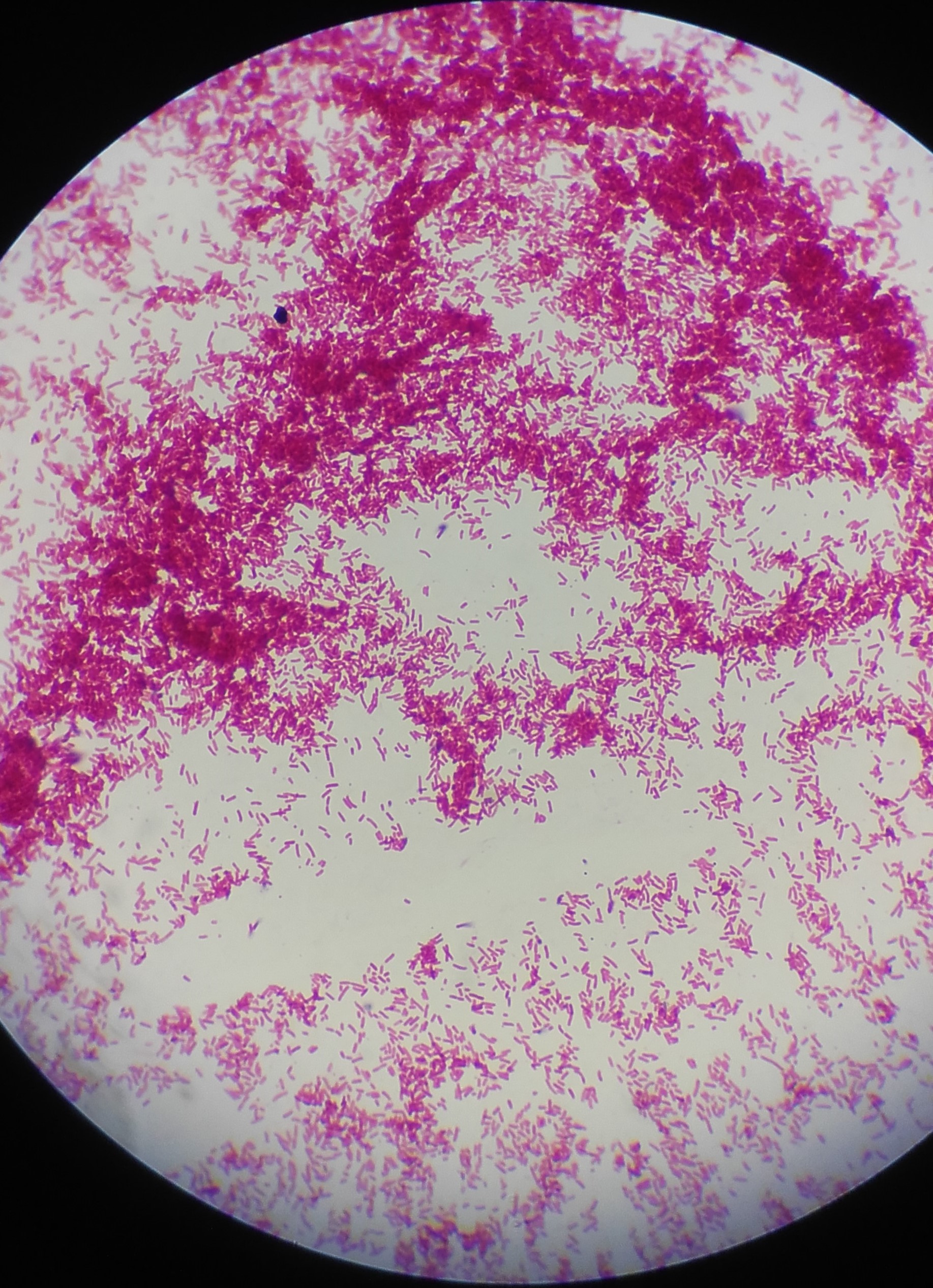
| Gram staining properties | Positive |
| Shape | Rod |
| Mobility | No |
| Flagellar presence | Yes |
| Number of membranes | 1 |

Image source: Wikipedia/Wikimedia
| Ecology, Host, and Life Cycle | |
|---|---|
| Oxygen requirements | Facultative anaerobe |
| Optimal temperature | 42 |
| Temperature range | Mesophilic |
| Habitat | Multiple |
| Biotic relationship | Free living |
| Host(s) | Homo sapiens |
| Cell arrangement | Chains |
| Sporulation | Not Available |
| Energy source | Not Available |
| Pathogenicity | Not Available |
Gene Summary
Adenine Count
514288 bp
Thymine Count
510890 bp
Guanine Count
497608 bp
Cytosine Count
497049 bp
Genome Length
2019838 bp
Protein-coding Genes
1885 genes
Non-Coding Genes
88 genes
# of Chromosomes/Plasmids
1
Genes
| Name | Locus Tag | UniProt ID | Strand Orientation | Gene Start/End | Protein Molecular Weight |
|---|---|---|---|---|---|
| hypothetical protein | FEZ35_08170 | Not Available | Positive | 1564067 - 1564477 | 15304.4 |
| hypothetical protein | FEZ35_08185 | Not Available | Positive | 1566638 - 1567069 | 15861.1 |
| is110 family transposase | FEZ35_08190 | Not Available | Positive | 1567411 - 1567518 | 3977.76 |
| dihydroneopterin aldolase | FEZ35_08205 | Not Available | Positive | 1568186 - 1568536 | 13070.9 |
| gtp cyclohydrolase i fole | FEZ35_08210 | Not Available | Positive | 1568533 - 1569606 | 40404.0 |
| bifunctional folylpolyglutamate synthase/dihydrofolate synthase | FEZ35_08215 | Not Available | Positive | 1569590 - 1570927 | 49792.3 |
| dihydropteroate synthase | FEZ35_08220 | Not Available | Positive | 1570917 - 1572008 | 40338.5 |
| nudix domain-containing protein | FEZ35_08225 | Not Available | Positive | 1572020 - 1572556 | 19788.9 |
| hypothetical protein | FEZ35_08235 | Not Available | Negative | 1572978 - 1573259 | 11296.9 |
| merr family transcriptional regulator | FEZ35_08245 | Not Available | Negative | 1573737 - 1574144 | 15938.3 |
Pathways
0 pathways
No pathways found
No metabolic pathways have been associated with this bacterium yet.
Health Effects
No health effects information available for this bacterium.