
Kingdom
Pseudomonadati
Phylum
Pseudomonadota
Class
Gammaproteobacteria
Order
Moraxellales
Family
Moraxellaceae
Genus
Acinetobacter
Description
Taxonomy
| Kingdom | Pseudomonadati |
|---|---|
| Phylum | Pseudomonadota |
| Class | Gammaproteobacteria |
| Order | Moraxellales |
| Family | Moraxellaceae |
| Genus | Acinetobacter |
| Species | Acinetobacter baumannii |
| Strain | strain Ab89 |
Profile
| Physiology | |
|---|---|
| Gram staining properties | Negative |
| Shape | Rod |
| Mobility | No |
| Flagellar presence | Yes |
| Number of membranes | 2 |
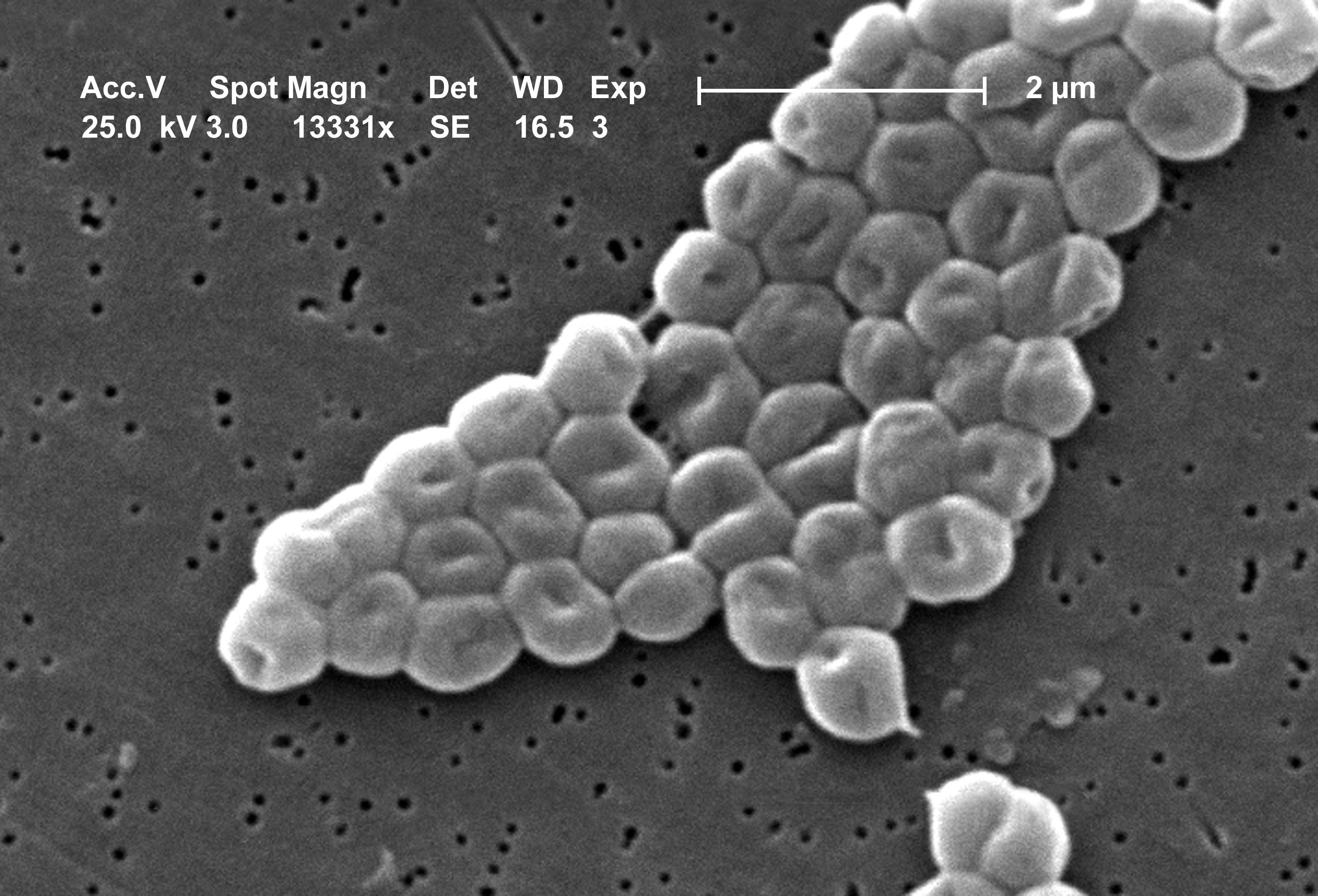
Image source: Wikipedia/Wikimedia
| Ecology, Host, and Life Cycle | |
|---|---|
| Oxygen requirements | Aerobe |
| Optimal temperature | 37 |
| Temperature range | Mesophilic |
| Habitat | Multiple |
| Biotic relationship | Free living |
| Host(s) | Homo sapiens, Gallus gallus, Bos taurus |
| Cell arrangement | Singles |
| Sporulation | Not Available |
| Energy source | Heterotroph - Chemoheterotroph |
| Pathogenicity | Human |
Gene Summary
Adenine Count
Not Available
Thymine Count
Not Available
Guanine Count
Not Available
Cytosine Count
Not Available
Genome Length
Not Available
Protein-coding Genes
3279 genes
Non-Coding Genes
447 genes
# of Chromosomes/Plasmids
1
Genes
| Name | Locus Tag | UniProt ID | Strand Orientation | Gene Start/End | Protein Molecular Weight |
|---|---|---|---|---|---|
| mfs transporter | FED17_00260 | Not Available | Positive | 50265 - 51449 | 42925.2 |
| trna dihydrouridine(20/20a) synthase dusa | FED17_00265 | Not Available | Positive | 51598 - 52602 | 37842.6 |
| hypothetical protein | FED17_00270 | Not Available | Positive | 52938 - 53447 | 19106.1 |
| lysr family transcriptional regulator | FED17_00275 | Not Available | Negative | 53455 - 54348 | 33404.7 |
| hypothetical protein | FED17_00280 | Not Available | Positive | 54451 - 54573 | 4842.01 |
| trna threonylcarbamoyladenosine dehydratase | FED17_00285 | Not Available | Negative | 54636 - 55400 | 27539.7 |
| rida family protein | FED17_00290 | Not Available | Negative | 55525 - 55998 | 17024.6 |
| Ncrna_class:srp_rna | Not Available | Not Available | Positive | 58008 - 58104 | Not Available |
| aconitate hydratase acna | FED17_00295 | Not Available | Negative | 56119 - 58875 | 100065.0 |
| tatd family deoxyribonuclease | FED17_00300 | Not Available | Negative | 59000 - 59812 | 30303.4 |
Pathways
0 pathways
No pathways found
No metabolic pathways have been associated with this bacterium yet.
Health Effects
| Health Condition | Relation | Reference |
|---|---|---|
| Hospital-acquired pneumonia | Causes | PMC11264759 |
| Bacteremia | Causes | PMC11264759 |
| Urinary tract infections | Causes | PMC11264759 |
| Traumatic injuries | Causes | PMC11264759 |
| Respiratory tract infection | Causes | PMC11514839 |
| Healthcare-associated infections | Causes | PMC13168211 |
| Bacteremia | Causes | PMC10561989 |
| Hospital-acquired pneumonia | Causes | PMC11925754 |
| Bloodstream infections | Causes | PMC11925754 |
| Wound contaminations | Causes | PMC11925754 |

