
Kingdom
Pseudomonadati
Phylum
Pseudomonadota
Class
Gammaproteobacteria
Order
Moraxellales
Family
Moraxellaceae
Genus
Acinetobacter
Description
Taxonomy
| Kingdom | Pseudomonadati |
|---|---|
| Phylum | Pseudomonadota |
| Class | Gammaproteobacteria |
| Order | Moraxellales |
| Family | Moraxellaceae |
| Genus | Acinetobacter |
| Species | Acinetobacter baumannii |
| Strain | strain Ab20 |
Profile
| Physiology | |
|---|---|
| Gram staining properties | Negative |
| Shape | Rod |
| Mobility | No |
| Flagellar presence | Yes |
| Number of membranes | 2 |
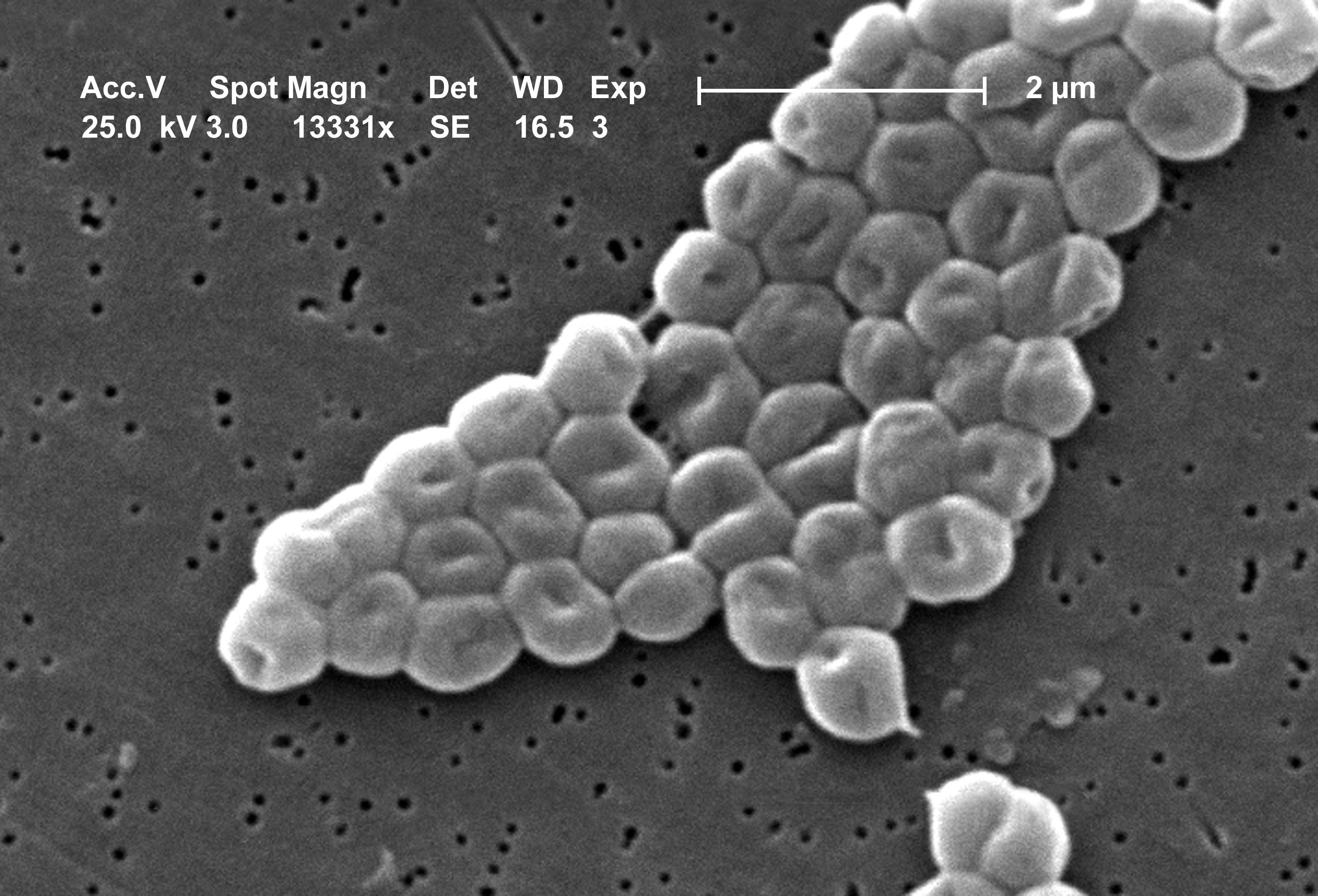
Image source: Wikipedia/Wikimedia
| Ecology, Host, and Life Cycle | |
|---|---|
| Oxygen requirements | Aerobe |
| Optimal temperature | 37 |
| Temperature range | Mesophilic |
| Habitat | Multiple |
| Biotic relationship | Free living |
| Host(s) | Homo sapiens, Gallus gallus, Bos taurus |
| Cell arrangement | Singles |
| Sporulation | Not Available |
| Energy source | Heterotroph - Chemoheterotroph |
| Pathogenicity | Human |
Gene Summary
Adenine Count
1184522 bp
Thymine Count
1176556 bp
Guanine Count
753238 bp
Cytosine Count
752222 bp
Genome Length
3867452 bp
Protein-coding Genes
3504 genes
Non-Coding Genes
188 genes
# of Chromosomes/Plasmids
1
Genes
| Name | Locus Tag | UniProt ID | Strand Orientation | Gene Start/End | Protein Molecular Weight |
|---|---|---|---|---|---|
| hypothetical protein | FEC44_11135 | Not Available | Negative | 2334942 - 2335184 | 9520.34 |
| tetr/acrr family transcriptional regulator | FEC44_11140 | Not Available | Positive | 2335369 - 2336028 | 25605.4 |
| restriction endonuclease | FEC44_11145 | Not Available | Positive | 2336204 - 2338891 | 102749.0 |
| hypothetical protein | FEC44_11150 | Not Available | Positive | 2339020 - 2339289 | 10844.2 |
| lysr family transcriptional regulator | FEC44_11155 | Not Available | Negative | 2339473 - 2340336 | 32581.4 |
| phzf family isomerase | FEC44_11160 | Not Available | Positive | 2340561 - 2341454 | 32139.4 |
| hypothetical protein | FEC44_11165 | Not Available | Negative | 2341769 - 2344693 | 93828.1 |
| hypothetical protein | FEC44_11170 | Not Available | Positive | 2345758 - 2346117 | 13700.2 |
| hypothetical protein | FEC44_11175 | Not Available | Positive | 2346157 - 2347002 | 33073.8 |
| membrane-bound pqq-dependent dehydrogenase, glucose/quinate/shikimate family | FEC44_11180 | Not Available | Negative | 2347173 - 2349584 | 87980.0 |
Pathways
0 pathways
No pathways found
No metabolic pathways have been associated with this bacterium yet.
Health Effects
| Health Condition | Relation | Reference |
|---|---|---|
| Hospital-acquired pneumonia | Causes | PMC11264759 |
| Bacteremia | Causes | PMC11264759 |
| Urinary tract infections | Causes | PMC11264759 |
| Traumatic injuries | Causes | PMC11264759 |
| Respiratory tract infection | Causes | PMC11514839 |
| Healthcare-associated infections | Causes | PMC13168211 |
| Bacteremia | Causes | PMC10561989 |
| Hospital-acquired pneumonia | Causes | PMC11925754 |
| Bloodstream infections | Causes | PMC11925754 |
| Wound contaminations | Causes | PMC11925754 |

