
Kingdom
Pseudomonadati
Phylum
Pseudomonadota
Class
Gammaproteobacteria
Order
Moraxellales
Family
Moraxellaceae
Genus
Acinetobacter
Description
Taxonomy
| Kingdom | Pseudomonadati |
|---|---|
| Phylum | Pseudomonadota |
| Class | Gammaproteobacteria |
| Order | Moraxellales |
| Family | Moraxellaceae |
| Genus | Acinetobacter |
| Species | Acinetobacter baumannii |
| Strain | strain Ab9 |
Profile
| Physiology | |
|---|---|
| Gram staining properties | Negative |
| Shape | Rod |
| Mobility | No |
| Flagellar presence | Yes |
| Number of membranes | 2 |
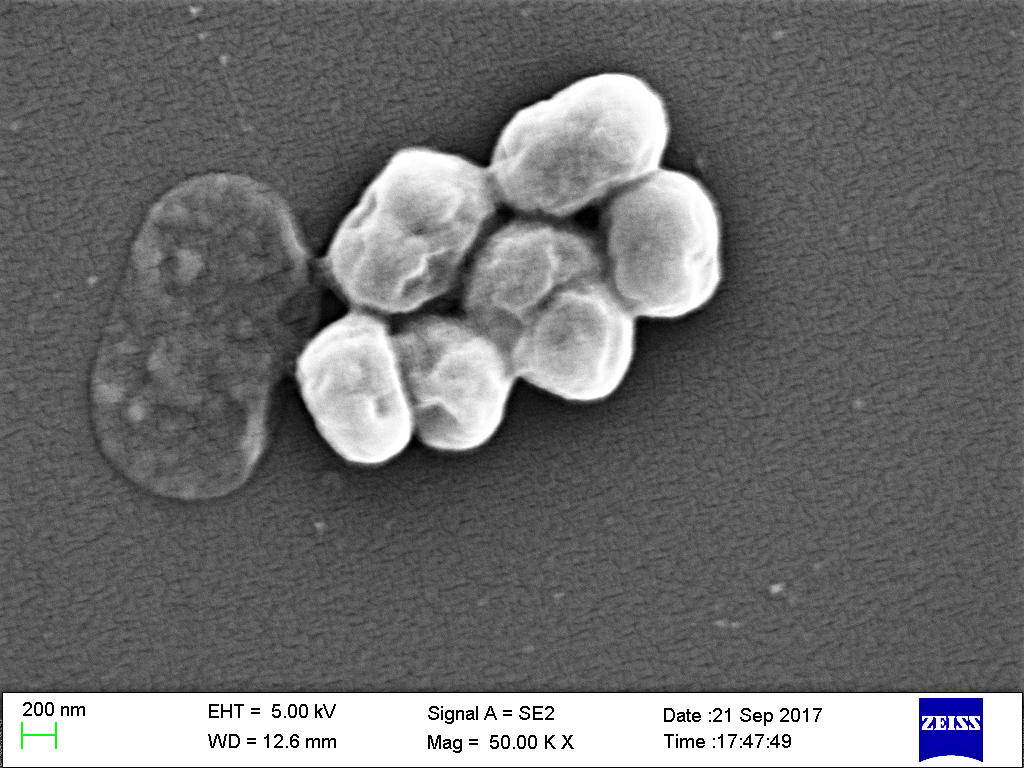
Image source: Wikipedia/Wikimedia
| Ecology, Host, and Life Cycle | |
|---|---|
| Oxygen requirements | Aerobe |
| Optimal temperature | 37 |
| Temperature range | Mesophilic |
| Habitat | Multiple |
| Biotic relationship | Free living |
| Host(s) | Homo sapiens, Gallus gallus, Bos taurus |
| Cell arrangement | Singles |
| Sporulation | Not Available |
| Energy source | Heterotroph - Chemoheterotroph |
| Pathogenicity | Human |
Gene Summary
Adenine Count
1198737 bp
Thymine Count
1195494 bp
Guanine Count
760153 bp
Cytosine Count
779798 bp
Genome Length
3936644 bp
Protein-coding Genes
3566 genes
Non-Coding Genes
113 genes
# of Chromosomes/Plasmids
1
Genes
| Name | Locus Tag | UniProt ID | Strand Orientation | Gene Start/End | Protein Molecular Weight |
|---|---|---|---|---|---|
| nadh-quinone oxidoreductase subunit nuoh | FEC37_14225 | Not Available | Negative | 2971387 - 2972403 | 37714.1 |
| nadh-quinone oxidoreductase subunit nuog | FEC37_14230 | Not Available | Negative | 2972407 - 2975091 | 97979.9 |
| nadh-quinone oxidoreductase subunit nuof | FEC37_14235 | Not Available | Negative | 2975103 - 2976434 | 48624.4 |
| nadh-quinone oxidoreductase subunit nuoe | FEC37_14240 | Not Available | Negative | 2976431 - 2976940 | 18930.0 |
| nadh-quinone oxidoreductase subunit c/d | FEC37_14245 | Not Available | Negative | 2976954 - 2978741 | 68583.9 |
| nadh-quinone oxidoreductase subunit b | FEC37_14250 | Not Available | Negative | 2978826 - 2979503 | 25553.1 |
| nadh-quinone oxidoreductase subunit a | FEC37_14255 | Not Available | Negative | 2979510 - 2980061 | 19981.4 |
| diguanylate cyclase | FEC37_14260 | Not Available | Positive | 2980489 - 2981910 | 53376.8 |
| hypothetical protein | FEC37_14265 | Not Available | Positive | 2982057 - 2982356 | 11345.2 |
| hamp domain-containing protein | FEC37_14270 | Not Available | Negative | 2982379 - 2983983 | 60688.4 |
Pathways
0 pathways
No pathways found
No metabolic pathways have been associated with this bacterium yet.
Health Effects
| Health Condition | Relation | Reference |
|---|---|---|
| Hospital-acquired pneumonia | Causes | PMC11264759 |
| Bacteremia | Causes | PMC11264759 |
| Urinary tract infections | Causes | PMC11264759 |
| Traumatic injuries | Causes | PMC11264759 |
| Respiratory tract infection | Causes | PMC11514839 |
| Healthcare-associated infections | Causes | PMC13168211 |
| Bacteremia | Causes | PMC10561989 |
| Hospital-acquired pneumonia | Causes | PMC11925754 |
| Bloodstream infections | Causes | PMC11925754 |
| Wound contaminations | Causes | PMC11925754 |

