
Kingdom
Pseudomonadati
Phylum
Pseudomonadota
Class
Gammaproteobacteria
Order
Moraxellales
Family
Moraxellaceae
Genus
Acinetobacter
Description
Taxonomy
| Kingdom | Pseudomonadati |
|---|---|
| Phylum | Pseudomonadota |
| Class | Gammaproteobacteria |
| Order | Moraxellales |
| Family | Moraxellaceae |
| Genus | Acinetobacter |
| Species | Acinetobacter baumannii |
| Strain | strain Ab49 |
Profile
| Physiology | |
|---|---|
| Gram staining properties | Negative |
| Shape | Rod |
| Mobility | No |
| Flagellar presence | Yes |
| Number of membranes | 2 |
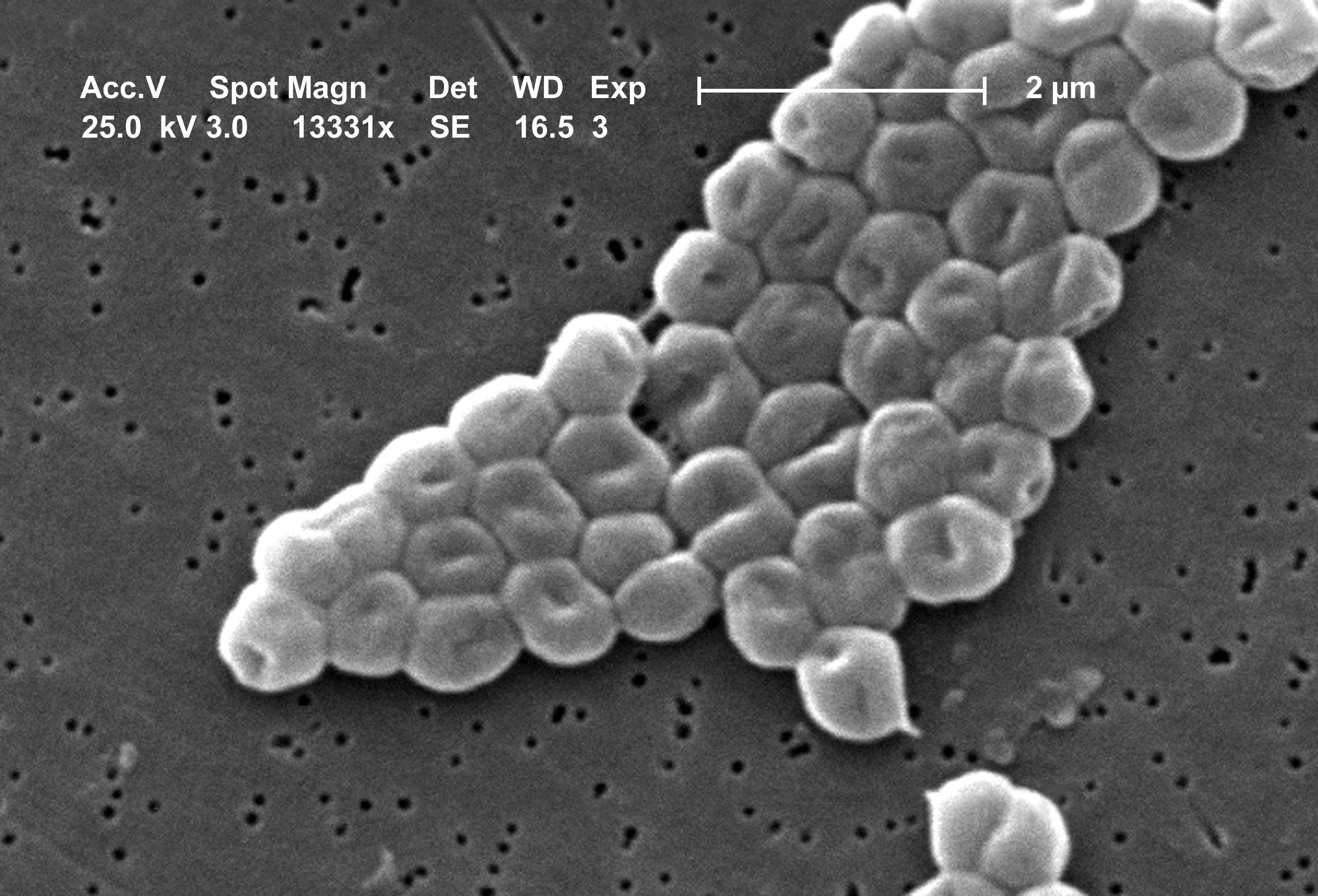
Image source: Wikipedia/Wikimedia
| Ecology, Host, and Life Cycle | |
|---|---|
| Oxygen requirements | Aerobe |
| Optimal temperature | 37 |
| Temperature range | Mesophilic |
| Habitat | Multiple |
| Biotic relationship | Free living |
| Host(s) | Homo sapiens, Gallus gallus, Bos taurus |
| Cell arrangement | Singles |
| Sporulation | Not Available |
| Energy source | Heterotroph - Chemoheterotroph |
| Pathogenicity | Human |
Gene Summary
Adenine Count
1207737 bp
Thymine Count
1202547 bp
Guanine Count
767112 bp
Cytosine Count
763062 bp
Genome Length
3941109 bp
Protein-coding Genes
3612 genes
Non-Coding Genes
156 genes
# of Chromosomes/Plasmids
1
Genes
| Name | Locus Tag | UniProt ID | Strand Orientation | Gene Start/End | Protein Molecular Weight |
|---|---|---|---|---|---|
| abc transporter permease | FEC50_11200 | Not Available | Negative | 2347946 - 2349088 | 41447.2 |
| abc transporter permease | FEC50_11205 | Not Available | Negative | 2349096 - 2350034 | 35023.1 |
| zn-dependent oligopeptidase | FEC50_11210 | Not Available | Negative | 2350047 - 2352080 | 77535.4 |
| heme-binding protein | FEC50_11215 | Not Available | Negative | 2352081 - 2353904 | 69233.3 |
| heme-binding protein | FEC50_11220 | Not Available | Negative | 2353920 - 2355710 | 67540.3 |
| hypothetical protein | FEC50_11225 | Not Available | Positive | 2355882 - 2355965 | 3415.25 |
| tonb-dependent receptor | FEC50_11230 | Not Available | Positive | 2356486 - 2359155 | 96880.2 |
| energy transducer tonb | FEC50_11235 | Not Available | Positive | 2359265 - 2359981 | 25406.0 |
| mota/tolq/exbb proton channel family protein | FEC50_11240 | Not Available | Positive | 2360022 - 2360903 | 31254.6 |
| biopolymer transporter exbd | FEC50_11245 | Not Available | Positive | 2360919 - 2361341 | 15373.7 |
Pathways
1315 pathways
Health Effects
| Health Condition | Relation | Reference |
|---|---|---|
| Hospital-acquired pneumonia | Causes | PMC11264759 |
| Bacteremia | Causes | PMC11264759 |
| Urinary tract infections | Causes | PMC11264759 |
| Traumatic injuries | Causes | PMC11264759 |
| Respiratory tract infection | Causes | PMC11514839 |
| Healthcare-associated infections | Causes | PMC13168211 |
| Bacteremia | Causes | PMC10561989 |
| Hospital-acquired pneumonia | Causes | PMC11925754 |
| Bloodstream infections | Causes | PMC11925754 |
| Wound contaminations | Causes | PMC11925754 |

