
Kingdom
Pseudomonadati
Phylum
Pseudomonadota
Class
Gammaproteobacteria
Order
Enterobacterales
Family
Enterobacteriaceae
Genus
Salmonella
Description
Taxonomy
| Kingdom | Pseudomonadati |
|---|---|
| Phylum | Pseudomonadota |
| Class | Gammaproteobacteria |
| Order | Enterobacterales |
| Family | Enterobacteriaceae |
| Genus | Salmonella |
| Species | Salmonella enterica |
| Strain | subsp. enterica serovar Dublin strain |
Profile
| Physiology | |
|---|---|
| Gram staining properties | Negative |
| Shape | Spirilla |
| Mobility | No |
| Flagellar presence | Yes |
| Number of membranes | 2 |
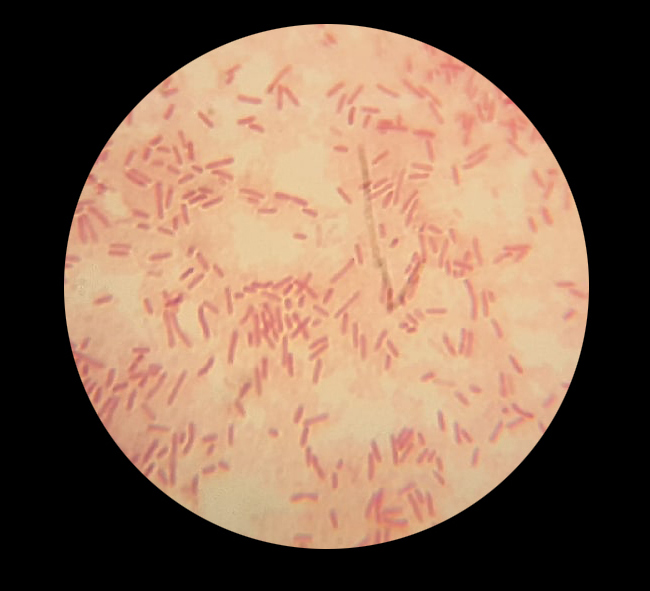
Image source: Wikipedia/Wikimedia
| Ecology, Host, and Life Cycle | |
|---|---|
| Oxygen requirements | Microaerophilic |
| Optimal temperature | 37 |
| Temperature range | Mesophilic |
| Habitat | HostAssociated |
| Biotic relationship | Free living |
| Host(s) | Homo sapiens, Bos taurus, Bos |
| Cell arrangement | Chains - Singles |
| Sporulation | Not Available |
| Energy source | Chemoorganotroph |
| Pathogenicity | Not Available |
Gene Summary
Adenine Count
1178342 bp
Thymine Count
1188090 bp
Guanine Count
1296899 bp
Cytosine Count
1274653 bp
Genome Length
4937984 bp
Protein-coding Genes
3832 genes
Non-Coding Genes
243 genes
# of Chromosomes/Plasmids
1
Genes
| Name | Locus Tag | UniProt ID | Strand Orientation | Gene Start/End | Protein Molecular Weight |
|---|---|---|---|---|---|
| protease sohb | FD850_15925 | Not Available | Negative | 3223492 - 3224538 | 38967.4 |
| ycik family oxidoreductase | FD850_15930 | Not Available | Positive | 3224776 - 3225537 | 28074.7 |
| cob(i)yrinic acid a,c-diamide adenosyltransferase | FD850_15935 | Not Available | Positive | 3225534 - 3226124 | 21727.0 |
| 23s rrna pseudouridine(2605) synthase rlub | FD850_15940 | Not Available | Negative | 3226211 - 3227086 | 32614.3 |
| threonylcarbamoyl-amp synthase | FD850_15945 | Not Available | Negative | 3227187 - 3227807 | 23107.9 |
| 5'-3' exoribonuclease | FD850_15950 | Not Available | Negative | 3227815 - 3228696 | 32313.6 |
| trp operon leader peptide | FD850_15955 | Not Available | Positive | 3228818 - 3228862 | 1634.94 |
| anthranilate synthase component i | FD850_15960 | Not Available | Positive | 3228957 - 3230519 | 57105.3 |
| bifunctional anthranilate synthase glutamate amidotransferase component trpg/anthranilate phosphoribosyltransferase trpd | FD850_15965 | Not Available | Positive | 3230519 - 3232114 | 56911.5 |
| bifunctional indole-3-glycerol-phosphate synthase trpc/phosphoribosylanthranilate isomerase trpf | FD850_15970 | Not Available | Positive | 3232118 - 3233476 | 49245.6 |
Pathways
0 pathways
No pathways found
No metabolic pathways have been associated with this bacterium yet.


