Kingdom
Pseudomonadati
Phylum
Campylobacterota
Class
Epsilonproteobacteria
Order
Campylobacterales
Family
Helicobacteraceae
Genus
Helicobacter
Description
Taxonomy
| Kingdom | Pseudomonadati |
|---|---|
| Phylum | Campylobacterota |
| Class | Epsilonproteobacteria |
| Order | Campylobacterales |
| Family | Helicobacteraceae |
| Genus | Helicobacter |
| Species | Helicobacter pametensis |
| Strain | strain NCTC12888 |
Profile
| Physiology | |
|---|---|
| Gram staining properties | Not Available |
| Shape | Not Available |
| Mobility | Not Available |
| Flagellar presence | Not Available |
| Number of membranes | Not Available |

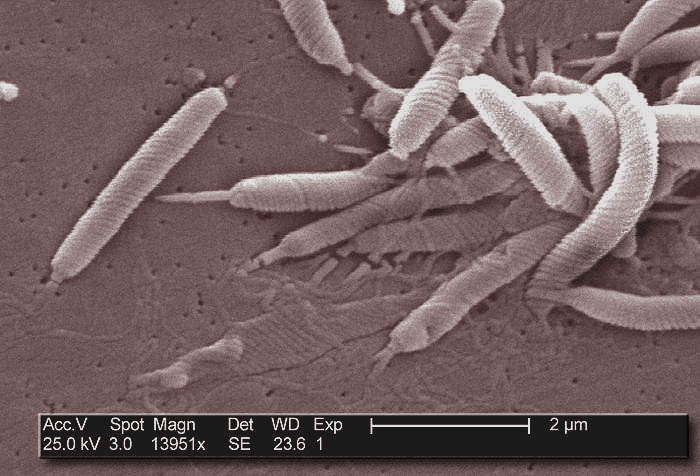
Image source: Wikipedia/Wikimedia
| Ecology, Host, and Life Cycle | |
|---|---|
| Oxygen requirements | microaerophile |
| Optimal temperature | Not Available |
| Temperature range | Not Available |
| Habitat | Not Available |
| Biotic relationship | Not Available |
| Host(s) | Not Available |
| Cell arrangement | Not Available |
| Sporulation | Not Available |
| Energy source | Not Available |
| Pathogenicity | Not Available |
Gene Summary
Adenine Count
427696 bp
Thymine Count
434597 bp
Guanine Count
531763 bp
Cytosine Count
524300 bp
Genome Length
1918356 bp
Protein-coding Genes
1789 genes
Non-Coding Genes
110 genes
# of Chromosomes/Plasmids
1
Genes
| Name | Locus Tag | UniProt ID | Strand Orientation | Gene Start/End | Protein Molecular Weight |
|---|---|---|---|---|---|
| putative outer membrane protein nmb0088 precursor | NCTC12888_01757 | Not Available | Positive | 1752732 - 1754147 | 51328.0 |
| monoamine oxidase | NCTC12888_01758 | Not Available | Negative | 1754452 - 1755696 | 45581.0 |
| predicted exporter | NCTC12888_01759 | Not Available | Negative | 1755742 - 1758054 | 82348.5 |
| acyl-coa synthetase | NCTC12888_01760 | Not Available | Negative | 1758047 - 1759702 | 60566.1 |
| uncharacterised protein | NCTC12888_01761 | Not Available | Negative | 1759941 - 1760573 | 23460.6 |
| lipoprotein chaperone | NCTC12888_01762 | Not Available | Negative | 1760724 - 1761320 | 21870.6 |
| acyl-coa thioesterase ybgc | NCTC12888_01763 | Not Available | Negative | 1761420 - 1761866 | 17277.8 |
| lipid a biosynthesis lauroyl acyltransferase | NCTC12888_01764 | Not Available | Negative | 1761859 - 1763523 | 62235.0 |
| abc transporter atp-binding protein | NCTC12888_01765 | Not Available | Negative | 1763606 - 1765516 | 71324.8 |
| rebeccamycin o-methyltransferase | NCTC12888_01766 | Not Available | Negative | 1765628 - 1766281 | 23969.8 |
Pathways
0 pathways
No pathways found
No metabolic pathways have been associated with this bacterium yet.
Health Effects
No health effects information available for this bacterium.