Kingdom
Pseudomonadati
Phylum
Campylobacterota
Class
Epsilonproteobacteria
Order
Campylobacterales
Family
Helicobacteraceae
Genus
Helicobacter
Description
Taxonomy
| Kingdom | Pseudomonadati |
|---|---|
| Phylum | Campylobacterota |
| Class | Epsilonproteobacteria |
| Order | Campylobacterales |
| Family | Helicobacteraceae |
| Genus | Helicobacter |
| Species | Helicobacter pametensis |
| Strain | strain NCTC12888 |
Profile
| Physiology | |
|---|---|
| Gram staining properties | Not Available |
| Shape | Not Available |
| Mobility | Not Available |
| Flagellar presence | Not Available |
| Number of membranes | Not Available |

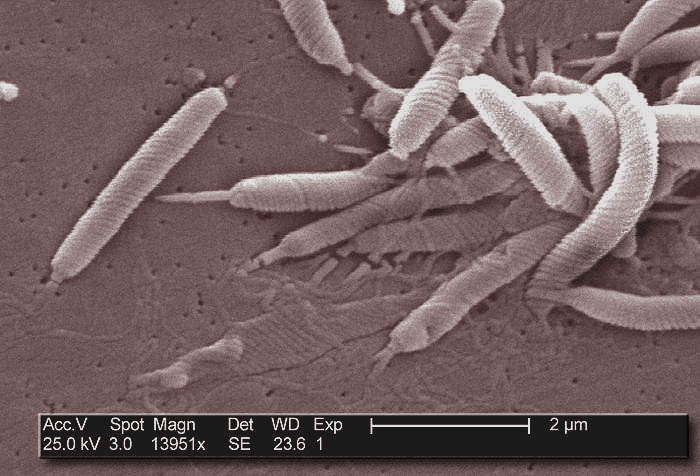
Image source: Wikipedia/Wikimedia
| Ecology, Host, and Life Cycle | |
|---|---|
| Oxygen requirements | microaerophile |
| Optimal temperature | Not Available |
| Temperature range | Not Available |
| Habitat | Not Available |
| Biotic relationship | Not Available |
| Host(s) | Not Available |
| Cell arrangement | Not Available |
| Sporulation | Not Available |
| Energy source | Not Available |
| Pathogenicity | Not Available |
Gene Summary
Adenine Count
427696 bp
Thymine Count
434597 bp
Guanine Count
531763 bp
Cytosine Count
524300 bp
Genome Length
1918356 bp
Protein-coding Genes
1789 genes
Non-Coding Genes
110 genes
# of Chromosomes/Plasmids
1
Genes
| Name | Locus Tag | UniProt ID | Strand Orientation | Gene Start/End | Protein Molecular Weight |
|---|---|---|---|---|---|
| probable thiol:disulfide interchange protein dsbc precursor | NCTC12888_01717 | Not Available | Negative | 1711802 - 1712590 | 28335.0 |
| uncharacterized protein conserved in bacteria | NCTC12888_01718 | Not Available | Negative | 1712753 - 1713943 | 43842.5 |
| dna methylase | NCTC12888_01719 | Not Available | Positive | 1714672 - 1715484 | 29300.2 |
| toxr-activated protein | NCTC12888_01720 | Not Available | Negative | 1715635 - 1716609 | 33549.1 |
| protein-l-isoaspartate o-methyltransferase | NCTC12888_01721 | Not Available | Negative | 1716697 - 1717362 | 24075.4 |
| stationary phase survival protein | NCTC12888_01722 | Not Available | Negative | 1717359 - 1718114 | 27174.9 |
| aspartate alpha-decarboxylase | NCTC12888_01723 | Not Available | Negative | 1718293 - 1718676 | 13759.6 |
| acyl-coa hydrolase | NCTC12888_01724 | Not Available | Negative | 1718816 - 1719313 | 18249.1 |
| predicted permeases | NCTC12888_01725 | Not Available | Negative | 1719375 - 1719776 | 14642.7 |
| bacterial protein of uncharacterised function (duf883) | NCTC12888_01726 | Not Available | Positive | 1720177 - 1720488 | 11742.0 |
Pathways
0 pathways
No pathways found
No metabolic pathways have been associated with this bacterium yet.
Health Effects
No health effects information available for this bacterium.