Kingdom
Pseudomonadati
Phylum
Campylobacterota
Class
Epsilonproteobacteria
Order
Campylobacterales
Family
Helicobacteraceae
Genus
Helicobacter
Description
Taxonomy
| Kingdom | Pseudomonadati |
|---|---|
| Phylum | Campylobacterota |
| Class | Epsilonproteobacteria |
| Order | Campylobacterales |
| Family | Helicobacteraceae |
| Genus | Helicobacter |
| Species | Helicobacter pametensis |
| Strain | strain NCTC12888 |
Profile
| Physiology | |
|---|---|
| Gram staining properties | Not Available |
| Shape | Not Available |
| Mobility | Not Available |
| Flagellar presence | Not Available |
| Number of membranes | Not Available |

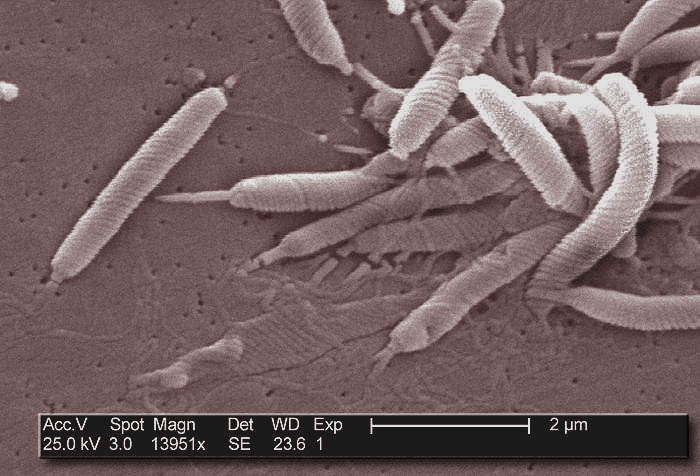
Image source: Wikipedia/Wikimedia
| Ecology, Host, and Life Cycle | |
|---|---|
| Oxygen requirements | microaerophile |
| Optimal temperature | Not Available |
| Temperature range | Not Available |
| Habitat | Not Available |
| Biotic relationship | Not Available |
| Host(s) | Not Available |
| Cell arrangement | Not Available |
| Sporulation | Not Available |
| Energy source | Not Available |
| Pathogenicity | Not Available |
Gene Summary
Adenine Count
427696 bp
Thymine Count
434597 bp
Guanine Count
531763 bp
Cytosine Count
524300 bp
Genome Length
1918356 bp
Protein-coding Genes
1789 genes
Non-Coding Genes
110 genes
# of Chromosomes/Plasmids
1
Genes
| Name | Locus Tag | UniProt ID | Strand Orientation | Gene Start/End | Protein Molecular Weight |
|---|---|---|---|---|---|
| protein of uncharacterised function (duf721) | NCTC12888_01456 | Not Available | Positive | 1453596 - 1454063 | 17349.7 |
| biotin synthase | NCTC12888_01457 | Not Available | Negative | 1454311 - 1455399 | 39709.6 |
| putative thiophene and furan oxidation protein | NCTC12888_01458 | Not Available | Negative | 1455637 - 1457004 | 48639.4 |
| amino acid permease | NCTC12888_01459 | Not Available | Negative | 1457110 - 1458645 | 55728.4 |
| protein of uncharacterised function (duf328) | NCTC12888_01460 | Not Available | Negative | 1459110 - 1460003 | 33412.3 |
| putative lyse type translocator/threonine efflux protein | NCTC12888_01461 | Not Available | Positive | 1460041 - 1460694 | 23380.8 |
| uncharacterised protein | NCTC12888_01462 | Not Available | Positive | 1460823 - 1461164 | 12363.7 |
| carbamoyl-phosphate synthase large chain | NCTC12888_01463 | Not Available | Positive | 1461682 - 1464891 | 116948.0 |
| Trna-leu | Not Available | Not Available | Positive | 1506049 - 1506133 | Not Available |
| rna-binding protein hi_1333 | NCTC12888_01525 | Not Available | Negative | 1506269 - 1506553 | 10497.7 |
Pathways
0 pathways
No pathways found
No metabolic pathways have been associated with this bacterium yet.
Health Effects
No health effects information available for this bacterium.