Kingdom
Pseudomonadati
Phylum
Campylobacterota
Class
Epsilonproteobacteria
Order
Campylobacterales
Family
Helicobacteraceae
Genus
Helicobacter
Description
Taxonomy
| Kingdom | Pseudomonadati |
|---|---|
| Phylum | Campylobacterota |
| Class | Epsilonproteobacteria |
| Order | Campylobacterales |
| Family | Helicobacteraceae |
| Genus | Helicobacter |
| Species | Helicobacter pametensis |
| Strain | strain NCTC12888 |
Profile
| Physiology | |
|---|---|
| Gram staining properties | Not Available |
| Shape | Not Available |
| Mobility | Not Available |
| Flagellar presence | Not Available |
| Number of membranes | Not Available |

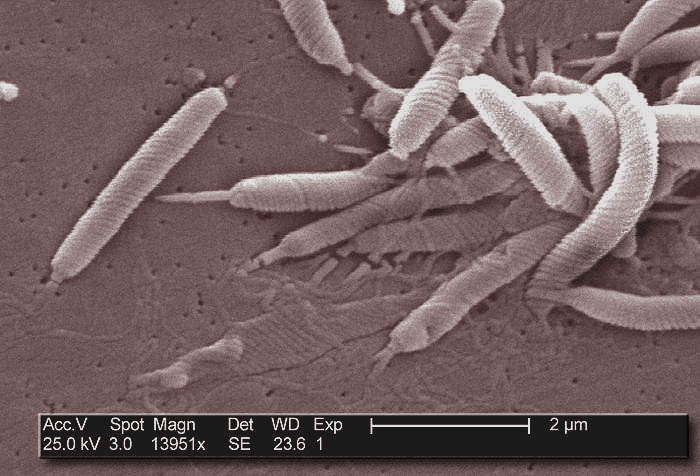
Image source: Wikipedia/Wikimedia
| Ecology, Host, and Life Cycle | |
|---|---|
| Oxygen requirements | microaerophile |
| Optimal temperature | Not Available |
| Temperature range | Not Available |
| Habitat | Not Available |
| Biotic relationship | Not Available |
| Host(s) | Not Available |
| Cell arrangement | Not Available |
| Sporulation | Not Available |
| Energy source | Not Available |
| Pathogenicity | Not Available |
Gene Summary
Adenine Count
427696 bp
Thymine Count
434597 bp
Guanine Count
531763 bp
Cytosine Count
524300 bp
Genome Length
1918356 bp
Protein-coding Genes
1789 genes
Non-Coding Genes
110 genes
# of Chromosomes/Plasmids
1
Genes
| Name | Locus Tag | UniProt ID | Strand Orientation | Gene Start/End | Protein Molecular Weight |
|---|---|---|---|---|---|
| putative chloramphenical resistance permease rard | NCTC12888_01235 | Not Available | Positive | 1232898 - 1233800 | 33227.2 |
| uncharacterised protein | NCTC12888_01236 | Not Available | Positive | 1233975 - 1234328 | 12700.4 |
| dna gyrase subunit b | NCTC12888_01237 | Not Available | Positive | 1234410 - 1236809 | 88430.7 |
| uncharacterised protein | NCTC12888_01238 | Not Available | Positive | 1236879 - 1237565 | 25076.2 |
| uncharacterised protein | NCTC12888_01239 | Not Available | Positive | 1237700 - 1238215 | 18330.7 |
| yicc-like family, n-terminal region | NCTC12888_01240 | Not Available | Negative | 1238269 - 1239147 | 33040.9 |
| putative integral membrane protein | NCTC12888_01241 | Not Available | Negative | 1239213 - 1240085 | 31472.3 |
| uncharacterised protein | NCTC12888_01242 | Not Available | Negative | 1240286 - 1240552 | 10349.4 |
| cell division protein ftsb | NCTC12888_01243 | Not Available | Negative | 1240648 - 1240956 | 11347.5 |
| enolase | NCTC12888_01244 | Not Available | Negative | 1240971 - 1242257 | 45754.6 |
Pathways
0 pathways
No pathways found
No metabolic pathways have been associated with this bacterium yet.
Health Effects
No health effects information available for this bacterium.